Guides
How Many Lumens Do You Actually Need?
The honest answer is almost always fewer than the box is selling you, and buying fewer usually gets you a longer runtime and a lighter light.
By Scooter M. · Published September 2, 2026
Short answer
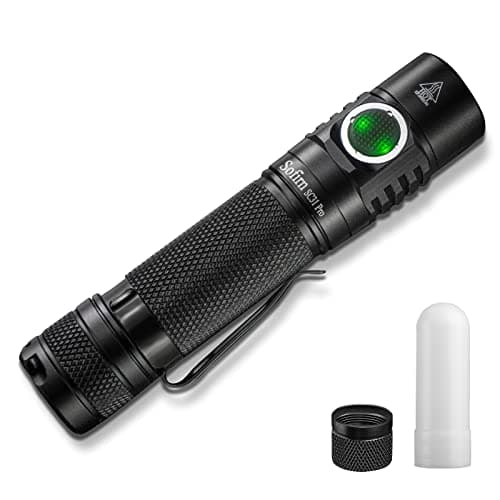
Sofirn SC31 Pro
Two thousand published lumens out of a standard 18650 you can buy anywhere for a few dollars, in a light that costs less than most brands charge for a keychain. The cell is the whole argument: when it dies in three years you replace a battery, not a flashlight.
Price as of October 18, 2026 — 47 lumens per dollar. #ad How we earn
Disclosure — we earn a commission on qualifying purchases made through the Amazon links on this page, at no extra cost to you. It does not change which lights we pick or what we say about them. The full version.
How we rank. Published ANSI FL1 output divided by the live retail price, with sealed-battery lights marked down because a light you cannot re-cell is a light with an expiry date. Units we claim to have tested: 0 — we compile manufacturers' published figures and show the arithmetic instead. How we work this out.
How many lumens you need, by use
| What you are doing | Lumens you need | Why |
|---|---|---|
| Reading, tent use, finding something in a bag | 5 - 50 | Preserves night vision and runs for tens of hours |
| Walking a familiar path, a dog walk, a corridor | 50 - 150 | Enough to see your feet and read a sign |
| Finding a fuse box, working under a sink | 150 - 300 | Close work at arm's length; flood matters more than output |
| Walking rough ground at night, a campsite | 300 - 500 | Enough to see a trip hazard several steps ahead |
| Lighting a yard, a garage, an engine bay | 500 - 1,000 | Area coverage rather than reach |
| Seeing something 100 m or more away | 1,000+ with a tight beam | Beam shape does more here than raw output |
For most people, most of the time, 100 to 300 lumens is enough. Reading and tent use want 5 to 50. Walking rough ground wants 300 to 500. Lighting a yard wants 500 to 1,000. Only seeing something a hundred meters away genuinely needs four figures, and even then beam shape matters more than output.
Why the number you are sold is bigger
Lumens are the one flashlight specification that is easy to print on a box and easy to compare between two boxes. Runtime is harder, beam quality is harder still, and color rendering is nearly invisible on packaging. So the whole category competes on the one number that is legible at a glance, and it inflates.
The cost is real and it is paid in runtime. Light output and current draw are roughly proportional, so a light running at 2,000 lumens empties a cell several times faster than the same light at 500. NEBO's published table for the TORCHY 3K makes the shape of that trade explicit: 800 lumens for two hours, 250 lumens for three and a half, 50 lumens for twenty.
Your eyes do not work the way the number implies
Perceived brightness is not proportional to lumens. Doubling the output does not look twice as bright; the response is closer to logarithmic, which is why the step from 100 to 200 lumens is obvious and the step from 1,000 to 2,000 is far less so.
There is a second effect that works against high output indoors and up close. A very bright light causes your pupils to close down, so everything outside the beam goes black. In a room or an engine bay a dimmer, wider light lets you see more, not less.
Where the lumen figure stops being the right question
If your problem is seeing a long way, the number to compare is beam distance in meters, or candela if the manufacturer publishes it. The gap can be enormous: COAST publishes 300 lumens reaching 352 meters on the HP7R, while Streamlight publishes 500 lumens reaching 165 meters on the ProTac 2L-X. More light, less reach — because the optics are doing different jobs.
1. Best lumens per dollar overall
Sofirn SC31 Pro
Lumens per dollar
47
Two thousand published lumens out of a standard 18650 you can buy anywhere for a few dollars, in a light that costs less than most brands charge for a keychain. The cell is the whole argument: when it dies in three years you replace a battery, not a flashlight.
- Max output
- 2,000 lm
- Runtime
- Not published per mode
- Battery
- Replaceable cell
- Water rating
- IPX8
What it gets right
- Standard 18650 cell — replacements cost a few dollars and are sold everywhere
- IPX8, the strongest water rating in this price class
- USB-C charging built into the light, so no separate charger to lose
- Anduril firmware gives real ramping control rather than four fixed steps
What it gets wrong
- Sofirn publishes no per-mode runtime figures on the product page
- Anduril is genuinely confusing for the first week
- Tint varies between batches, which is the price of this price
Published specification
- Maximum output: 2,000 lumens — Sofirn published specification
- Beam distance: 226 m — Sofirn published specification
- Battery: 1 x 18650 Li-ion, user replaceable — Sofirn published specification
- Charging: USB-C, 2.5 hours with a 2A adapter — Sofirn published specification
- Water rating: IPX8 — Sofirn published specification
- Weight: 59 g without battery — Sofirn published specification
- Length: 117.5 mm — Sofirn published specification
- Emitter: SST40, 5000K or 6500K — Sofirn published specification
- Per-mode runtime: Not published on the product page
Skip this one if
you want to press one button and get one brightness. Anduril has a shortcut for everything and a menu for everything else, and if that sounds tiring you will be happier with a three-mode light.
Buy it if: anyone who intends to keep the light for longer than the battery lasts, and does not mind reading a manual once.
- Output 9.0
- Battery 9.5
- Build 8.0
- Usability 7.0
- Overall 8.6
Price as of October 18, 2026 — 47 lumens per dollar. #ad How we earn
2. Most complete published runtime table
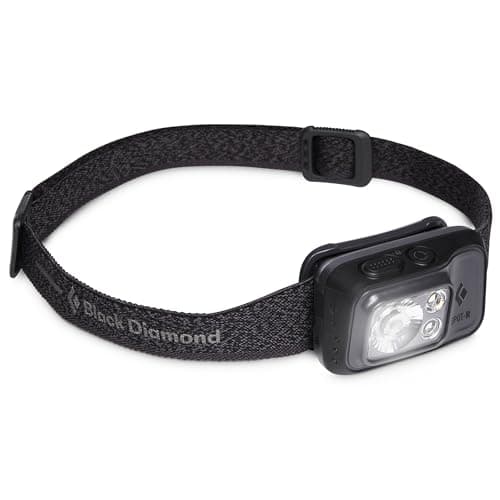
Black Diamond Spot 400-R
Lumens per dollar
7
Four hundred lumens for four hours, 200 for eight, 6 for two hundred and twenty-five. Black Diamond publishes lumens, runtime and beam distance for all three modes, and IP67 on top. There is nothing to guess at here.
- Max output
- 400 lm
- Runtime
- 4 h
- Battery
- Sealed
- Water rating
- IP67
What it gets right
- Lumens, runtime and distance published for every mode
- Two hundred and twenty-five hours on low is a genuine emergency reserve
- IP67 and a battery meter that shows an actual percentage
What it gets wrong
- Micro-USB in a year when everything else is USB-C
- Integrated battery — no spare, no re-cell
- Eighty-six grams is heavy next to the ultralight class
Published specification
- High: 400 lumens, 4 hours, 100 m — Black Diamond published specification
- Medium: 200 lumens, 8 hours, 60 m — Black Diamond published specification
- Low: 6 lumens, 225 hours, 12 m — Black Diamond published specification
- Battery: Integrated 1,500 mAh Li-ion, micro-USB — Black Diamond published specification
- Water rating: IP67, tested to 1.0 m for 30 minutes — Black Diamond published specification
- Weight: 86 g — Black Diamond published specification
Skip this one if
you have standardized on USB-C. Carrying a second cable for one device is a small annoyance that compounds on a long trip.
Buy it if: camp, dog walks and anyone who wants a headlamp whose numbers are all on the box.
- Output 6.5
- Battery 5.5
- Weight 7.0
- Usability 9.0
- Overall 7.7
Price as of October 18, 2026 — 7 lumens per dollar. #ad How we earn
3. Best pen-clip light with published runtimes
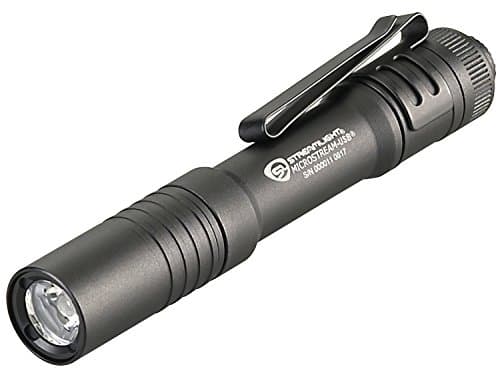
Streamlight MicroStream USB
Lumens per dollar
7
Two hundred and fifty lumens for an hour and a half, fifty for three and a half, at 1.2 ounces. The battery is sealed, which caps its lifespan, but every other number on the sheet is published and checkable.
- Max output
- 250 lm
- Runtime
- 1 h 30 min
- Battery
- Sealed
- Water rating
- IPX4
What it gets right
- Every mode's runtime is published, which is why it scores well here despite modest output
- Deep pocket clip that actually holds in a shirt pocket
- 1.2 ounces — it is easy to forget you have it
What it gets wrong
- The cell is sealed in; when it fails the light is finished
- IPX4 splash rating only
- 250 lumens is not enough to light a yard
Published specification
- High: 250 lumens, 68 m, 1.5 hours — Streamlight published specification
- Low: 50 lumens, 31 m, 3.5 hours — Streamlight published specification
- Battery: Lithium-ion, charges in-product in 4 hours — Streamlight published specification
- Water rating: IPX4 — Streamlight published specification
- Impact: 1 m tested — Streamlight published specification
- Weight: 1.2 oz (34.1 g) — Streamlight published specification
- Length: 3.87 in (9.83 cm) — Streamlight published specification
Skip this one if
you want a light you can re-cell. For a keychain-sized light with a replaceable battery, look at the Sofirn SC21 Pro instead.
Buy it if: a shirt pocket, a scrubs pocket, or anyone who wants a light without a bulge.
- Output 5.5
- Battery 4.5
- Build 8.5
- Usability 9.0
- Overall 7.2
Price as of October 18, 2026 — 7 lumens per dollar. #ad How we earn
listing
image
4. Best color quality per dollar
Wurkkos FC11
Lumens per dollar
Computed the moment we have a live price for it
A 90-CRI emitter at a price where nobody else bothers, which means colors look like colors rather than like a parking lot. Same replaceable 18650 story as the Sofirn, plus a magnetic tail that turns it into a work light.
- Max output
- 1,300 lm
- Runtime
- Not published per mode
- Battery
- Replaceable cell
- Water rating
- IPX7
What it gets right
- 90 CRI at a price where 70 CRI is normal — skin, wiring and paint read correctly
- Magnetic tailcap sticks it to anything ferrous and frees both hands
- Standard 18650, USB-C charging in the light
- Two mode groups, so you can pick a simple ramp or a stepped set
What it gets wrong
- IPX7 rather than IPX8 — fine for rain, not for a river
- High CRI costs raw lumens; the Sofirn is visibly brighter on turbo
- No per-mode runtime published on the product page
Published specification
- Maximum output: 1,300 lumens — Wurkkos published specification
- Beam distance: 144 m (157 yd) — Wurkkos published specification
- Battery: 1 x 18650 Li-ion, user replaceable — Wurkkos published specification
- Water rating: IPX7 — Wurkkos published specification
- Weight: 65 g +/- 1 g without battery — Wurkkos published specification
- Length: 116.23 mm — Wurkkos published specification
- Emitter: Nichia 519A / LH351D, 90 CRI — Wurkkos published specification
- Body: 6061 aluminum, type III hard anodized — Wurkkos published specification
Skip this one if
the only number you care about is peak output. You are paying part of this light's budget for color accuracy, and if you will never notice that, the money is better spent elsewhere.
Buy it if: anyone who uses a flashlight to look at things closely — wiring, paint, engine bays, a face — rather than to light up a field.
- Output 7.5
- Battery 9.5
- Build 8.0
- Usability 8.0
- Overall 8.4
We show a price only when we have pulled a live one. #ad How we earn
How to pick a number and stop thinking about it
- 1.Decide the furthest thing you need to see and how often. If it is under 50 meters, you need far less than you think.
- 2.Pick from the table above, then buy a light whose maximum is roughly double it — so your usual mode is a comfortable middle setting rather than the maximum.
- 3.Check the runtime at that middle setting, not at maximum. That is the number you will live with.
- 4.Prefer a light with a usable sub-10-lumen mode. It is the mode you will use most at night and it runs almost indefinitely.
Units we claim to have tested: 0
Every publisher in this category says they tested twenty flashlights. We have not tested any, and we say so. What we do instead: compile the manufacturer's own published ANSI FL1 figures, pull the price the light is selling for right now, and divide one by the other. Every number on this page is one you can check yourself in about two minutes.
Common questions
How many lumens do I actually need?
For walking a dog, finding a fuse box or reading a map, 100 to 300 lumens is plenty and will run far longer. For a garage, a yard or a campsite, 500 to 1,000 lumens is comfortable. Above about 2,000 lumens you are buying a burst rather than a mode, because almost no handheld light can shed that much heat continuously.
How many lumens does the average flashlight have?
Modern rechargeable handhelds cluster between about 500 and 2,000 lumens at maximum, though the mode most owners actually use is far lower. What matters more than the maximum is the runtime at a mid setting: NEBO publishes 800 lumens for two hours and 250 lumens for three and a half on the TORCHY 3K, and the second of those is closer to how a light gets used.
How many lumens do police flashlights have?
We are not going to state a figure for what any particular service issues, because we have no verified source for it. What we can point at is the duty-grade equipment marketed for that use: Streamlight publishes 2,000 lumens for two hours with a 315-meter beam on the Stinger 2020. Note that the runtime is published alongside the output, which is the characteristic worth copying.
How many lumens is an iPhone flashlight?
Apple does not publish a lumen figure for the camera flash used as a torch, so any number you see quoted is somebody's estimate rather than a specification, and we are not going to repeat one. Practically, it is bright enough to find a keyhole and not bright enough to light a path, which puts it well below the 50-to-150-lumen band in the table above.
Sources
- NEBO published product specifications — mode-by-mode lumen, runtime and beam figures, read 2026-09-01; LUXTREME SL75 and SL50 read 2026-09-22; OMNI 2K and SLYDE KING 4K read 2026-10-18
- COAST published product specifications — read 2026-09-01
- Streamlight published product specifications — per-mode lumens, runtime, beam distance, impact and IP ratings, read 2026-09-01; Waypoint 400 and Waypoint C-cell read 2026-09-22; FlipMate read 2026-10-18
- Wurkkos published product specifications and user manuals — FC11 and TS10 read 2026-09-01; FC11C read 2026-09-21
- Streamlight, ANSI Information — definitions of light output, beam distance, run time, impact and water resistance under the FL1 standard, read 2026-09-01
- Lumen & Ledger method — how every figure on this page is derived
Who writes this
Scooter M. — I am an enthusiast who is genuinely into this. I read the manuals, compile the published specs, and do the math. No lab coat, no test bench, no drawer of free samples. What I can tell you is exactly what a light claims on paper, exactly what it costs right now, and what those two numbers mean when you divide one by the other.
Read next
Is 1,000 lumens bright for a flashlight?
Yes, and here is what that looks like in the four places you will use it.
Lumens vs candela
One measures how much light there is. The other measures how far it goes.
The 10,000-lumen problem
Why the biggest number on the box is the one you can use for the shortest time.
Best flashlights for walking at night
The one job where less output is better, and why a headlamp may be the right answer.
Do you need a moonlight mode?
The sub-10-lumen setting that outlasts every other mode, and the three brands that publish it.
The Ledger
Every light we cover in one ranked table, sorted by lumens per dollar.