Where to Buy
Rechargeable Flashlights on Amazon: What's Actually Worth Buying
The widest selection in the category and the least regulated specification writing. Both facts have the same cause, and both are manageable once you know what to read.
By Scooter M. · Published September 2, 2026
Short answer
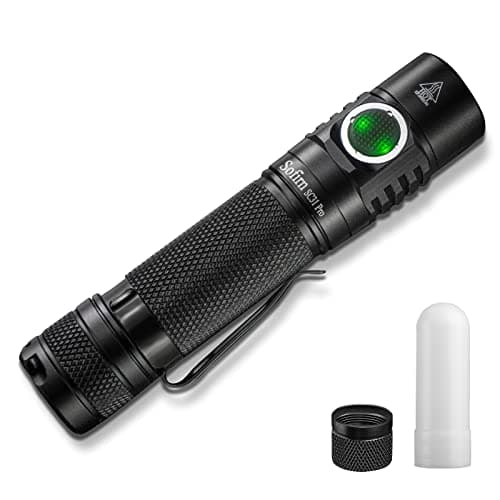
Sofirn SC31 Pro
Two thousand published lumens out of a standard 18650 you can buy anywhere for a few dollars, in a light that costs less than most brands charge for a keychain. The cell is the whole argument: when it dies in three years you replace a battery, not a flashlight.
Price as of October 18, 2026 — 47 lumens per dollar. #ad How we earn
Disclosure — we earn a commission on qualifying purchases made through the Amazon links on this page, at no extra cost to you. It does not change which lights we pick or what we say about them. The full version.
How we rank. Published ANSI FL1 output divided by the live retail price, with sealed-battery lights marked down because a light you cannot re-cell is a light with an expiry date. Units we claim to have tested: 0 — we compile manufacturers' published figures and show the arithmetic instead. How we work this out.
The trade Amazon makes
Amazon carries far more flashlights than any physical retailer, including the direct-selling brands that offer the best value in the category. It also has the least consistent specification writing anywhere, because listings are written by sellers rather than by a buying department. The selection is the reason to shop there; the listings are the reason to read carefully.
Both facts come from the same structure. A marketplace with a low barrier to entry gets everything, including the enthusiast brands with excellent products and no retail distribution, and including sellers whose lumen figures were chosen rather than measured. You cannot have the first without the second.
| # | Light | Max output | Battery | Lumens / $ | Price |
|---|---|---|---|---|---|
| 1 | Sofirn SC31 Pro Best lumens per dollar overall | 2,000 | Replaceable | 47 | $42.99 on Amazon Price as of October 18, 2026 — 47 lumens per dollar. #ad How we earn |
| 2 | 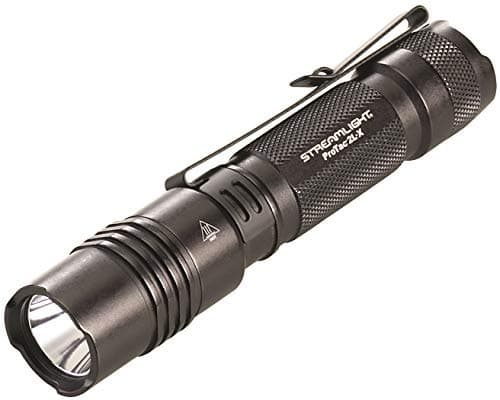 Streamlight ProTac 2L-X Best documented tactical light | 500 | Replaceable | 7 | $66.99 on Amazon Price as of October 18, 2026 — 7 lumens per dollar. #ad How we earn |
| 3 | No listing image Wurkkos FC11 Best color quality per dollar | 1,300 | Replaceable | Needs a live price | Check price on Amazon We show a price only when we have pulled a live one. #ad How we earn |
| 4 | No listing image Wurkkos TS10 V2 Best pocket light under two ounces | 1,400 | Replaceable | Needs a live price | Check price on Amazon We show a price only when we have pulled a live one. #ad How we earn |
| 5 | No listing image NEBO Newton 2000 Best outage light you can feed from a stockpile | 2,000 | AA / AAA | Needs a live price | Check price on Amazon We show a price only when we have pulled a live one. #ad How we earn |
Prices pulled October 18, 2026. Lumens per dollar is the manufacturer's published maximum output divided by that price, recomputed every time the price moves.
How to read a listing, in order
- 1.Find the battery line first. A named cell format — 18650, 21700, 14500, 16340 — means the light can be re-celled for a few dollars. 'Built-in rechargeable battery' means the light has a service life rather than a lifespan.
- 2.Look for a runtime figure. Any runtime, for any mode. A seller who publishes one has told you something checkable; a listing with a four-figure lumen claim and no duration anywhere has told you about an LED, not a flashlight.
- 3.Check for an IP or IPX rating with a number attached. 'Waterproof' as an adjective is not a specification.
- 4.Read the emitter name. 'Nichia 519A' or 'SST40' is a part number you can look up. 'Super bright LED' is not.
- 5.Compare beam distance in meters, not lumens, if reach is what you want. The two are only loosely related.
- 6.Ignore the pictures of beams. Every one of them is a long-exposure photograph and none of them is comparable to another.
The lumen problem, specifically
Nothing compels a marketplace listing to state output measured to any particular standard, so the figure ranges from carefully measured to entirely aspirational. The tell is what sits beside it: manufacturers who measure their output tend to publish a runtime with it, because both come out of the same test.
Compare across our roster. Wurkkos publishes 1,400 lumens with a runtime of one hour fourteen minutes. Streamlight publishes 2,000 lumens with two hours. NEBO publishes 3,000 lumens for the TORCHY 3K with no runtime beside it, and 800 lumens for two hours on the mode below. The presence or absence of that second number is the most reliable signal available.
1. Best lumens per dollar overall
Sofirn SC31 Pro
Lumens per dollar
47
Two thousand published lumens out of a standard 18650 you can buy anywhere for a few dollars, in a light that costs less than most brands charge for a keychain. The cell is the whole argument: when it dies in three years you replace a battery, not a flashlight.
- Max output
- 2,000 lm
- Runtime
- Not published per mode
- Battery
- Replaceable cell
- Water rating
- IPX8
What it gets right
- Standard 18650 cell — replacements cost a few dollars and are sold everywhere
- IPX8, the strongest water rating in this price class
- USB-C charging built into the light, so no separate charger to lose
- Anduril firmware gives real ramping control rather than four fixed steps
What it gets wrong
- Sofirn publishes no per-mode runtime figures on the product page
- Anduril is genuinely confusing for the first week
- Tint varies between batches, which is the price of this price
Published specification
- Maximum output: 2,000 lumens — Sofirn published specification
- Beam distance: 226 m — Sofirn published specification
- Battery: 1 x 18650 Li-ion, user replaceable — Sofirn published specification
- Charging: USB-C, 2.5 hours with a 2A adapter — Sofirn published specification
- Water rating: IPX8 — Sofirn published specification
- Weight: 59 g without battery — Sofirn published specification
- Length: 117.5 mm — Sofirn published specification
- Emitter: SST40, 5000K or 6500K — Sofirn published specification
- Per-mode runtime: Not published on the product page
Skip this one if
you want to press one button and get one brightness. Anduril has a shortcut for everything and a menu for everything else, and if that sounds tiring you will be happier with a three-mode light.
Buy it if: anyone who intends to keep the light for longer than the battery lasts, and does not mind reading a manual once.
- Output 9.0
- Battery 9.5
- Build 8.0
- Usability 7.0
- Overall 8.6
Price as of October 18, 2026 — 47 lumens per dollar. #ad How we earn
2. Best documented tactical light
Streamlight ProTac 2L-X
Lumens per dollar
7
Five hundred lumens with the runtime published for both battery types, 165 meters of throw, IPX7 and a 2-meter impact rating. Streamlight publishes what most brands leave out, and the numbers hold up when you divide them.
- Max output
- 500 lm
- Runtime
- 2 h 45 min (CR123A) / 3 h 15 min (SL-B26)
- Battery
- Replaceable cell
- Water rating
- IPX7
What it gets right
- Runtime published for every mode and both battery chemistries
- IPX7 plus a stated 2 m impact test, not a vague claim of toughness
- Runs on CR123A primaries when the rechargeable pack is flat
What it gets wrong
- Five hundred lumens is modest for the money in raw terms
- CR123A cells are expensive if you run it on primaries
- No high-CRI option
Published specification
- High: 500 lumens, 165 m, 2.75 h on CR123A / 3.25 h on SL-B26 — Streamlight published specification
- Low: 40 lumens, 49 m, 30 hours on either battery — Streamlight published specification
- Strobe: Up to 3.25 h (CR123A) / 4.5 h (SL-B26) — Streamlight published specification
- Battery: 2 x CR123A or the SL-B26 rechargeable pack — Streamlight published specification
- Water rating: IPX7, 1 m for 30 minutes — Streamlight published specification
- Impact: 2 m tested — Streamlight published specification
- Weight: 3.9 oz with CR123A / 4.4 oz with SL-B26 — Streamlight published specification
Skip this one if
you want the biggest number per dollar. Streamlight charges for documentation, warranty and consistency, and none of those show up in a lumens-per-dollar column.
Buy it if: someone whose light has to work every time and who would rather have a small honest number than a large unverifiable one.
- Output 6.5
- Battery 8.5
- Build 9.0
- Usability 8.5
- Overall 8.1
Price as of October 18, 2026 — 7 lumens per dollar. #ad How we earn
listing
image
3. Best color quality per dollar
Wurkkos FC11
Lumens per dollar
Computed the moment we have a live price for it
A 90-CRI emitter at a price where nobody else bothers, which means colors look like colors rather than like a parking lot. Same replaceable 18650 story as the Sofirn, plus a magnetic tail that turns it into a work light.
- Max output
- 1,300 lm
- Runtime
- Not published per mode
- Battery
- Replaceable cell
- Water rating
- IPX7
What it gets right
- 90 CRI at a price where 70 CRI is normal — skin, wiring and paint read correctly
- Magnetic tailcap sticks it to anything ferrous and frees both hands
- Standard 18650, USB-C charging in the light
- Two mode groups, so you can pick a simple ramp or a stepped set
What it gets wrong
- IPX7 rather than IPX8 — fine for rain, not for a river
- High CRI costs raw lumens; the Sofirn is visibly brighter on turbo
- No per-mode runtime published on the product page
Published specification
- Maximum output: 1,300 lumens — Wurkkos published specification
- Beam distance: 144 m (157 yd) — Wurkkos published specification
- Battery: 1 x 18650 Li-ion, user replaceable — Wurkkos published specification
- Water rating: IPX7 — Wurkkos published specification
- Weight: 65 g +/- 1 g without battery — Wurkkos published specification
- Length: 116.23 mm — Wurkkos published specification
- Emitter: Nichia 519A / LH351D, 90 CRI — Wurkkos published specification
- Body: 6061 aluminum, type III hard anodized — Wurkkos published specification
Skip this one if
the only number you care about is peak output. You are paying part of this light's budget for color accuracy, and if you will never notice that, the money is better spent elsewhere.
Buy it if: anyone who uses a flashlight to look at things closely — wiring, paint, engine bays, a face — rather than to light up a field.
- Output 7.5
- Battery 9.5
- Build 8.0
- Usability 8.0
- Overall 8.4
We show a price only when we have pulled a live one. #ad How we earn
listing
image
4. Best pocket light under two ounces
Wurkkos TS10 V2
Lumens per dollar
Computed the moment we have a live price for it
Thirty-two grams, three 90-CRI emitters, and one of the very few budget lights whose maker publishes the runtime at maximum output: one hour fourteen at 1,400 lumens. Publishing that number at all puts Wurkkos ahead of several brands ten times its size.
- Max output
- 1,400 lm
- Runtime
- 1 h 14 min
- Battery
- Replaceable cell
- Water rating
- IPX8
What it gets right
- Wurkkos publishes runtime at maximum output, which most brands quietly do not
- Thirty-two grams — light enough that you stop noticing it in a pocket
- Standard 14500 cell, replaceable
- Documented automatic step-down instead of an undocumented one
What it gets wrong
- A 14500 is a small cell; sustained output is not this light's job
- RGB auxiliary LEDs are a toy, and they draw from the same cell
- Anduril again, with the same learning curve
Published specification
- Maximum output: 1,400 lumens — Wurkkos published specification
- Runtime at maximum: 1 h 14 min — Wurkkos published specification
- Runtime at 1 lumen: 6 h 43 min — Wurkkos published specification
- Battery: 1 x 14500 Li-ion, user replaceable — Wurkkos published specification
- Water rating: IPX8, 2 m — Wurkkos published specification
- Weight: 32 g +/- 1 g without battery — Wurkkos published specification
- Length: 71.5 mm — Wurkkos published specification
- Thermal behavior: Automatic step-down from turbo to high — Wurkkos published specification
Skip this one if
you need something to run for an hour on high without getting hot. A light this small has nowhere to put the heat, and the step-down is not optional.
Buy it if: the person who wants a real light on them at all times and will not carry anything heavier than a pen.
- Output 8.0
- Battery 8.0
- Build 7.5
- Usability 7.5
- Overall 8.2
We show a price only when we have pulled a live one. #ad How we earn
listing
image
5. Best outage light you can feed from a stockpile
NEBO Newton 2000
Lumens per dollar
Computed the moment we have a live price for it
Two thousand lumens for two and a half hours on nine AA alkalines, IPX7, with the runtime published for every mode. It is heavy and it is not clever, and for a week without power that is the correct set of trade-offs.
- Max output
- 2,000 lm
- Runtime
- 2.5 h
- Battery
- AA / AAA
- Water rating
- IPX7
What it gets right
- Runtime published at maximum output, which is the number that actually matters
- AA cells store for years and can be bought anywhere, including during an outage
- IPX7 — it survives being dropped in standing water
What it gets wrong
- Nine AA cells is a real weight and a real running cost
- Zoom optics trade beam quality for a party trick
- Nothing about it is pocketable
Published specification
- High: 2,000 lumens, 2.5 hours, 188 m — NEBO published specification
- Medium: 600 lumens, 6 hours, 120 m — NEBO published specification
- Low: 100 lumens, 20 hours, 50 m — NEBO published specification
- Battery: 9 x AA alkaline — NEBO published specification
- Water rating: IPX7 — NEBO published specification
- Body: Aircraft-grade aluminum, impact resistant — NEBO published specification
Skip this one if
you want one light for everything. Running this daily on disposable alkalines costs more in a year than the light did.
Buy it if: the hall closet, the basement, and the shelf you go to when the power has been off for two days.
- Output 8.5
- Battery 7.5
- Build 7.5
- Usability 7.0
- Overall 7.6
We show a price only when we have pulled a live one. #ad How we earn
How we ranked these
Published output over live price, battery architecture, published ratings and usability — with an explicit preference for brands that publish enough specification to be held to it. On a marketplace where anyone can write anything, documentation is the closest thing to a quality signal available at a distance.
Units we claim to have tested: 0
Every publisher in this category says they tested twenty flashlights. We have not tested any, and we say so. What we do instead: compile the manufacturer's own published ANSI FL1 figures, pull the price the light is selling for right now, and divide one by the other. Every number on this page is one you can check yourself in about two minutes.
What Amazon is genuinely best for
- Direct-selling enthusiast brands with no retail presence, which is where the value in this category lives.
- Replacement cells and chargers, which physical stores stock poorly if at all.
- Comparing several lights side by side at leisure rather than against a shelf.
- Returns, which are straightforward, and which matter more when specifications are unreliable.
What it is worst for
Judging beam quality, tint, weight in the hand and switch feel — none of which appears in any listing, and all of which decide whether you keep using a light. If those matter to you, a store you can walk into has a genuine advantage, and our other retailer guides cover how to use it.
We do not publish a stock list for this retailer. Assortments change week to week and store to store, and a list written today would be wrong by the time you read it. What does not change is how to read the shelf, and that is what this page is for.
Common questions
Are Amazon flashlights any good?
Many are excellent, because the marketplace is where the direct-selling enthusiast brands live and those brands offer the best value in the category. The variable is the listing, not the light: outputs are self-reported and inconsistently measured. Read the battery line, look for any published runtime, and require an IP rating with a number — three checks that separate the good listings from the optimistic ones.
What is the brightest flashlight you can buy on Amazon?
Listings claim figures in the tens of thousands of lumens, and we are not going to repeat a number we cannot verify. The useful question is what a light sustains: among the manufacturers we cite, Streamlight publishes 2,000 lumens for two hours and NEBO publishes 2,000 lumens for two and a half. A four-figure claim with no runtime beside it describes an emitter rather than a flashlight.
Are cheap rechargeable flashlights any good?
Many are, and for a specific reason: the LED emitters, drivers and 18650 cells that budget brands buy are the same commodity parts the expensive brands buy. What you give up at the low end is documentation, quality control between batches, and a warranty worth using. The way to shop it is to look for a brand that publishes runtime figures — a manufacturer willing to print how long the turbo mode lasts is telling you something about the rest of the specification.
Can you replace the battery in a rechargeable flashlight?
It depends entirely on the model, and it is the single most consequential thing to check before buying. Lights built around a standard cell — an 18650, a 21700, a 14500, a 16340 — take a screw-off tailcap and a five-dollar replacement. Lights with a built-in cell, which manufacturers describe as 'integrated' or 'non-removable', cannot be re-celled by an ordinary owner: when the battery reaches the end of its cycle life the whole light is refuse. Energizer, for example, states plainly that the Vision HD Rechargeable uses non-removable lithium-ion batteries.
Sources
- Sofirn published product specifications — read 2026-09-01
- Wurkkos published product specifications and user manuals — FC11 and TS10 read 2026-09-01; FC11C read 2026-09-21
- Streamlight published product specifications — per-mode lumens, runtime, beam distance, impact and IP ratings, read 2026-09-01; Waypoint 400 and Waypoint C-cell read 2026-09-22; FlipMate read 2026-10-18
- NEBO published product specifications — mode-by-mode lumen, runtime and beam figures, read 2026-09-01; LUXTREME SL75 and SL50 read 2026-09-22; OMNI 2K and SLYDE KING 4K read 2026-10-18
- Lumen & Ledger method — how every figure on this page is derived
Who writes this
Scooter M. — I am an enthusiast who is genuinely into this. I read the manuals, compile the published specs, and do the math. No lab coat, no test bench, no drawer of free samples. What I can tell you is exactly what a light claims on paper, exactly what it costs right now, and what those two numbers mean when you divide one by the other.
Read next
Are Amazon flashlights any good?
How to read a listing where the lumen figure is a marketing decision.
The 10,000-lumen problem
Why the biggest number on the box is the one you can use for the shortest time.
The best rechargeable flashlights for the money
The flagship ranking: every pick scored on output over price, with the arithmetic shown.
Rechargeable flashlights at Walmart
What the aisle stocks, what those brands publish, and what the same money buys online.
Where to buy a rechargeable flashlight near you
Which aisle to walk to, what a store can give you that a website cannot, and when to drive.
The Ledger
Every light we cover in one ranked table, sorted by lumens per dollar.