Guides
The 10,000-Lumen Problem
The biggest number on the box is the one you can use for the shortest time. Two manufacturers publish exactly how short, and their honesty is the best evidence available.
By Scooter M. · Published September 2, 2026
Short answer
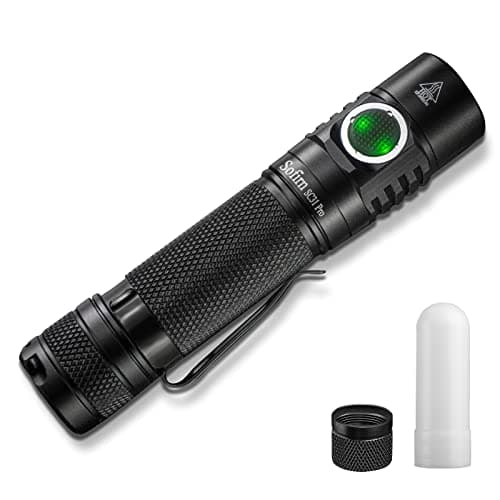
Sofirn SC31 Pro
Two thousand published lumens out of a standard 18650 you can buy anywhere for a few dollars, in a light that costs less than most brands charge for a keychain. The cell is the whole argument: when it dies in three years you replace a battery, not a flashlight.
Price as of October 18, 2026 — 47 lumens per dollar. #ad How we earn
Disclosure — we earn a commission on qualifying purchases made through the Amazon links on this page, at no extra cost to you. It does not change which lights we pick or what we say about them. The full version.
How we rank. Published ANSI FL1 output divided by the live retail price, with sealed-battery lights marked down because a light you cannot re-cell is a light with an expiry date. Units we claim to have tested: 0 — we compile manufacturers' published figures and show the arithmetic instead. How we work this out.
What actually happens when you press turbo
An LED converts most of the power it draws into heat rather than light. In a handheld body there is nowhere for that heat to go except the aluminum in your hand, and once it gets too hot the driver reduces current to protect the emitter. That is thermal step-down. It is not a defect, it is the design working, and it is why the biggest number on the box is the one you can use for the shortest time.
The physics is unforgiving and it is the same for every brand. A small light has a small surface area, so it sheds heat slowly. A large light with a lot of metal sheds it faster, which is why Maglite can publish over three hours at 1,082 lumens on a physically large ML150LR while a 32-gram pocket light cannot hold a comparable output for a fraction as long.
Two manufacturers who publish the duration
This is the most useful evidence on the page, and it comes from the brands themselves rather than from us.
| Light | Turbo claim | Duration the manufacturer publishes |
|---|---|---|
| NEBO SLIM Mini 500 | 500 lumens | 30 seconds |
| Streamlight Wedge (THRO) | 1,000 lumens | 35-second burst |
| NEBO TORCHY 3K | 3,000 lumens | Not published |
| NEBO LEO 1800 Flex | 1,800 lumens | Not published |
| Energizer 3500XT-R | 3,500 lumens | Not published |
Read those two published figures and then read the three below them. NEBO states plainly that its 500-lumen turbo lasts thirty seconds, and states nothing at all about how long its 3,000-lumen turbo lasts. That is not a contradiction — it is the same company being specific where it is comfortable and silent where it is not.
Where 10,000 lumens goes
Work the energy through. A large 21700 lithium cell holds roughly 15 to 17 watt-hours. Producing ten thousand lumens from a typical LED array requires on the order of a hundred watts. At a hundred watts, seventeen watt-hours is about ten minutes of energy — and that assumes the cell can deliver a hundred watts at all, and that the body could shed a hundred watts of heat, which it cannot.
In practice a handheld light claiming five figures will hit the number briefly, get very hot, and step down to something it does not print. The claim is not necessarily false: the emitters can produce it. It simply describes a moment rather than a mode.
How to read any turbo claim in ten seconds
- 1.Find the highest published output. Ignore it for now.
- 2.Look for a runtime printed beside it. If there is one, that is the specification and you can trust the number.
- 3.If there is no runtime, drop to the next mode down and read its runtime. That is the light you are actually buying.
- 4.Compare lights on that second figure, not the first. Streamlight publishes 2,000 lumens for two hours on the Stinger 2020; that is a real 2,000-lumen light.
- 5.If a light publishes no runtime for any mode at all, treat every number on the page as unverified.
1. Best lumens per dollar overall
Sofirn SC31 Pro
Lumens per dollar
47
Two thousand published lumens out of a standard 18650 you can buy anywhere for a few dollars, in a light that costs less than most brands charge for a keychain. The cell is the whole argument: when it dies in three years you replace a battery, not a flashlight.
- Max output
- 2,000 lm
- Runtime
- Not published per mode
- Battery
- Replaceable cell
- Water rating
- IPX8
What it gets right
- Standard 18650 cell — replacements cost a few dollars and are sold everywhere
- IPX8, the strongest water rating in this price class
- USB-C charging built into the light, so no separate charger to lose
- Anduril firmware gives real ramping control rather than four fixed steps
What it gets wrong
- Sofirn publishes no per-mode runtime figures on the product page
- Anduril is genuinely confusing for the first week
- Tint varies between batches, which is the price of this price
Published specification
- Maximum output: 2,000 lumens — Sofirn published specification
- Beam distance: 226 m — Sofirn published specification
- Battery: 1 x 18650 Li-ion, user replaceable — Sofirn published specification
- Charging: USB-C, 2.5 hours with a 2A adapter — Sofirn published specification
- Water rating: IPX8 — Sofirn published specification
- Weight: 59 g without battery — Sofirn published specification
- Length: 117.5 mm — Sofirn published specification
- Emitter: SST40, 5000K or 6500K — Sofirn published specification
- Per-mode runtime: Not published on the product page
Skip this one if
you want to press one button and get one brightness. Anduril has a shortcut for everything and a menu for everything else, and if that sounds tiring you will be happier with a three-mode light.
Buy it if: anyone who intends to keep the light for longer than the battery lasts, and does not mind reading a manual once.
- Output 9.0
- Battery 9.5
- Build 8.0
- Usability 7.0
- Overall 8.6
Price as of October 18, 2026 — 47 lumens per dollar. #ad How we earn
2. Best big-box light if you want the headline number
NEBO TORCHY 3K
Lumens per dollar
43
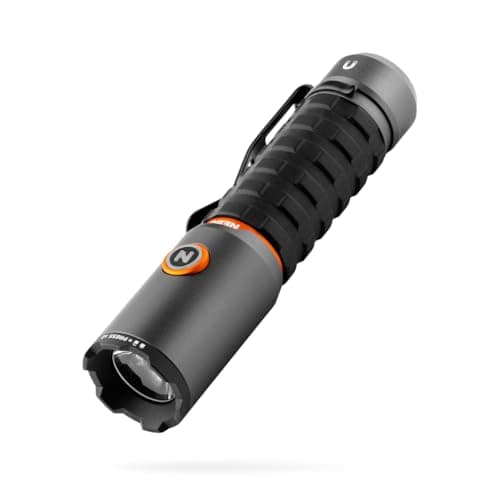
Three thousand lumens on the box, and NEBO publishes a runtime for every mode except that one. High is 800 lumens for two hours, which is the number to plan around. Read the spec table and the light tells you what it really is.
- Max output
- 3,000 lm
- Runtime
- Not published at turbo; 2 h at 800 lm high
- Battery
- Sealed
- Water rating
- IPX6
What it gets right
- NEBO publishes a full mode-by-mode table, which is more than several rivals manage
- USB-C, magnetic base, detachable clip
- Sold in stores you can drive to, and returnable to the same counter
What it gets wrong
- The battery is built in — when it dies the whole light is refuse
- No runtime published for the 3,000-lumen mode the box is named after
- IPX6 is splash and rain, not submersion
Published specification
- Turbo: 3,000 lumens, 150 m — no runtime published — NEBO published specification
- High: 800 lumens, 2 hours, 80 m — NEBO published specification
- Medium: 250 lumens, 3.5 hours, 40 m — NEBO published specification
- Low: 50 lumens, 20 hours, 20 m — NEBO published specification
- Battery: 2,200 mAh 3.7V Li-ion, built in — NEBO published specification
- Recharge time: 2 hours, USB-C — NEBO published specification
- Water rating: IPX6 — NEBO published specification
Skip this one if
you expect the 3K on the label to be a mode you can use. The mode you will actually use is the 800-lumen one, and there are cheaper lights that do 800 lumens for two hours.
Buy it if: somebody who wants a decent light today, from a shop, with a receipt.
- Output 8.5
- Battery 4.0
- Build 7.5
- Usability 8.0
- Overall 7.0
Price as of October 18, 2026 — 43 lumens per dollar. #ad How we earn
3. Highest output with a published runtime to match
Streamlight Stinger 2020
Lumens per dollar
16
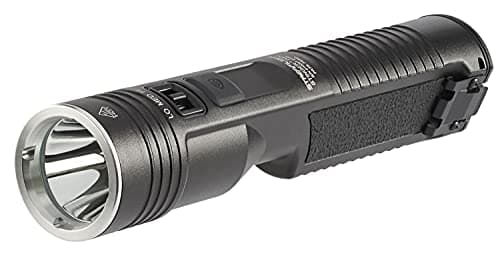
Two thousand lumens for two hours, 850 for four, 100 for twenty-four, 315 meters of throw, IPX7. This is what a 2,000-lumen claim looks like when the manufacturer stands behind it with a duration.
- Max output
- 2,000 lm
- Runtime
- 2 h
- Battery
- Replaceable cell
- Water rating
- IPX7
What it gets right
- Two thousand lumens with two hours beside it, published together
- Twenty-four hours on low makes it viable as an outage light
- Duty-grade build with the warranty and spares to match
What it gets wrong
- Twelve and a half ounces — this is a belt light, not a pocket light
- Priced well above everything else in the value tier
- Charging is via a cradle, which is another thing to own
Published specification
- High: 2,000 lumens, 315 m, 2 hours — Streamlight published specification
- Medium: 850 lumens, 200 m, 4 hours — Streamlight published specification
- Low: 100 lumens, 70 m, 24 hours — Streamlight published specification
- Strobe: 3.25 hours — Streamlight published specification
- Water rating: IPX7 — Streamlight published specification
- Impact: 2 m tested — Streamlight published specification
- Weight: 12.3 oz (350 g) — Streamlight published specification
- Length: 7.67 in (19.48 cm) — Streamlight published specification
Skip this one if
you want value. On lumens per dollar it will lose to a Sofirn every time; what it buys is the certainty that the number is real.
Buy it if: professional use, and anyone comparing a budget light's 2,000-lumen claim against a documented one.
- Output 9.5
- Battery 8.5
- Build 9.5
- Usability 7.5
- Overall 8.4
Price as of October 18, 2026 — 16 lumens per dollar. #ad How we earn
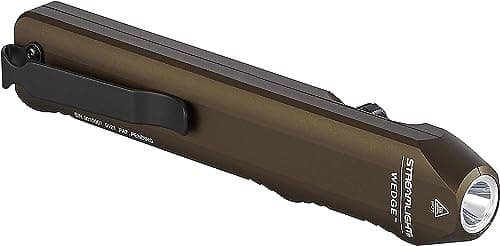
4. The clearest published turbo duration anywhere
Streamlight Wedge
Lumens per dollar
10
Three hundred lumens for three hours in normal use, and a boost mode Streamlight publishes as a 1,000-lumen, 35-second burst. Not a footnote, not buried in a manual — printed as the specification. Every brand knows their turbo behaves like this; this one says so.
- Max output
- 1,000 lm
- Runtime
- 35 seconds at 1,000 lm; 3 h at 300 lm
- Battery
- Sealed
- Water rating
- IPX7
What it gets right
- The 35-second burst duration is published outright — an unusual piece of honesty
- Flat, wedge-shaped body sits in a pocket without rolling
- IPX7 in a light this thin
What it gets wrong
- Sealed cell, so the light has a service life
- Three hundred lumens constant is its real specification
- Thumb-wheel switch is divisive and cannot be locked out mechanically
Published specification
- Constant: 300 lumens, 69 m, 3 hours — Streamlight published specification
- THRO boost: 1,000 lumens, 110 m, 35-second burst — Streamlight published specification
- Battery: Built-in lithium-ion, USB-C — Streamlight published specification
- Water rating: IPX7, 1 m — Streamlight published specification
- Impact: 1 m tested — Streamlight published specification
- Weight: 3.3 oz (93.6 g) — Streamlight published specification
Skip this one if
you plan to use the 1,000-lumen mode as a mode. It is a burst by design and Streamlight tells you the duration in seconds.
Buy it if: someone who wants a flat pocket light and appreciates a manufacturer that publishes the uncomfortable number.
- Output 6.5
- Battery 4.5
- Build 8.5
- Usability 8.0
- Overall 7.3
Price as of October 18, 2026 — 10 lumens per dollar. #ad How we earn
listing
image
5. Best pocket task light for a toolbag
NEBO SLIM Mini 500
Lumens per dollar
Computed the moment we have a live price for it
The most honest spec sheet in this whole roundup, and not in the way NEBO intended: turbo is 500 lumens for thirty seconds. High is 250 lumens for two hours. That thirty-second figure is printed by the manufacturer, and it is the clearest illustration of the whole turbo problem you will find.
- Max output
- 500 lm
- Runtime
- 30 seconds at turbo; 2 h at 250 lm high
- Battery
- Sealed
- Water rating
- IPX4
What it gets right
- Genuinely flat — it disappears into a work-pants pocket
- Magnetic base plus green and red modes for inspection work
- NEBO states the turbo duration outright, which is rare and creditable
What it gets wrong
- Turbo lasts half a minute; treat 250 lumens as the real specification
- 450 mAh sealed cell, so this is a light with a service life rather than a lifespan
- IPX4 is splash resistance and nothing more
Published specification
- Turbo: 500 lumens for 30 seconds, 100 m — NEBO published specification
- High: 250 lumens, 2 hours, 250 m — NEBO published specification
- Low: 50 lumens, 5 hours, 50 m — NEBO published specification
- Battery: 450 mAh 3.7V (1.66 Wh) Li-ion, built in — NEBO published specification
- Recharge time: 2 hours, USB-C — NEBO published specification
- Water rating: IPX4 — NEBO published specification
- Weight: 0.07 lb — NEBO published specification
Skip this one if
you want a light for walking outdoors. This is a task light for arm's-length work and it does not throw usefully far in practice.
Buy it if: electricians, mechanics and anyone whose light spends its life eighteen inches from the thing it is lighting.
- Output 6.0
- Battery 4.5
- Build 7.5
- Usability 8.5
- Overall 6.8
We show a price only when we have pulled a live one. #ad How we earn
listing
image
6. Highest published output in a supermarket aisle
Energizer 3500XT-R
Lumens per dollar
Computed the moment we have a live price for it
Thirty-five hundred lumens on the box, 300 meters of beam, twelve hours on low — and no runtime published for the number in the model name. That gap is not an oversight, it is the industry's house style.
- Max output
- 3,500 lm
- Runtime
- Not published at maximum; up to 12 h on low
- Battery
- Sealed
- Water rating
- IPX4
What it gets right
- A very high published output for a mainstream retail price
- USB-C and a power-bank output
- Shatterproof lens and a 1 m drop rating
What it gets wrong
- No runtime published for the 3,500-lumen mode
- IPX4 splash resistance in a light this size is thin
- Digital-focus zoom head, with the usual beam artifacts
Published specification
- Maximum output: Up to 3,500 lumens — Energizer published specification
- Beam distance: Up to 300 m — Energizer published specification
- Runtime on low: Up to 12 hours — Energizer published specification
- Battery: Lithium-ion, USB-C rechargeable — Energizer published specification
- Water rating: IPX4 — Energizer published specification
- Impact: Drops up to 1 m — Energizer published specification
- Runtime at maximum: Not published on the product page
Skip this one if
you are buying it because of the 3,500. Without a published runtime for that mode, the figure tells you what the emitter can do for an unstated period, and nothing about what the light can do.
Buy it if: someone who wants maximum brightness from a shop they can walk into, and understands what they are buying.
- Output 9.0
- Battery 3.5
- Build 7.0
- Usability 7.0
- Overall 6.9
We show a price only when we have pulled a live one. #ad How we earn
Why this is the site's central argument
Because the entire value question in this category turns on it. Lumens per dollar is only a meaningful metric if the lumens are real. A ranking that divided unverified peak claims by price would reward the manufacturers who inflate hardest, which is the opposite of useful.
So we score down every light whose headline output has no published duration beside it, and we say plainly when a figure is missing rather than quietly filling it in. The brands that publish a runtime — Wurkkos at one hour fourteen, Streamlight at two hours, NEBO at thirty seconds — are the ones whose numbers survive contact with arithmetic.
Units we claim to have tested: 0
Every publisher in this category says they tested twenty flashlights. We have not tested any, and we say so. What we do instead: compile the manufacturer's own published ANSI FL1 figures, pull the price the light is selling for right now, and divide one by the other. Every number on this page is one you can check yourself in about two minutes.
Common questions
Are 10,000 lumen flashlights real?
The emitters can genuinely produce that output; what almost no handheld can do is sustain it. Producing ten thousand lumens takes on the order of a hundred watts, and a large 21700 cell holds only around fifteen to seventeen watt-hours — before considering whether the body could shed a hundred watts of heat, which it cannot. The claim describes a moment rather than a mode.
Why does my flashlight dim after 30 seconds?
That is thermal step-down, and it is deliberate. LEDs degrade when they overheat, so the driver reduces current once the body reaches a set temperature. NEBO publishes a 30-second turbo duration for the SLIM Mini 500 and Streamlight publishes a 35-second burst for the Wedge's THRO mode — those published durations are exactly what your light is doing.
How can I tell if a lumen claim is honest?
Look for a runtime printed beside the output. A manufacturer that publishes both measured them together and expects to be checked. Where a headline figure appears with no duration anywhere on the page, read the mode below it instead — that is the light you can actually use, and it is the number worth comparing between products.
Is a brighter flashlight always better?
No, and above roughly 1,000 lumens it is often worse for the job at hand. Higher output empties the cell proportionally faster, generates heat that forces step-down, and indoors closes your pupils down so that everything outside the beam goes black. A light that holds 1,000 lumens for an hour is more useful than one that hits 3,000 for an unstated period.
Sources
- NEBO published product specifications — mode-by-mode lumen, runtime and beam figures, read 2026-09-01; LUXTREME SL75 and SL50 read 2026-09-22; OMNI 2K and SLYDE KING 4K read 2026-10-18
- Streamlight published product specifications — per-mode lumens, runtime, beam distance, impact and IP ratings, read 2026-09-01; Waypoint 400 and Waypoint C-cell read 2026-09-22; FlipMate read 2026-10-18
- Energizer published product specifications — read 2026-09-01
- Maglite published product specifications — ML150LR read 2026-09-01; MAG-TAC Rechargeable (plain bezel) and Mini Maglite Pro LED read 2026-10-10; ML300LX 3-Cell D and ML50LX 2-Cell C read 2026-10-13
- Wurkkos published product specifications and user manuals — FC11 and TS10 read 2026-09-01; FC11C read 2026-09-21
- NitecoreLights, ANSI / NEMA FL-1 Guide — FL1 definitions plus a published account of the standard's runtime limitation, read 2026-09-01
- Lumen & Ledger method — how every figure on this page is derived
Who writes this
Scooter M. — I am an enthusiast who is genuinely into this. I read the manuals, compile the published specs, and do the math. No lab coat, no test bench, no drawer of free samples. What I can tell you is exactly what a light claims on paper, exactly what it costs right now, and what those two numbers mean when you divide one by the other.
Read next
Streamlight Wedge review
The maker prints its turbo as a 35-second burst. That disclosure is the product.
Is 1,000 lumens bright for a flashlight?
Yes, and here is what that looks like in the four places you will use it.
Best high-lumen rechargeable flashlights
High output judged on sustained performance rather than a thirty-second peak.
Flashlight runtime explained
Why a published runtime can be honest and still describe a light that dimmed an hour ago.
Best rechargeable spotlights
Throw is candela, not lumens. The four that publish theirs, and the fiction to avoid.
The Ledger
Every light we cover in one ranked table, sorted by lumens per dollar.