Flashlights
Streamlight Wedge Review: 1,000 Lumens for Thirty-Five Seconds, and They Say So
Every flashlight brand knows its turbo mode is a burst. This is one of the very few that prints how long the burst lasts, in the specification, before you pay.
By Scooter M. · Published September 27, 2026
Short answer
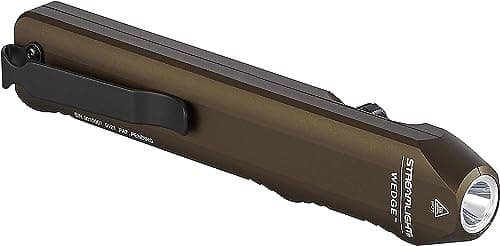
Streamlight Wedge
Three hundred lumens for three hours in normal use, and a boost mode Streamlight publishes as a 1,000-lumen, 35-second burst. Not a footnote, not buried in a manual — printed as the specification. Every brand knows their turbo behaves like this; this one says so.
Price as of September 27, 2026 — 10 lumens per dollar. #ad How we earn
Disclosure — we earn a commission on qualifying purchases made through the Amazon links on this page, at no extra cost to you. It does not change which lights we pick or what we say about them. The full version.
How we rank. Published ANSI FL1 output divided by the live retail price, with sealed-battery lights marked down because a light you cannot re-cell is a light with an expiry date. Units we claim to have tested: 0 — we compile manufacturers' published figures and show the arithmetic instead. How we work this out.
The verdict
Buy the Wedge if you want a flat pocket light and you value a manufacturer that tells the truth about its own headline. Streamlight publishes the Wedge as 300 lumens for three hours in constant mode, with a THRO boost of 1,000 lumens lasting 35 seconds — printed as the specification rather than buried. It is IPX7, impact tested to a meter, and 3.3 ounces. The catch is a sealed cell, which gives the light a service life rather than a lifespan, and a thumb-wheel switch that people either love or cannot stand.
We have not used this light. What makes it worth a dedicated page is not the hardware, which is good but not remarkable. It is one line on the spec sheet.
The published specification
| Specification | Published figure |
|---|---|
| Constant output | 300 lumens, 69 m, 3 hours |
| THRO boost | 1,000 lumens, 110 m, 35-second burst |
| Battery | Built-in lithium-ion, USB-C |
| Water rating | IPX7, 1 m |
| Impact | 1 m tested |
| Weight | 3.3 oz (93.6 g) |
Why 35 seconds is the most valuable number on this site
Nearly every flashlight sold has a maximum mode it cannot sustain. A handheld light is a small aluminum tube with nowhere to put heat, so above roughly a thousand lumens the driver steps the output down within seconds or minutes to protect the emitter and the cell. This is not a defect and it is not a scandal. It is physics, and every manufacturer knows it.
What almost none of them do is tell you how long it lasts. They print the peak figure on the box, omit the duration, and let you discover the step-down after you have paid. We have documented that pattern across this site: Fenix publishes 3,300 lumens for the C7 V2.0 with no runtime beside it, NEBO names a light the TORCHY 3K and publishes a runtime for every mode except the 3,000-lumen one, and Olight publishes a single low-mode figure and nothing else.
Streamlight prints 35 seconds. In the specification. Next to the number that sells the light. That is a company choosing to make its own headline look smaller because the alternative is letting a buyer believe something untrue, and it tells you something about how to read every other figure on the sheet.
It also, usefully, gives you a scale for everyone else. When you next see an unqualified 1,000-lumen claim on a pocket light, the honest translation is roughly what Streamlight printed: about half a minute, then something much lower.
What you are actually buying: 300 lumens for three hours
Treat the Wedge as a 300-lumen light and the purchase makes sense. Three hundred lumens for three hours at 69 meters is a genuinely useful pocket light — it is more than enough for a walk, a fuse box, a car park or a dog, and three hours is a real evening rather than a demonstration.
The THRO burst is then what it is meant to be: a thing you press when you need to see something further away for a moment. Used that way it is excellent. Bought as a 1,000-lumen light it will disappoint, which is precisely why Streamlight told you.
The body is the other half of the appeal. It is flat rather than cylindrical, which means it sits in a pocket without rolling and lies flush against a phone, and at 3.3 ounces it is light without being negligible. IPX7 in something that thin is a good result.
| # | Light | Max output | Battery | Lumens / $ | Price |
|---|---|---|---|---|---|
| 1 | Streamlight Wedge The clearest published turbo duration anywhere | 1,000 | Sealed | 10 | $98.82 on Amazon Price as of September 27, 2026 — 10 lumens per dollar. #ad How we earn |
| 2 | 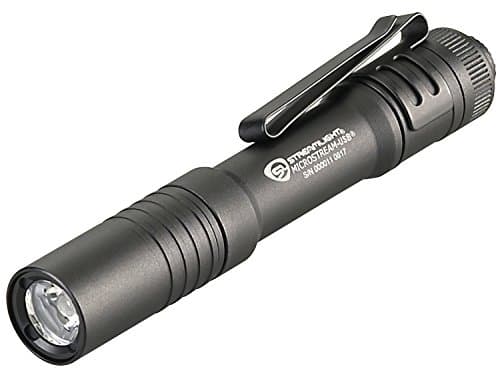 Streamlight MicroStream USB Best pen-clip light with published runtimes | 250 | Sealed | 7 | $37.81 on Amazon Price as of September 27, 2026 — 7 lumens per dollar. #ad How we earn |
| 3 | No listing image Wurkkos TS10 V2 Best pocket light under two ounces | 1,400 | Replaceable | Needs a live price | Check price on Amazon We show a price only when we have pulled a live one. #ad How we earn |
Prices pulled September 27, 2026. Lumens per dollar is the manufacturer's published maximum output divided by that price, recomputed every time the price moves.
1. The clearest published turbo duration anywhere
Streamlight Wedge
Lumens per dollar
10
Three hundred lumens for three hours in normal use, and a boost mode Streamlight publishes as a 1,000-lumen, 35-second burst. Not a footnote, not buried in a manual — printed as the specification. Every brand knows their turbo behaves like this; this one says so.
- Max output
- 1,000 lm
- Runtime
- 35 seconds at 1,000 lm; 3 h at 300 lm
- Battery
- Sealed
- Water rating
- IPX7
What it gets right
- The 35-second burst duration is published outright — an unusual piece of honesty
- Flat, wedge-shaped body sits in a pocket without rolling
- IPX7 in a light this thin
What it gets wrong
- Sealed cell, so the light has a service life
- Three hundred lumens constant is its real specification
- Thumb-wheel switch is divisive and cannot be locked out mechanically
Published specification
- Constant: 300 lumens, 69 m, 3 hours — Streamlight published specification
- THRO boost: 1,000 lumens, 110 m, 35-second burst — Streamlight published specification
- Battery: Built-in lithium-ion, USB-C — Streamlight published specification
- Water rating: IPX7, 1 m — Streamlight published specification
- Impact: 1 m tested — Streamlight published specification
- Weight: 3.3 oz (93.6 g) — Streamlight published specification
Skip this one if
you plan to use the 1,000-lumen mode as a mode. It is a burst by design and Streamlight tells you the duration in seconds.
Buy it if: someone who wants a flat pocket light and appreciates a manufacturer that publishes the uncomfortable number.
- Output 6.5
- Battery 4.5
- Build 8.5
- Usability 8.0
- Overall 7.3
Price as of September 27, 2026 — 10 lumens per dollar. #ad How we earn
2. Best pen-clip light with published runtimes
Streamlight MicroStream USB
Lumens per dollar
7
Two hundred and fifty lumens for an hour and a half, fifty for three and a half, at 1.2 ounces. The battery is sealed, which caps its lifespan, but every other number on the sheet is published and checkable.
- Max output
- 250 lm
- Runtime
- 1 h 30 min
- Battery
- Sealed
- Water rating
- IPX4
What it gets right
- Every mode's runtime is published, which is why it scores well here despite modest output
- Deep pocket clip that actually holds in a shirt pocket
- 1.2 ounces — it is easy to forget you have it
What it gets wrong
- The cell is sealed in; when it fails the light is finished
- IPX4 splash rating only
- 250 lumens is not enough to light a yard
Published specification
- High: 250 lumens, 68 m, 1.5 hours — Streamlight published specification
- Low: 50 lumens, 31 m, 3.5 hours — Streamlight published specification
- Battery: Lithium-ion, charges in-product in 4 hours — Streamlight published specification
- Water rating: IPX4 — Streamlight published specification
- Impact: 1 m tested — Streamlight published specification
- Weight: 1.2 oz (34.1 g) — Streamlight published specification
- Length: 3.87 in (9.83 cm) — Streamlight published specification
Skip this one if
you want a light you can re-cell. For a keychain-sized light with a replaceable battery, look at the Sofirn SC21 Pro instead.
Buy it if: a shirt pocket, a scrubs pocket, or anyone who wants a light without a bulge.
- Output 5.5
- Battery 4.5
- Build 8.5
- Usability 9.0
- Overall 7.2
Price as of September 27, 2026 — 7 lumens per dollar. #ad How we earn
listing
image
3. Best pocket light under two ounces
Wurkkos TS10 V2
Lumens per dollar
Computed the moment we have a live price for it
Thirty-two grams, three 90-CRI emitters, and one of the very few budget lights whose maker publishes the runtime at maximum output: one hour fourteen at 1,400 lumens. Publishing that number at all puts Wurkkos ahead of several brands ten times its size.
- Max output
- 1,400 lm
- Runtime
- 1 h 14 min
- Battery
- Replaceable cell
- Water rating
- IPX8
What it gets right
- Wurkkos publishes runtime at maximum output, which most brands quietly do not
- Thirty-two grams — light enough that you stop noticing it in a pocket
- Standard 14500 cell, replaceable
- Documented automatic step-down instead of an undocumented one
What it gets wrong
- A 14500 is a small cell; sustained output is not this light's job
- RGB auxiliary LEDs are a toy, and they draw from the same cell
- Anduril again, with the same learning curve
Published specification
- Maximum output: 1,400 lumens — Wurkkos published specification
- Runtime at maximum: 1 h 14 min — Wurkkos published specification
- Runtime at 1 lumen: 6 h 43 min — Wurkkos published specification
- Battery: 1 x 14500 Li-ion, user replaceable — Wurkkos published specification
- Water rating: IPX8, 2 m — Wurkkos published specification
- Weight: 32 g +/- 1 g without battery — Wurkkos published specification
- Length: 71.5 mm — Wurkkos published specification
- Thermal behavior: Automatic step-down from turbo to high — Wurkkos published specification
Skip this one if
you need something to run for an hour on high without getting hot. A light this small has nowhere to put the heat, and the step-down is not optional.
Buy it if: the person who wants a real light on them at all times and will not carry anything heavier than a pen.
- Output 8.0
- Battery 8.0
- Build 7.5
- Usability 7.5
- Overall 8.2
We show a price only when we have pulled a live one. #ad How we earn
Where it is weak
The cell is sealed in. Streamlight publishes a built-in lithium-ion battery charged over USB-C, which means this light has a service life: when the cell reaches the end of its cycles, the light is refuse rather than a body waiting for a new battery. For a light at this price that is the single biggest reservation, and it is why the Wurkkos TS10 V2 appears on this page — it does a comparable job on a standard 14500 you can replace for a few dollars.
The thumb-wheel switch is divisive. It is a rotating wheel rather than a button, which some people find the best interface on any pocket light and others find fiddly with gloves or in the dark. We have not used it and cannot arbitrate, but it is worth knowing it is unusual before buying, and it cannot be mechanically locked out the way a twist-head light can.
And on pure arithmetic it loses. Three hundred constant lumens at this price will not compete with a budget 18650 light publishing four figures, and it is not trying to. What you are paying for is documentation, an IPX7 rating, an impact figure and a shape.
How it compares to the obvious alternatives
Against Streamlight's own MicroStream the trade is size against output: the MicroStream is 1.2 ounces and 250 lumens with every mode's runtime published, but only IPX4, so it handles a splash rather than a puddle. If you want the smallest documented Streamlight, that is the one.
Against the Wurkkos TS10 V2 the trade is honesty against ownership. Wurkkos also publishes a runtime at maximum output — one hour fourteen at 1,400 lumens, which is unusually forthcoming for a budget brand — and its cell is a replaceable 14500. It is also 32 grams and IPX8. What you give up is Anduril's learning curve and Streamlight's build and warranty.
The flat-light class it belongs to
Flat pocket lights have become their own category, and the Wedge is one of the more conservative examples. Several brands now build them, usually with a side-facing panel of LEDs rather than a reflector, and the appeal is consistent: a flat body carries against a phone instead of fighting it, and it does not roll off a bench.
Streamlight's version keeps a conventional forward beam and a real 69-meter throw figure, where several rivals trade distance for a wide panel flood. If you want a flat light that still reaches across a yard rather than lighting a workbench, that is the distinction to check before buying — and it is the reason the beam distance appears in the table above at all.
Who should buy it
- Anyone who wants a flat light that does not roll off a table or bulge in a pocket.
- Anyone who would rather have a small honest number than a large unverifiable one, which is the whole case for this light.
- Somebody buying a first serious pocket light who wants the interface to be simple and the specification to be complete.
Who should not
- Anyone who plans to use the 1,000-lumen mode as a mode. Streamlight tells you the duration in seconds; believe it.
- Anyone who wants to re-cell a light rather than replace it. The battery is sealed in.
- Anyone shopping on lumens per dollar, where 300 constant lumens will always look poor next to a budget 18650.
Units we claim to have tested: 0
Every publisher in this category says they tested twenty flashlights. We have not tested any, and we say so. What we do instead: compile the manufacturer's own published ANSI FL1 figures, pull the price the light is selling for right now, and divide one by the other. Every number on this page is one you can check yourself in about two minutes.
What we cannot tell you
We have not held this light, so the thumb wheel is the largest unknown on the page and it is the thing most likely to decide whether you like it. We also cannot tell you how the beam looks, how the anodizing wears, how many charge cycles the sealed cell actually delivers, or what happens at second 36 of the THRO mode — Streamlight publishes the burst length but not the level it steps down to.
Common questions
How long does the Streamlight Wedge last on high?
Streamlight publishes two figures and the distinction is the point. Constant mode is 300 lumens for three hours. The THRO boost mode is 1,000 lumens for a 35-second burst, and Streamlight prints that duration in the specification rather than leaving you to discover it. Treat the light as a 300-lumen, three-hour tool with a short high beam available on demand.
Can you replace the Streamlight Wedge battery?
No. Streamlight publishes a built-in lithium-ion cell charged over USB-C, so the light cannot be re-celled by an owner and has a service life rather than an indefinite lifespan. If a replaceable cell matters to you, the Wurkkos TS10 V2 runs on a standard 14500 and also publishes a runtime at maximum output, or Streamlight's own ProTac 2L-X takes CR123A primaries.
Is the Streamlight Wedge worth it?
It depends on what you are buying. On raw output per dollar, no — 300 constant lumens loses to any budget 18650 light. What the money buys is a flat body that carries well, an IPX7 rating and a 1-meter impact figure, and a manufacturer that publishes the uncomfortable number about its own turbo mode. If that disclosure is worth something to you, it is a good buy; if you only want the biggest number, it is not.
How many lumens do I actually need?
For walking a dog, finding a fuse box or reading a map, 100 to 300 lumens is plenty and will run far longer. For a garage, a yard or a campsite, 500 to 1,000 lumens is comfortable. Above about 2,000 lumens you are buying a burst rather than a mode, because almost no handheld light can shed that much heat continuously.
Sources
- Streamlight published product specifications — per-mode lumens, runtime, beam distance, impact and IP ratings, read 2026-09-01; Waypoint 400 and Waypoint C-cell read 2026-09-22
- Wurkkos published product specifications and user manuals — FC11 and TS10 read 2026-09-01; FC11C read 2026-09-21
- Streamlight, ANSI Information — definitions of light output, beam distance, run time, impact and water resistance under the FL1 standard, read 2026-09-01
- Lumen & Ledger method — how every figure on this page is derived
Who writes this
Scooter M. — I am an enthusiast who is genuinely into this. I read the manuals, compile the published specs, and do the math. No lab coat, no test bench, no drawer of free samples. What I can tell you is exactly what a light claims on paper, exactly what it costs right now, and what those two numbers mean when you divide one by the other.
Read next
Best flashlights under $100
Where you stop buying lumens and start buying documentation, sealing and spare parts.
The 10,000-lumen problem
Why the biggest number on the box is the one you can use for the shortest time.
Flashlight runtime explained
Why a published runtime can be honest and still describe a light that dimmed an hour ago.
Best pocket flashlights
Ranked on published millimeters and grams, because length is what decides if it gets carried.
Olight vs Streamlight
Convenience against documentation, and the one spec column that settles it.
The Ledger
Every light we cover in one ranked table, sorted by lumens per dollar.