Guides
How to Choose a Flashlight
Five questions, asked in this order. The first one decides whether you are buying a tool or a consumable, and almost nobody asks it first.
By Scooter M. · Published October 18, 2026
Short answer
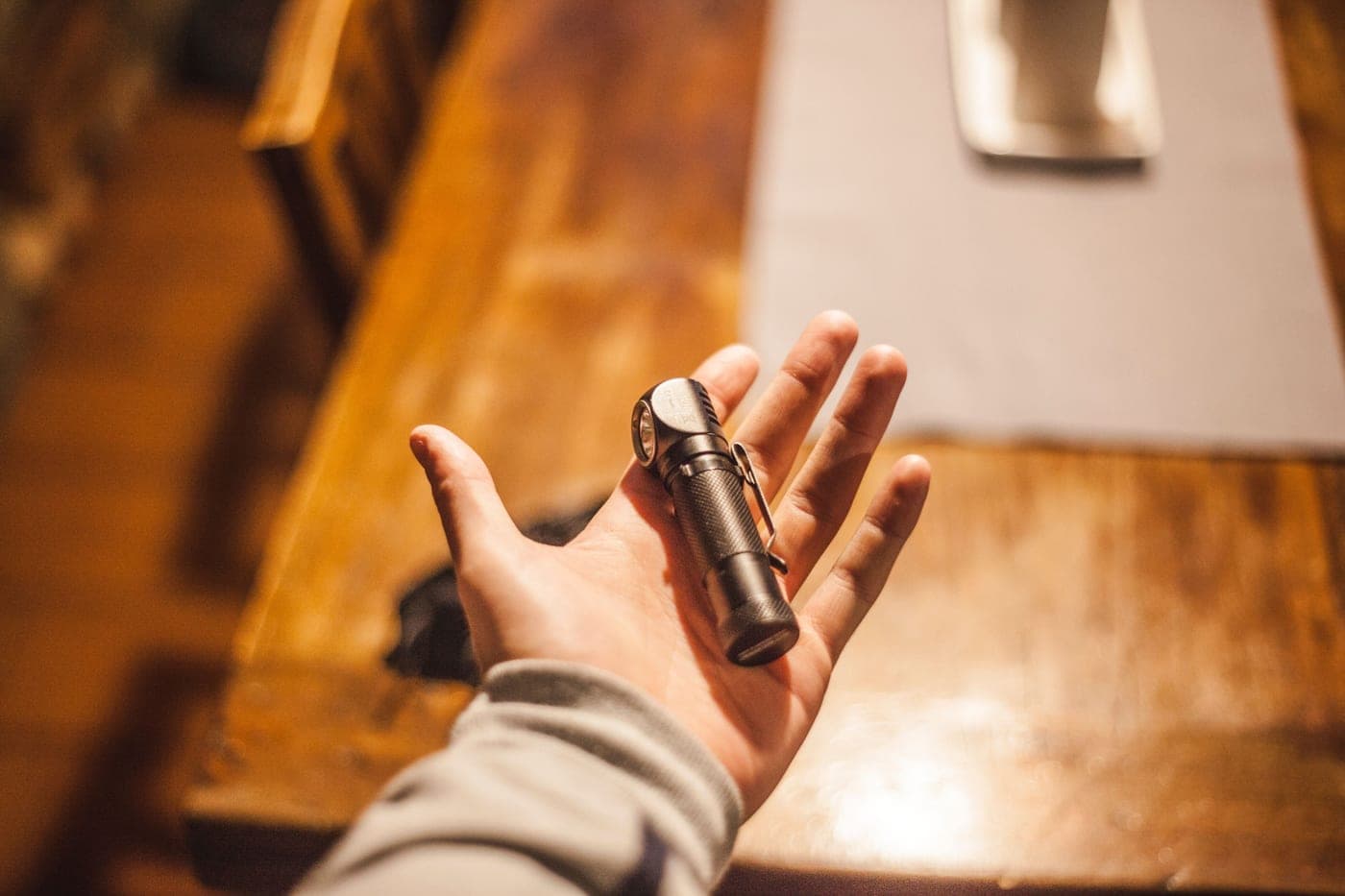
Sofirn SC31 Pro
Two thousand published lumens out of a standard 18650 you can buy anywhere for a few dollars, in a light that costs less than most brands charge for a keychain. The cell is the whole argument: when it dies in three years you replace a battery, not a flashlight.
Price as of October 18, 2026 — 47 lumens per dollar. #ad How we earn
Disclosure — we earn a commission on qualifying purchases made through the Amazon links on this page, at no extra cost to you. It does not change which lights we pick or what we say about them. The full version.
How we rank. Published ANSI FL1 output divided by the live retail price, with sealed-battery lights marked down because a light you cannot re-cell is a light with an expiry date. Units we claim to have tested: 0 — we compile manufacturers' published figures and show the arithmetic instead. How we work this out.
The short answer
Choose a flashlight on its battery architecture first, on whether a runtime is published beside the headline lumens second, and on the lumens themselves last. A light built around a standard replaceable cell — the Sofirn SC31 Pro, 2,000 lumens from an 18650 you can buy anywhere — survives its own battery; a sealed light is refuse when its cell tires. If the light will sit unused in a drawer for a year, buy one that takes AA cells instead, such as the ThruNite Archer 2A V3. Those two sentences settle most purchases.
What follows is the order in which the five specifications actually matter, which is close to the reverse of the order the packaging presents them in. Each question ends in a light that answers it, and the picks are ranked at the bottom by the only metric this site rates: published output divided by what the light costs right now.
Question 1: can you replace the battery?
This is the whole decision and it is printed in the smallest type. A flashlight built around a standard cell — an 18650, a 21700, a 14500, or plain AA cells — is a tool with a service life measured in decades. A flashlight with a sealed, built-in battery is a consumable with a service life measured in charge cycles, after which the aluminum, the emitter, the driver and the lens are all thrown away because one five-dollar part is tired.
Manufacturers describe the sealed arrangement as "integrated", "built-in" or "non-removable", and they describe it in a specification line rather than on the front of the box. Energizer states plainly that the Vision HD Rechargeable uses non-removable lithium-ion batteries. Many brands state nothing at all, and where nothing is stated we treat the cell as sealed, because a claim you cannot check is not a specification.
- Buy replaceable if you intend to own the light for more than a few years, or if it is going in an emergency kit where a flat cell is the failure mode.
- Buy AA or AAA if the light will be stored unused — alkalines hold charge for years and are sold in every shop on earth.
- Buy sealed only when size or weight is genuinely the point, as on a keychain light, and expect to replace the whole thing.
Question 2: is there a runtime printed beside the lumens?
A lumen figure on its own is a claim about one instant — usually the instant the light is switched on, before it has warmed up. The number that makes it meaningful is the runtime beside it, because every compact light steps down from its peak within minutes to protect itself from its own heat.
So the test is not how big the number is. It is whether a duration is printed next to it at all. Streamlight publishes 2,000 lumens for 2 hours on the Stinger 2020 and 500 lumens for 2 hours 45 minutes on the ProTac 2L-X. Sofirn publishes 2,000 lumens and no per-mode runtime at all. Both lights are worth owning; only one of them can be checked.
Question 3: do you need a beam that reaches, or one that fills?
Lumens measure total output; candela measures beam intensity in the direction you are pointing. Reach comes from candela, and the two can vary almost independently. A 3,000-lumen flood can easily throw less far than a 1,000-lumen thrower.
In practice: for indoor use, a garage, a car or a dog walk you want a wide, soft beam and you want fewer lumens than you think. For a yard, a field or a tree line you want published beam distance in meters. Where a brand publishes candela — Fenix publishes 36,600 cd on the PD36R Pro's turbo — you can compare reach directly rather than guessing from the lumen figure.
| # | Light | Max output | Battery | Lumens / $ | Price |
|---|---|---|---|---|---|
| 1 | Sofirn SC31 Pro Best lumens per dollar overall | 2,000 | Replaceable | 47 | $42.99 on Amazon Price as of October 18, 2026 — 47 lumens per dollar. #ad How we earn |
| 2 | 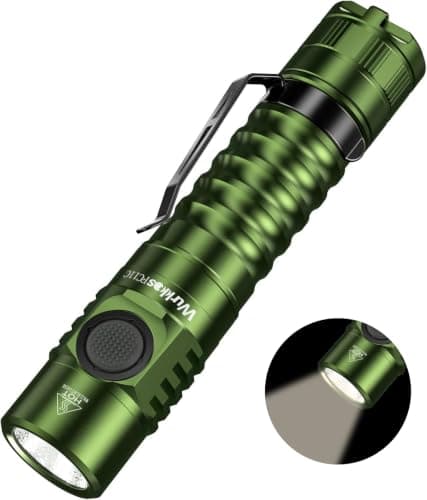 Wurkkos FC11C Highest published CRI figure here | 1,200 | Replaceable | 42 | $28.79 on Amazon Price as of October 18, 2026 — 42 lumens per dollar. #ad How we earn |
| 3 | 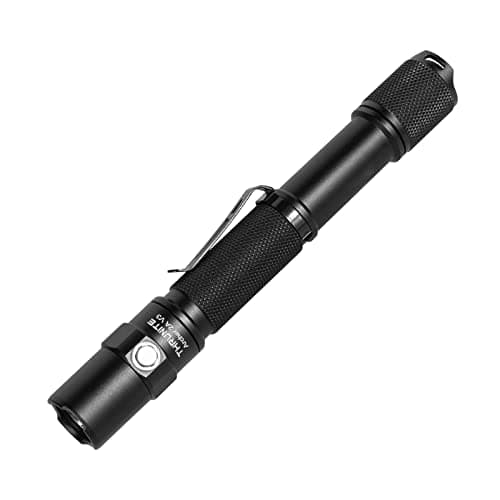 ThruNite Archer 2A V3 Best light that runs on batteries from any gas station | 500 | AA / AAA | 22 | $22.95 on Amazon Price as of October 18, 2026 — 22 lumens per dollar. #ad How we earn |
| 4 | 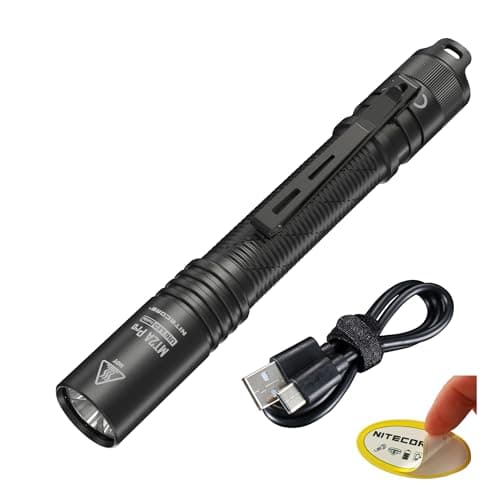 NITECORE MT2A Pro Best dual-power pocket light | 1,000 | Replaceable | 22 | $44.95 on Amazon Price as of October 18, 2026 — 22 lumens per dollar. #ad How we earn |
| 5 | 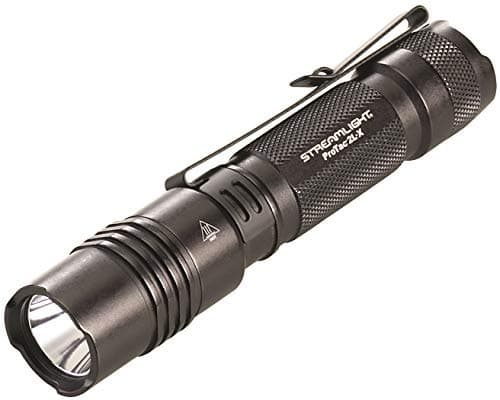 Streamlight ProTac 2L-X Best documented tactical light | 500 | Replaceable | 7 | $66.99 on Amazon Price as of October 18, 2026 — 7 lumens per dollar. #ad How we earn |
Prices pulled October 18, 2026. Lumens per dollar is the manufacturer's published maximum output divided by that price, recomputed every time the price moves.
Question 4: what is the water rating, as a number?
IPX4 means splashes from any direction. IPX7 means immersion to one meter for thirty minutes. IPX8 means deeper, to a depth the manufacturer defines. IP68 adds a dust rating to the front of it. The practical band for almost everyone is IPX7: that is the rating at which a light survives being dropped in a puddle or left in a downpour, which is the accident that actually happens.
Treat "water resistant" with no number as no rating. It is a marketing word with no test behind it, and it appears on lights that cost more than ones carrying a real IP figure.
Question 5: will the switch annoy you every single day?
This is last on the list and it is the one most likely to make you dislike an otherwise good light. Three patterns, and which one suits you is not a question of quality.
- Forward-clicky tail switch: press lightly for momentary light, click to latch. Easiest to use without looking, and the reason the ThruNite Archer 2A V3 is on this page.
- Side-mounted electronic switch: usually with a mode memory, often with a lock-out. Fine for general use, and the default on most rechargeable lights.
- Ramping firmware such as Anduril, on the Sofirn and Wurkkos lights: infinitely adjustable, genuinely confusing for the first week, and wonderful afterwards if you like that sort of thing.
If somebody else will use the light — an older relative, a teenager, a glovebox shared with a partner — pick the first pattern and stop reading here. Our page on lights for seniors goes into why one switch beats five modes.
1. Best lumens per dollar overall
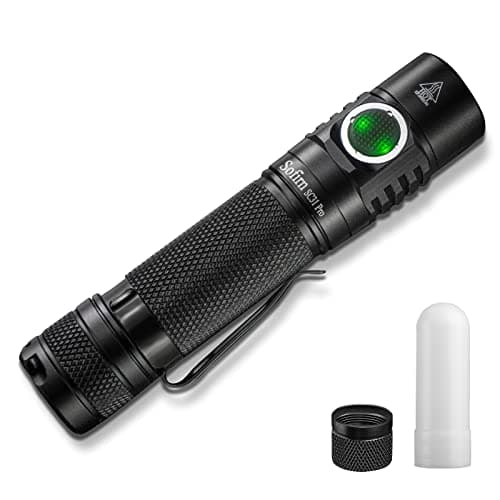
Sofirn SC31 Pro
Lumens per dollar
47
Two thousand published lumens out of a standard 18650 you can buy anywhere for a few dollars, in a light that costs less than most brands charge for a keychain. The cell is the whole argument: when it dies in three years you replace a battery, not a flashlight.
- Max output
- 2,000 lm
- Runtime
- Not published per mode
- Battery
- Replaceable cell
- Water rating
- IPX8
What it gets right
- Standard 18650 cell — replacements cost a few dollars and are sold everywhere
- IPX8, the strongest water rating in this price class
- USB-C charging built into the light, so no separate charger to lose
- Anduril firmware gives real ramping control rather than four fixed steps
What it gets wrong
- Sofirn publishes no per-mode runtime figures on the product page
- Anduril is genuinely confusing for the first week
- Tint varies between batches, which is the price of this price
Published specification
- Maximum output: 2,000 lumens — Sofirn published specification
- Beam distance: 226 m — Sofirn published specification
- Battery: 1 x 18650 Li-ion, user replaceable — Sofirn published specification
- Charging: USB-C, 2.5 hours with a 2A adapter — Sofirn published specification
- Water rating: IPX8 — Sofirn published specification
- Weight: 59 g without battery — Sofirn published specification
- Length: 117.5 mm — Sofirn published specification
- Emitter: SST40, 5000K or 6500K — Sofirn published specification
- Per-mode runtime: Not published on the product page
Skip this one if
you want to press one button and get one brightness. Anduril has a shortcut for everything and a menu for everything else, and if that sounds tiring you will be happier with a three-mode light.
Buy it if: anyone who intends to keep the light for longer than the battery lasts, and does not mind reading a manual once.
- Output 9.0
- Battery 9.5
- Build 8.0
- Usability 7.0
- Overall 8.6
Price as of October 18, 2026 — 47 lumens per dollar. #ad How we earn
2. Highest published CRI figure here
Wurkkos FC11C
Lumens per dollar
42
Ninety-five CRI from a Nichia 519A, in the same 18650 body as the FC11 and at the same sort of money. It gives up a hundred lumens against its own predecessor to do it, which is the trade high-CRI emitters always make and the reason it is worth understanding before you buy.
- Max output
- 1,200 lm
- Runtime
- Not published per mode
- Battery
- Replaceable cell
- Water rating
- IPX8
What it gets right
- Ninety-five CRI is the highest figure any manufacturer publishes for a light we cover
- IPX8 rather than the FC11's IPX7, in the same size body
- Standard 18650 with USB-C charging in the light
- A buck driver, which Wurkkos names on the product page rather than leaving you to guess
What it gets wrong
- Twelve hundred lumens against the FC11's thirteen hundred — high CRI costs output
- Wurkkos publishes no per-mode runtime for this model, unlike the TS10
- Anduril firmware again, with the learning curve that implies
Published specification
- Maximum output: 1,200 lumens — Wurkkos published specification
- Emitter: 1 x Nichia 519A, 95 CRI, 5000K or 4000K — Wurkkos published specification
- Beam distance: 155 m — Wurkkos published specification
- Battery: 1 x 18650 Li-ion, user replaceable — Wurkkos published specification
- Charging: USB-C, without removing the cell — Wurkkos published specification
- Water rating: IPX8 — Wurkkos published specification
- Weight: 65 g without battery — Wurkkos published specification
- Length: 116.23 mm — Wurkkos published specification
- Per-mode runtime: Not published on the product page
Skip this one if
you want maximum output per dollar. A 95-CRI emitter spends part of its budget making color correct rather than making light, and that is a poor trade if you only ever point a light down a driveway.
Buy it if: anyone whose light is used to inspect things at close range — wiring, paint, skin, a leak — where telling two similar colors apart is the actual job.
- Output 7.0
- Battery 9.5
- Build 8.0
- Usability 8.0
- Overall 8.3
Price as of October 18, 2026 — 42 lumens per dollar. #ad How we earn
3. Best light that runs on batteries from any gas station
ThruNite Archer 2A V3
Lumens per dollar
22
Five hundred lumens on two AA cells. It will never win a lumens-per-dollar contest against an 18650 light, and it does not need to: it is the light that still works when you are three days into an outage and the only thing left in the store is alkalines.
- Max output
- 500 lm
- Runtime
- Not published per mode
- Battery
- AA / AAA
- Water rating
- None published
What it gets right
- Runs on the most widely stocked battery on earth
- No lithium cell to self-discharge in a glovebox for two years
- Forward clicky switch, so you can signal without cycling modes
What it gets wrong
- AA alkalines sag hard under load; 500 lumens is a brief 500 lumens on them
- No published runtime or water rating on the product page
- Rechargeable it is not — the running cost is on you
Published specification
- Maximum output: 500 lumens, turbo — ThruNite published specification
- Battery: 2 x AA alkaline or 2 x AA NiMH (not included) — ThruNite published specification
- Modes: Five — ThruNite published specification
- Switch: Forward clicky with momentary-on — ThruNite published specification
- Protection: Reversed-polarity protection — ThruNite published specification
- Clip: Reversible, removable, titanium coated — ThruNite published specification
- Per-mode runtime: Not published on the product page
- Water rating: Not published on the product page
Skip this one if
this is your only light and you will use it daily. Feeding a daily-use light on disposable AAs is the single most expensive way to own a flashlight, which is the entire reason this site exists.
Buy it if: the glovebox, the storm kit, and the drawer you open twice a year.
- Output 6.0
- Battery 7.0
- Build 8.0
- Usability 8.5
- Overall 7.4
Price as of October 18, 2026 — 22 lumens per dollar. #ad How we earn
4. Best dual-power pocket light
NITECORE MT2A Pro
Lumens per dollar
22
A thousand lumens and 255 meters out of a penlight body that runs on its own removable 14500 or on two AA cells from any shop on earth. IP68 on top. It is the rare light that answers the shelf-life problem and the output problem in the same package.
- Max output
- 1,000 lm
- Runtime
- 20 h
- Battery
- Replaceable cell
- Water rating
- IP68
What it gets right
- Dual power: a removable 14500 for output, or two AA cells when there is no charger
- IP68 to two meters, which almost nothing at this size publishes
- Two hundred and fifty-five meters of throw from a penlight-shaped body
- The charging port is in the cell, so a spare cell charges while the light is in use
What it gets wrong
- NITECORE publishes only the maximum runtime, not a figure per mode
- On alkaline AA cells the output is far below the 1,000-lumen headline
- A penlight body is long for its diameter and rolls off a sloped surface
Published specification
- Maximum output: 1,000 lumens — NITECORE published specification
- Peak beam intensity: 16,500 cd — NITECORE published specification
- Beam distance: 255 m — NITECORE published specification
- Battery: 2 x AA, or 1 x NL1416R 14500 Li-ion with USB-C charging in the cell — NITECORE published specification
- Water rating: IP68, submersible to 2 m — NITECORE published specification
- Impact: 1 m — NITECORE published specification
- Weight: 40 g (1.41 oz) without battery — NITECORE published specification
- Length: 142.8 mm — NITECORE published specification
- Modes: Three brightness levels, single tail switch — NITECORE published specification
- Maximum runtime: 20 hours at 50 lumens — NITECORE published specification
- Per-mode runtime: Not published on the product page
Skip this one if
you want the smallest possible pocket light. At 142.8 mm this is a long, thin light rather than a short one, and that shape suits a shirt pocket better than a jeans pocket.
Buy it if: anyone who wants one light for both daily use and the drawer, and refuses to be stopped by a flat cell.
- Output 8.0
- Battery 9.5
- Build 9.0
- Usability 8.0
- Overall 8.6
Price as of October 18, 2026 — 22 lumens per dollar. #ad How we earn
5. Best documented tactical light
Streamlight ProTac 2L-X
Lumens per dollar
7
Five hundred lumens with the runtime published for both battery types, 165 meters of throw, IPX7 and a 2-meter impact rating. Streamlight publishes what most brands leave out, and the numbers hold up when you divide them.
- Max output
- 500 lm
- Runtime
- 2 h 45 min (CR123A) / 3 h 15 min (SL-B26)
- Battery
- Replaceable cell
- Water rating
- IPX7
What it gets right
- Runtime published for every mode and both battery chemistries
- IPX7 plus a stated 2 m impact test, not a vague claim of toughness
- Runs on CR123A primaries when the rechargeable pack is flat
What it gets wrong
- Five hundred lumens is modest for the money in raw terms
- CR123A cells are expensive if you run it on primaries
- No high-CRI option
Published specification
- High: 500 lumens, 165 m, 2.75 h on CR123A / 3.25 h on SL-B26 — Streamlight published specification
- Low: 40 lumens, 49 m, 30 hours on either battery — Streamlight published specification
- Strobe: Up to 3.25 h (CR123A) / 4.5 h (SL-B26) — Streamlight published specification
- Battery: 2 x CR123A or the SL-B26 rechargeable pack — Streamlight published specification
- Water rating: IPX7, 1 m for 30 minutes — Streamlight published specification
- Impact: 2 m tested — Streamlight published specification
- Weight: 3.9 oz with CR123A / 4.4 oz with SL-B26 — Streamlight published specification
Skip this one if
you want the biggest number per dollar. Streamlight charges for documentation, warranty and consistency, and none of those show up in a lumens-per-dollar column.
Buy it if: someone whose light has to work every time and who would rather have a small honest number than a large unverifiable one.
- Output 6.5
- Battery 8.5
- Build 9.0
- Usability 8.5
- Overall 8.1
Price as of October 18, 2026 — 7 lumens per dollar. #ad How we earn
How we ranked these
Published output divided by live price, with battery architecture weighted hardest because it is what makes a cheap light expensive over any timeframe longer than the warranty. The five picks are not a best-of list; each one is the answer to one of the questions above, and the ranking between them is arithmetic rather than opinion.
Units we claim to have tested: 0
Every publisher in this category says they tested twenty flashlights. We have not tested any, and we say so. What we do instead: compile the manufacturer's own published ANSI FL1 figures, pull the price the light is selling for right now, and divide one by the other. Every number on this page is one you can check yourself in about two minutes.
What a flashlight should cost
| Budget | What it reliably buys | What it does not |
|---|---|---|
| Under $20 | A usable AA light, or a sealed keychain light | A replaceable lithium cell with a published runtime |
| $20 - $50 | 1,000 - 2,000 lumens, a replaceable 18650, USB-C, IPX7 or better | Published per-mode runtimes from most budget brands |
| $50 - $100 | A documented light from a mainstream brand, with impact and IP ratings | Meaningfully more usable light than the tier below |
| Over $100 | A complete specification, including candela, and a long warranty | Better value; this tier buys certainty, not lumens |
The steepest part of that curve is between twenty and fifty dollars, and it is where almost every light this site ranks first happens to sit. Above a hundred dollars you are buying documentation, warranty and finish rather than light, which is a legitimate purchase and a different one.
The four things a spec sheet will never tell you
Everything above is checkable before you buy. These four are not, and they are the most common reasons people end up disliking a light that scored well on paper.
- Tint. Two lights with identical lumen figures can throw visibly different colors of white — one blue-green, one creamy — and budget brands vary between production batches of the same model. No manufacturer publishes a tint tolerance. A published CRI figure is the closest proxy, and it is not the same thing.
- Switch feel. Travel, resistance and whether the click is positive are decided in the first week of ownership and appear in no specification. This is the single most common reason a good light ends up in a drawer.
- Thermal behavior. Every manufacturer publishes a maximum output; almost none publishes the output it sustains after five minutes. Two lights rated 2,000 lumens can settle at very different levels, and only independent bench measurement would reveal it.
- What happens when it breaks. Warranty length is published; how a company actually handles a claim, in your country, two years in, is not. This is most of what you are buying at the top of the market and none of it is on the box.
The practical response is not to despair of the specification — it is to use the specification to narrow the field to three lights, and then to accept that the choice between those three is a matter of taste, reputation and return policy. That is also why we weight a brand that publishes thoroughly: it correlates with the parts you cannot check, even though it does not prove them.
One light or several?
Most people shopping for a flashlight are actually shopping for two or three, and buying one expensive light instead is the usual mistake. A light in a drawer upstairs is not available in a basement, and the cost of a second decent light is lower than the cost of most single upgrades within a tier.
The arrangement that works: one small light you carry, one larger light where the work happens — a garage, a car, a toolbox — and one light that never moves and never needs charging, ideally on AA cells, kept wherever you would look during a power cut. Those three jobs have different right answers, which is why this site is organized by job rather than by price.
What we cannot tell you
We have not handled these lights. We cannot tell you how a switch feels, how consistent a brand's anodizing is between batches, how any of these perform after two years in a toolbox, or how a tint reads in person. Every specification quoted here is the manufacturer's own, read on the date given in the sources. The ordering of the five questions is our judgment, and it is the part of this page you should argue with if you disagree.
Common questions
How do I choose a flashlight?
Ask five questions in this order. Can the battery be replaced? Is a runtime printed beside the headline lumen figure? Do you need reach (candela) or a wide beam? What is the water rating, as a number rather than a word? And will the switch suit you daily? Battery architecture matters most, because a sealed light is refuse when its cell tires, and the peak lumen figure matters least.
What should I look for in a flashlight?
A standard replaceable cell, a published runtime beside the output figure, a numbered IP rating of at least IPX4 and preferably IPX7, and a switch you can operate without reading a manual. Beam distance in meters matters if you need to see any distance. Anything advertising four or five figures of lumens with no runtime printed anywhere is best avoided.
How many lumens should a flashlight have?
For walking, a fuse box or a dropped key, 100 to 300 lumens is plenty and runs far longer. For a garage, yard or campsite, 500 to 1,000 is comfortable. Above about 2,000 lumens you are buying a burst rather than a mode, because a handheld light cannot shed that much heat continuously.
Is a more expensive flashlight better?
Better documented and better finished, usually; brighter per dollar, no. The steepest part of the value curve runs from about twenty to fifty dollars, where a replaceable 18650, USB-C charging and a real IP rating all become available. Above a hundred dollars you are mostly buying a complete specification and a warranty, which is worth it to some buyers and not to others.
Can you replace the battery in a rechargeable flashlight?
It depends entirely on the model, and it is the single most consequential thing to check before buying. Lights built around a standard cell — an 18650, a 21700, a 14500, a 16340 — take a screw-off tailcap and a five-dollar replacement. Lights with a built-in cell, which manufacturers describe as 'integrated' or 'non-removable', cannot be re-celled by an ordinary owner: when the battery reaches the end of its cycle life the whole light is refuse. Energizer, for example, states plainly that the Vision HD Rechargeable uses non-removable lithium-ion batteries.
Sources
- Sofirn published product specifications — read 2026-09-01
- ThruNite published product specifications — read 2026-09-01
- Wurkkos published product specifications and user manuals — FC11 and TS10 read 2026-09-01; FC11C read 2026-09-21
- NITECORE published product specifications — NU25 MCT UL read 2026-09-01; MT2A Pro read 2026-09-13; EDC31 read 2026-10-03; MH25 Pro and Tiki LE read 2026-10-10
- Streamlight published product specifications — per-mode lumens, runtime, beam distance, impact and IP ratings, read 2026-09-01; Waypoint 400 and Waypoint C-cell read 2026-09-22; FlipMate read 2026-10-18
- Fenix published product specifications — read 2026-09-01; PD36R Pro product page read 2026-10-18
- Energizer published product specifications — read 2026-09-01
- Lumen & Ledger method — how every figure on this page is derived
Who writes this
Scooter M. — I am an enthusiast who is genuinely into this. I read the manuals, compile the published specs, and do the math. No lab coat, no test bench, no drawer of free samples. What I can tell you is exactly what a light claims on paper, exactly what it costs right now, and what those two numbers mean when you divide one by the other.
Read next
18650 vs 21700
Two cell sizes, two philosophies, and which one your next light should take.
The 10,000-lumen problem
Why the biggest number on the box is the one you can use for the shortest time.
IP and IPX ratings explained
What IPX4, IPX7 and IP68 mean, and why a missing rating is information too.
Best flashlights for seniors
One switch, a grip you can hold, and a light that is never flat when it is needed.
The best rechargeable flashlights for the money
The flagship ranking: every pick scored on output over price, with the arithmetic shown.
The Ledger
Every light we cover in one ranked table, sorted by lumens per dollar.