Flashlights
Best Rechargeable Flashlights for Home Use
The light in your kitchen drawer will be picked up by someone who did not choose it, in the dark, in a hurry. That single fact disqualifies most of the lights we rank highest.
By Scooter M. · Published September 13, 2026
Short answer
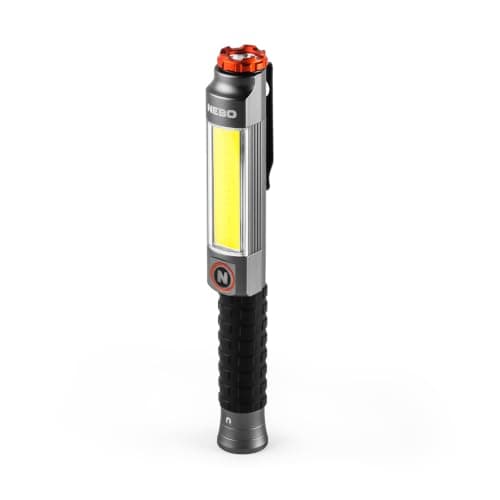
NEBO BIG LARRY 3
A 600-lumen COB panel, a 220-lumen spot and a red task mode, on three AA cells, with a magnet strong enough to hold it under a hood. It is the least glamorous light here and it is the one that gets used most.
Price as of September 14, 2026 — 39 lumens per dollar. #ad How we earn
Disclosure — we earn a commission on qualifying purchases made through the Amazon links on this page, at no extra cost to you. It does not change which lights we pick or what we say about them. The full version.
How we rank. Published ANSI FL1 output divided by the live retail price, with sealed-battery lights marked down because a light you cannot re-cell is a light with an expiry date. Units we claim to have tested: 0 — we compile manufacturers' published figures and show the arithmetic instead. How we work this out.
The household test our favorite lights fail
A house light is judged on whether somebody who did not buy it can use it in the dark on the first try. That means one button, an obvious brightness order, no strobe on the way to low, and a power source that is not flat after six months in a drawer. Those requirements disqualify most of the enthusiast lights at the top of our value rankings, and we would rather say so than recommend a light that will annoy your household.
This is a different page from our emergency lighting ranking, which is about the outage kit — the lantern on the shelf, the AA stockpile, the light beside the fuse box. This one is about the ordinary light that lives in a kitchen drawer and gets used forty times a year for forty seconds: finding a dropped earring, checking a breaker, looking behind the dryer, seeing what the dog ate.
Criterion one: anyone can work it in the dark
The lights this site ranks highest on value almost all run Anduril, an open-source firmware with ramping, mode groups and a configuration menu. For somebody who likes flashlights it is excellent. For a partner, a houseguest or a teenager who grabbed it in a hurry it is a light that does something unexpected and gets put back.
So the specification here is interface rather than output. A forward clicky switch — light pressure for momentary light, press through for constant on — is the easiest thing in the category to use without instruction, and ThruNite fits one to the Archer 2A V3. A simple three-level cycle is the next best. A light that passes through strobe on the way to anything is the one to avoid, because in a genuinely dark house a strobe is disorienting rather than useful.
Criterion two: it must not be flat
The most common household flashlight failure is not darkness or breakage. It is reaching for a light you charged eight months ago and finding nothing. Lithium cells self-discharge slowly and age on the calendar whether used or not, and a drawer light is by definition rarely used.
There are two good answers. A light that runs on ordinary AA cells is never really flat, because the cells sit for years and the replacements are in the same drawer — that is why the ThruNite and the NEBO BIG LARRY 3 rank where they do despite neither being a value leader. Or a dual-power light like NITECORE's MT2A Pro, which takes its own rechargeable cell for daily use and two AA cells when that is dead. Our page on whether rechargeable lights are worth it works this trade through in detail.
| # | Light | Max output | Battery | Lumens / $ | Price |
|---|---|---|---|---|---|
| 1 | NEBO BIG LARRY 3 Best cheap magnetic work light | 600 | AA / AAA | 39 | $15.50 on Amazon Price as of September 14, 2026 — 39 lumens per dollar. #ad How we earn |
| 2 | 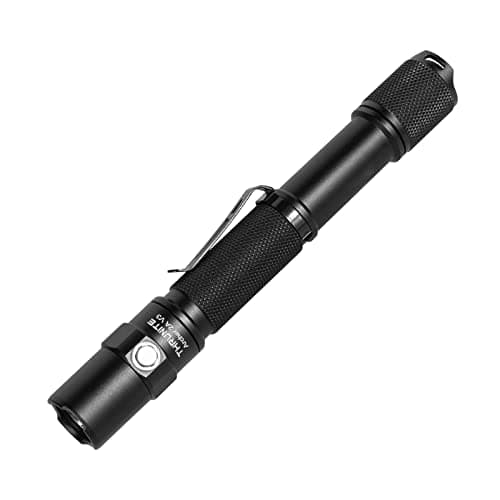 ThruNite Archer 2A V3 Best light that runs on batteries from any gas station | 500 | AA / AAA | 22 | $22.95 on Amazon Price as of September 14, 2026 — 22 lumens per dollar. #ad How we earn |
| 3 | 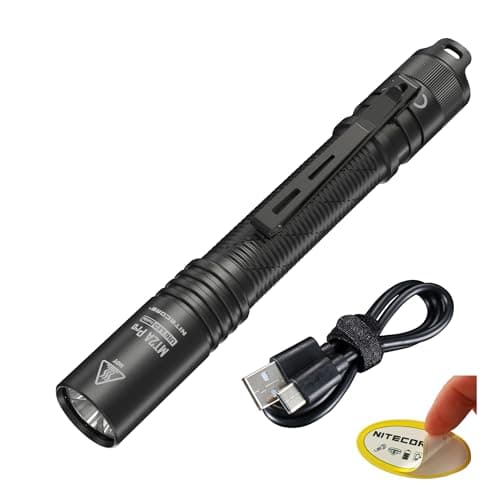 NITECORE MT2A Pro Best dual-power pocket light | 1,000 | Replaceable | 22 | $44.95 on Amazon Price as of September 14, 2026 — 22 lumens per dollar. #ad How we earn |
| 4 | 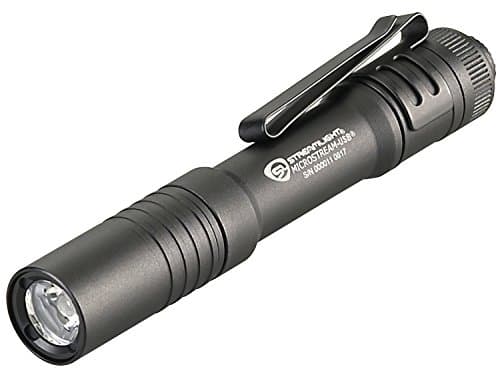 Streamlight MicroStream USB Best pen-clip light with published runtimes | 250 | Sealed | 7 | $37.81 on Amazon Price as of September 14, 2026 — 7 lumens per dollar. #ad How we earn |
| 5 | 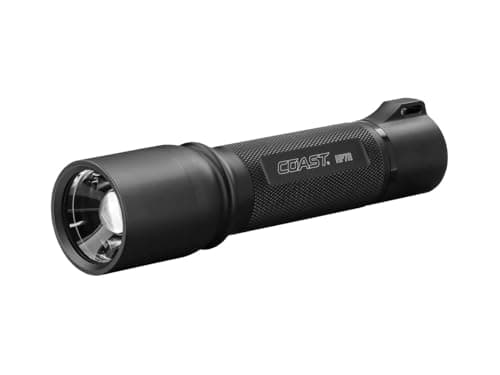 COAST HP7R Longest published runtime in this roundup | 300 | Replaceable | 3 | $90.49 on Amazon Price as of September 14, 2026 — 3 lumens per dollar. #ad How we earn |
Prices pulled September 14, 2026. Lumens per dollar is the manufacturer's published maximum output divided by that price, recomputed every time the price moves.
Criterion three: enough light, and not more
Indoors, a very bright light is actively worse. Two thousand lumens in a hallway reflects off pale walls straight back into your eyes, contracts your pupils and leaves everything outside the beam looking black — and if somebody else is asleep in the house you have just lit the whole landing.
One hundred to three hundred lumens covers essentially every household job, and a usable low mode under about 20 lumens is what you want at 3 a.m. Streamlight publishes 250 lumens for an hour and a half and 50 lumens for three and a half hours on the MicroStream; NITECORE publishes 20 hours at 50 lumens on the MT2A Pro. Our guide to how many lumens you actually need has a table by task, and every household row is lower than people expect.
The charging decision that keeps a drawer light alive
A rechargeable household light has one recurring failure and it is not the hardware. Nobody charges it, because nothing prompts them to, and the next time it is needed it is flat. The households that avoid this do one of two things, and both are decisions rather than purchases.
Either the light lives on a charger permanently — a cradle or a magnetic dock in the place it is stored, so putting it away and charging it are the same action — or the light runs on ordinary cells and the charging problem is deleted. What does not work is a light in a drawer and a cable in another room, which is the arrangement most people end up with by default.
If you do go rechargeable, store it part-charged rather than full and top it up on a calendar reminder twice a year. A lithium cell held at 100 percent for months ages faster than one stored part-full, and a cell left completely flat can drop below the voltage its protection circuit will recover from. Our page on charging a rechargeable flashlight covers both failure modes properly.
Criterion four: it has to be findable
A light you cannot locate in the dark is not a light. This is the argument for a magnetic body: NEBO's BIG LARRY 3 has a magnet strong enough to hold it on a steel surface, plus a belt clip and a wall-mount hole, which means it can live in one known place rather than migrating to the bottom of a drawer.
The unglamorous version of the same advice costs nothing: pick one spot, tell the household, and put the light back there. A mid-priced light in a known place beats an excellent one you have to hunt for, and most households are better served by two cheap lights in two known places than by one good light somewhere.
1. Best cheap magnetic work light
NEBO BIG LARRY 3
Lumens per dollar
39
A 600-lumen COB panel, a 220-lumen spot and a red task mode, on three AA cells, with a magnet strong enough to hold it under a hood. It is the least glamorous light here and it is the one that gets used most.
- Max output
- 600 lm
- Runtime
- Not published per mode
- Battery
- AA / AAA
- Water rating
- None published
What it gets right
- A flood panel is the right shape of light for working on something close up
- AA cells, so it survives a year in a toolbox and still lights
- The magnet is strong enough to matter
What it gets wrong
- NEBO publishes no runtime and no water rating for this model
- COB panels have poor color rendering as a class
- Not rechargeable, so the running cost is AA cells
Published specification
- COB work light: 600 lumens high / 150 lumens low — NEBO published specification
- Spot flashlight: 220 lumens high / 60 lumens low — NEBO published specification
- Red task light: 40 lumens high / 12 lumens low — NEBO published specification
- Battery: 3 x AA (included) — NEBO published specification
- Weight: 0.42 lb — NEBO published specification
- Fittings: Magnetic base, steel belt clip, wall-mount hole — NEBO published specification
- Per-mode runtime: Not published on the product page
- Water rating: Not published on the product page
Skip this one if
you need to see color accurately. For paint matching or diagnosing a wiring loom, a high-CRI light is worth the extra money.
Buy it if: the toolbox, the trunk and the shelf above the workbench.
- Output 6.5
- Battery 7.0
- Build 7.5
- Usability 8.5
- Overall 7.3
Price as of September 14, 2026 — 39 lumens per dollar. #ad How we earn
2. Best light that runs on batteries from any gas station
ThruNite Archer 2A V3
Lumens per dollar
22
Five hundred lumens on two AA cells. It will never win a lumens-per-dollar contest against an 18650 light, and it does not need to: it is the light that still works when you are three days into an outage and the only thing left in the store is alkalines.
- Max output
- 500 lm
- Runtime
- Not published per mode
- Battery
- AA / AAA
- Water rating
- None published
What it gets right
- Runs on the most widely stocked battery on earth
- No lithium cell to self-discharge in a glovebox for two years
- Forward clicky switch, so you can signal without cycling modes
What it gets wrong
- AA alkalines sag hard under load; 500 lumens is a brief 500 lumens on them
- No published runtime or water rating on the product page
- Rechargeable it is not — the running cost is on you
Published specification
- Maximum output: 500 lumens, turbo — ThruNite published specification
- Battery: 2 x AA alkaline or 2 x AA NiMH (not included) — ThruNite published specification
- Modes: Five — ThruNite published specification
- Switch: Forward clicky with momentary-on — ThruNite published specification
- Protection: Reversed-polarity protection — ThruNite published specification
- Clip: Reversible, removable, titanium coated — ThruNite published specification
- Per-mode runtime: Not published on the product page
- Water rating: Not published on the product page
Skip this one if
this is your only light and you will use it daily. Feeding a daily-use light on disposable AAs is the single most expensive way to own a flashlight, which is the entire reason this site exists.
Buy it if: the glovebox, the storm kit, and the drawer you open twice a year.
- Output 6.0
- Battery 7.0
- Build 8.0
- Usability 8.5
- Overall 7.4
Price as of September 14, 2026 — 22 lumens per dollar. #ad How we earn
3. Best dual-power pocket light
NITECORE MT2A Pro
Lumens per dollar
22
A thousand lumens and 255 meters out of a penlight body that runs on its own removable 14500 or on two AA cells from any shop on earth. IP68 on top. It is the rare light that answers the shelf-life problem and the output problem in the same package.
- Max output
- 1,000 lm
- Runtime
- 20 h
- Battery
- Replaceable cell
- Water rating
- IP68
What it gets right
- Dual power: a removable 14500 for output, or two AA cells when there is no charger
- IP68 to two meters, which almost nothing at this size publishes
- Two hundred and fifty-five meters of throw from a penlight-shaped body
- The charging port is in the cell, so a spare cell charges while the light is in use
What it gets wrong
- NITECORE publishes only the maximum runtime, not a figure per mode
- On alkaline AA cells the output is far below the 1,000-lumen headline
- A penlight body is long for its diameter and rolls off a sloped surface
Published specification
- Maximum output: 1,000 lumens — NITECORE published specification
- Peak beam intensity: 16,500 cd — NITECORE published specification
- Beam distance: 255 m — NITECORE published specification
- Battery: 2 x AA, or 1 x NL1416R 14500 Li-ion with USB-C charging in the cell — NITECORE published specification
- Water rating: IP68, submersible to 2 m — NITECORE published specification
- Impact: 1 m — NITECORE published specification
- Weight: 40 g (1.41 oz) without battery — NITECORE published specification
- Length: 142.8 mm — NITECORE published specification
- Modes: Three brightness levels, single tail switch — NITECORE published specification
- Maximum runtime: 20 hours at 50 lumens — NITECORE published specification
- Per-mode runtime: Not published on the product page
Skip this one if
you want the smallest possible pocket light. At 142.8 mm this is a long, thin light rather than a short one, and that shape suits a shirt pocket better than a jeans pocket.
Buy it if: anyone who wants one light for both daily use and the drawer, and refuses to be stopped by a flat cell.
- Output 8.0
- Battery 9.5
- Build 9.0
- Usability 8.0
- Overall 8.6
Price as of September 14, 2026 — 22 lumens per dollar. #ad How we earn
4. Best pen-clip light with published runtimes
Streamlight MicroStream USB
Lumens per dollar
7
Two hundred and fifty lumens for an hour and a half, fifty for three and a half, at 1.2 ounces. The battery is sealed, which caps its lifespan, but every other number on the sheet is published and checkable.
- Max output
- 250 lm
- Runtime
- 1 h 30 min
- Battery
- Sealed
- Water rating
- IPX4
What it gets right
- Every mode's runtime is published, which is why it scores well here despite modest output
- Deep pocket clip that actually holds in a shirt pocket
- 1.2 ounces — it is easy to forget you have it
What it gets wrong
- The cell is sealed in; when it fails the light is finished
- IPX4 splash rating only
- 250 lumens is not enough to light a yard
Published specification
- High: 250 lumens, 68 m, 1.5 hours — Streamlight published specification
- Low: 50 lumens, 31 m, 3.5 hours — Streamlight published specification
- Battery: Lithium-ion, charges in-product in 4 hours — Streamlight published specification
- Water rating: IPX4 — Streamlight published specification
- Impact: 1 m tested — Streamlight published specification
- Weight: 1.2 oz (34.1 g) — Streamlight published specification
- Length: 3.87 in (9.83 cm) — Streamlight published specification
Skip this one if
you want a light you can re-cell. For a keychain-sized light with a replaceable battery, look at the Sofirn SC21 Pro instead.
Buy it if: a shirt pocket, a scrubs pocket, or anyone who wants a light without a bulge.
- Output 5.5
- Battery 4.5
- Build 8.5
- Usability 9.0
- Overall 7.2
Price as of September 14, 2026 — 7 lumens per dollar. #ad How we earn
5. Longest published runtime in this roundup
COAST HP7R
Lumens per dollar
3
Three hundred lumens, a 352-meter beam and up to 33 hours of runtime on a removable ZITHION-X pack. It is the opposite of a turbo-number light: modest output, enormous endurance, and a cell you can replace.
- Max output
- 300 lm
- Runtime
- Up to 33 h
- Battery
- Replaceable cell
- Water rating
- None published
What it gets right
- Thirty-three hours of published runtime, which almost nothing else here approaches
- Removable battery pack sold as a separate part
- 352 m of throw from only 300 lumens — good optics beat brute force
What it gets wrong
- Three hundred lumens will disappoint anyone shopping by the big number
- COAST does not publish a water rating on this product page
- Its lumens-per-dollar figure will always look poor next to an 18650 light
Published specification
- Maximum output: 300 lumens — COAST published specification
- Beam distance: 352 m — COAST published specification
- Runtime: Up to 33 hours — COAST published specification
- Battery: ZX800 ZITHION-X, 2,400 mAh 3.7V, removable — COAST published specification
- Focus: Pure Beam focusing optic — COAST published specification
- Water rating: Not published on the product page
Skip this one if
you are ranking purely on lumens per dollar. This light loses that contest and wins the runtime one, and which of those matters is a question about you, not the light.
Buy it if: long shifts, night walks and anyone who would rather have light for a day than light for an hour.
- Output 5.5
- Battery 8.5
- Build 8.0
- Usability 8.0
- Overall 7.5
Price as of September 14, 2026 — 3 lumens per dollar. #ad How we earn
One good light, or three cheap ones?
For a household the answer is almost always more lights rather than a better one, and it is worth saying because it is the opposite of how this site usually reasons. A single excellent light is in exactly one place, and the place you need a light is wherever you are when something happens.
The practical test is how often you have gone looking for the flashlight. If the answer is most times you needed it, the problem is coverage rather than quality, and the fix is two more modest lights in the two places you keep walking to — not an upgrade. Three lights of the sort on this page cost less than one premium handheld, and our page on whether expensive flashlights are worth it works that trade through properly.
The household has to be able to use it
There is a category of household light failure that has nothing to do with the hardware: nobody else knows how it works, so nobody else uses it, and it is flat or missing when you need it. A light bought by an enthusiast and left in a shared drawer is frequently the least-used object in the house.
Two minutes fixes it. Show whoever else lives there how to turn it on and where it lives, and pick a light whose mode order is obvious enough that the demonstration sticks. If the light needs a paragraph of explanation, it is the wrong light for a shared drawer however well it scores in our rankings — which is the whole argument of this page, restated as a household test rather than a specification.
Where to put them
- Kitchen drawer. The one that gets used most. Simple switch, moderate output, ordinary cells.
- By the electrical panel. Usually a basement or a garage, usually damp, usually the worst light in the house. A magnetic body that sticks beside the panel earns its place here.
- A bedroom, if anyone would need to move around at night. Low mode matters far more than maximum.
- The car. Different problem entirely — heat, cold and two years of neglect — and our car kit ranking covers it separately.
The second light nobody buys until they need it
Almost every household discovers the same gap at the same moment: the power goes out, and the one good flashlight is upstairs in the dark, at the top of the stairs you now have to climb. A household light plan has to survive its own failure mode, which means at least one light on each floor rather than one excellent light somewhere.
That is also why this page ranks affordable lights highly and makes no apology for it. Three modest lights in three known places beat one premium light by a wide margin for this use, because coverage is the specification and brightness is not. Our emergency lighting ranking extends the same logic to lanterns and the outage kit specifically.
How we ranked these
The four scored attributes published on our methodology page — output against live price, battery architecture, build as evidenced by published ratings, and usability — with usability weighted hardest and read specifically as whether an untrained person can operate the light in the dark. That is a deliberate inversion of our value rankings, and it is why lights that top the Ledger do not top this page. Battery architecture is also read as readiness rather than running cost: a cell that is charged when you reach for it beats one that is cheaper per hour.
Units we claim to have tested: 0
Every publisher in this category says they tested twenty flashlights. We have not tested any, and we say so. What we do instead: compile the manufacturer's own published ANSI FL1 figures, pull the price the light is selling for right now, and divide one by the other. Every number on this page is one you can check yourself in about two minutes.
What we cannot tell you
We have not lived with any of these lights. We cannot tell you how a given switch feels to somebody with arthritis, how obvious each mode order is to a person using the light for the first time, how strong the NEBO magnet is in practice, or how any of them sound when dropped on a tile floor. The argument above is from published specifications and from how interfaces are designed rather than from a year in a kitchen drawer, and the interface point in particular is worth testing in your own hand before you commit the household to it. If you can, hand the light to somebody else in the house and watch them try to turn it on without being told how.
Common questions
What is the best flashlight to keep in the house?
One that anybody can work in the dark on the first try. That means a simple switch, no strobe on the way to low, moderate output around 100 to 300 lumens, and a power source that will not be flat after months unused — either ordinary AA cells or a dual-power light like the NITECORE MT2A Pro that accepts them as a fallback. The enthusiast lights that top our value rankings mostly run Anduril firmware and make poor household lights for exactly that reason.
How many lumens should a household flashlight have?
Between 100 and 300 lumens covers every ordinary job indoors, and a usable low mode under about 20 lumens is what you want at night. Anything much brighter reflects off pale walls back into your eyes and makes everything outside the beam look black. Buy for a comfortable low mode and a long runtime there rather than for the number on the box.
Should a house flashlight be rechargeable or battery powered?
For a light used often, rechargeable. For a light that lives in a drawer and is used a few times a year, ordinary AA cells are more dependable, because lithium cells self-discharge and age on the shelf while alkalines sit for years. The best answer for a household is a dual-power light that takes its own rechargeable cell normally and AA cells when that is dead, which removes the failure entirely.
Can you replace the battery in a rechargeable flashlight?
It depends entirely on the model, and it is the single most consequential thing to check before buying. Lights built around a standard cell — an 18650, a 21700, a 14500, a 16340 — take a screw-off tailcap and a five-dollar replacement. Lights with a built-in cell, which manufacturers describe as 'integrated' or 'non-removable', cannot be re-celled by an ordinary owner: when the battery reaches the end of its cycle life the whole light is refuse. Energizer, for example, states plainly that the Vision HD Rechargeable uses non-removable lithium-ion batteries.
Sources
- ThruNite published product specifications — read 2026-09-01
- NITECORE published product specifications — NU25 MCT UL read 2026-09-01; MT2A Pro read 2026-09-13
- NEBO published product specifications — mode-by-mode lumen, runtime and beam figures, read 2026-09-01
- Streamlight published product specifications — per-mode lumens, runtime, beam distance, impact and IP ratings, read 2026-09-01
- COAST published product specifications — read 2026-09-01
- Lumen & Ledger method — how every figure on this page is derived
Who writes this
Scooter M. — I am an enthusiast who is genuinely into this. I read the manuals, compile the published specs, and do the math. No lab coat, no test bench, no drawer of free samples. What I can tell you is exactly what a light claims on paper, exactly what it costs right now, and what those two numbers mean when you divide one by the other.
Read next
Best emergency lights for home
How many lights a house actually needs, and where each one should live.
Best flashlights for walking at night
The one job where less output is better, and why a headlamp may be the right answer.
Rechargeable vs battery flashlights
Five dimensions, one table, and a verdict that depends on where the light lives.
Best flashlights for power outages
The outage specification is shelf life, not brightness. That changes the answer.
How many lumens do you actually need?
A table by use case. Most people need far fewer than the box is selling them.
The Ledger
Every light we cover in one ranked table, sorted by lumens per dollar.