Flashlights
Best Rechargeable Flashlights Under $30
The floor at which a replaceable battery, a real water rating and USB-C can still coexist. Below this the compromises start being ones you notice.
By Scooter M. · Published September 2, 2026
Short answer
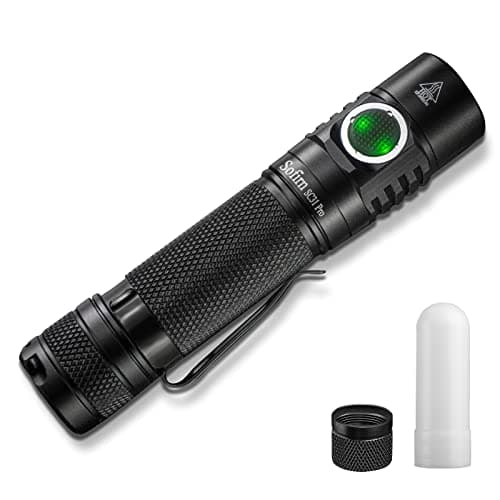
Sofirn SC31 Pro
Two thousand published lumens out of a standard 18650 you can buy anywhere for a few dollars, in a light that costs less than most brands charge for a keychain. The cell is the whole argument: when it dies in three years you replace a battery, not a flashlight.
Price as of October 18, 2026 — 47 lumens per dollar. #ad How we earn
Disclosure — we earn a commission on qualifying purchases made through the Amazon links on this page, at no extra cost to you. It does not change which lights we pick or what we say about them. The full version.
How we rank. Published ANSI FL1 output divided by the live retail price, with sealed-battery lights marked down because a light you cannot re-cell is a light with an expiry date. Units we claim to have tested: 0 — we compile manufacturers' published figures and show the arithmetic instead. How we work this out.
Thirty dollars, and what it still buys
At thirty dollars you can still get a standard 18650 cell, USB-C charging in the light, and a published IPX8 rating — the Sofirn SC31 Pro has all three and publishes 2,000 lumens. What you give up at this price is per-mode runtime figures, batch-to-batch consistency, and any warranty worth invoking.
This is the price point where the enthusiast brands genuinely outclass the mainstream ones, and it is worth understanding why. A brand like Sofirn or Wurkkos sells direct, in relatively small volumes, to people who read spec sheets. It cannot afford a retail markup or a marketing department, so its money goes into the emitter and the cell. A brand on a shelf in a large store is paying for the shelf.
| # | Light | Max output | Battery | Lumens / $ | Price |
|---|---|---|---|---|---|
| 1 | Sofirn SC31 Pro Best lumens per dollar overall | 2,000 | Replaceable | 47 | $42.99 on Amazon Price as of October 18, 2026 — 47 lumens per dollar. #ad How we earn |
| 2 | 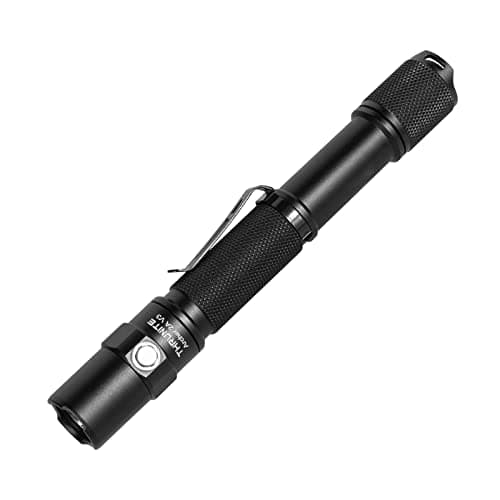 ThruNite Archer 2A V3 Best light that runs on batteries from any gas station | 500 | AA / AAA | 22 | $22.95 on Amazon Price as of October 18, 2026 — 22 lumens per dollar. #ad How we earn |
| 3 | No listing image Wurkkos FC11 Best color quality per dollar | 1,300 | Replaceable | Needs a live price | Check price on Amazon We show a price only when we have pulled a live one. #ad How we earn |
| 4 | No listing image Sofirn SC21 Pro Best keychain light with a replaceable cell | 1,100 | Replaceable | Needs a live price | Check price on Amazon We show a price only when we have pulled a live one. #ad How we earn |
| 5 | No listing image NEBO SLIM Mini 500 Best pocket task light for a toolbag | 500 | Sealed | Needs a live price | Check price on Amazon We show a price only when we have pulled a live one. #ad How we earn |
Prices pulled October 18, 2026. Lumens per dollar is the manufacturer's published maximum output divided by that price, recomputed every time the price moves.
The trap at this price: the sealed cell
The most common way a thirty-dollar light disappoints is not brightness. It is that in three years it stops holding charge and there is nothing to be done. NEBO's SLIM Mini 500, which is a genuinely good pocket task light, runs on a 450 mAh cell that is built in. Energizer states outright that the Vision HD uses non-removable lithium-ion batteries. Neither company is hiding it; both put it in the specification. Most buyers do not read that far.
This is worth a moment of arithmetic. A sealed thirty-dollar light replaced every three years is ten dollars a year, forever. A thirty-dollar light with an 18650 needs a five-dollar cell every few years, and the light itself may outlast your interest in flashlights. Over a decade the difference is roughly the price of a very good light.
1. Best lumens per dollar overall
Sofirn SC31 Pro
Lumens per dollar
47
Two thousand published lumens out of a standard 18650 you can buy anywhere for a few dollars, in a light that costs less than most brands charge for a keychain. The cell is the whole argument: when it dies in three years you replace a battery, not a flashlight.
- Max output
- 2,000 lm
- Runtime
- Not published per mode
- Battery
- Replaceable cell
- Water rating
- IPX8
What it gets right
- Standard 18650 cell — replacements cost a few dollars and are sold everywhere
- IPX8, the strongest water rating in this price class
- USB-C charging built into the light, so no separate charger to lose
- Anduril firmware gives real ramping control rather than four fixed steps
What it gets wrong
- Sofirn publishes no per-mode runtime figures on the product page
- Anduril is genuinely confusing for the first week
- Tint varies between batches, which is the price of this price
Published specification
- Maximum output: 2,000 lumens — Sofirn published specification
- Beam distance: 226 m — Sofirn published specification
- Battery: 1 x 18650 Li-ion, user replaceable — Sofirn published specification
- Charging: USB-C, 2.5 hours with a 2A adapter — Sofirn published specification
- Water rating: IPX8 — Sofirn published specification
- Weight: 59 g without battery — Sofirn published specification
- Length: 117.5 mm — Sofirn published specification
- Emitter: SST40, 5000K or 6500K — Sofirn published specification
- Per-mode runtime: Not published on the product page
Skip this one if
you want to press one button and get one brightness. Anduril has a shortcut for everything and a menu for everything else, and if that sounds tiring you will be happier with a three-mode light.
Buy it if: anyone who intends to keep the light for longer than the battery lasts, and does not mind reading a manual once.
- Output 9.0
- Battery 9.5
- Build 8.0
- Usability 7.0
- Overall 8.6
Price as of October 18, 2026 — 47 lumens per dollar. #ad How we earn
2. Best light that runs on batteries from any gas station
ThruNite Archer 2A V3
Lumens per dollar
22
Five hundred lumens on two AA cells. It will never win a lumens-per-dollar contest against an 18650 light, and it does not need to: it is the light that still works when you are three days into an outage and the only thing left in the store is alkalines.
- Max output
- 500 lm
- Runtime
- Not published per mode
- Battery
- AA / AAA
- Water rating
- None published
What it gets right
- Runs on the most widely stocked battery on earth
- No lithium cell to self-discharge in a glovebox for two years
- Forward clicky switch, so you can signal without cycling modes
What it gets wrong
- AA alkalines sag hard under load; 500 lumens is a brief 500 lumens on them
- No published runtime or water rating on the product page
- Rechargeable it is not — the running cost is on you
Published specification
- Maximum output: 500 lumens, turbo — ThruNite published specification
- Battery: 2 x AA alkaline or 2 x AA NiMH (not included) — ThruNite published specification
- Modes: Five — ThruNite published specification
- Switch: Forward clicky with momentary-on — ThruNite published specification
- Protection: Reversed-polarity protection — ThruNite published specification
- Clip: Reversible, removable, titanium coated — ThruNite published specification
- Per-mode runtime: Not published on the product page
- Water rating: Not published on the product page
Skip this one if
this is your only light and you will use it daily. Feeding a daily-use light on disposable AAs is the single most expensive way to own a flashlight, which is the entire reason this site exists.
Buy it if: the glovebox, the storm kit, and the drawer you open twice a year.
- Output 6.0
- Battery 7.0
- Build 8.0
- Usability 8.5
- Overall 7.4
Price as of October 18, 2026 — 22 lumens per dollar. #ad How we earn
listing
image
3. Best color quality per dollar
Wurkkos FC11
Lumens per dollar
Computed the moment we have a live price for it
A 90-CRI emitter at a price where nobody else bothers, which means colors look like colors rather than like a parking lot. Same replaceable 18650 story as the Sofirn, plus a magnetic tail that turns it into a work light.
- Max output
- 1,300 lm
- Runtime
- Not published per mode
- Battery
- Replaceable cell
- Water rating
- IPX7
What it gets right
- 90 CRI at a price where 70 CRI is normal — skin, wiring and paint read correctly
- Magnetic tailcap sticks it to anything ferrous and frees both hands
- Standard 18650, USB-C charging in the light
- Two mode groups, so you can pick a simple ramp or a stepped set
What it gets wrong
- IPX7 rather than IPX8 — fine for rain, not for a river
- High CRI costs raw lumens; the Sofirn is visibly brighter on turbo
- No per-mode runtime published on the product page
Published specification
- Maximum output: 1,300 lumens — Wurkkos published specification
- Beam distance: 144 m (157 yd) — Wurkkos published specification
- Battery: 1 x 18650 Li-ion, user replaceable — Wurkkos published specification
- Water rating: IPX7 — Wurkkos published specification
- Weight: 65 g +/- 1 g without battery — Wurkkos published specification
- Length: 116.23 mm — Wurkkos published specification
- Emitter: Nichia 519A / LH351D, 90 CRI — Wurkkos published specification
- Body: 6061 aluminum, type III hard anodized — Wurkkos published specification
Skip this one if
the only number you care about is peak output. You are paying part of this light's budget for color accuracy, and if you will never notice that, the money is better spent elsewhere.
Buy it if: anyone who uses a flashlight to look at things closely — wiring, paint, engine bays, a face — rather than to light up a field.
- Output 7.5
- Battery 9.5
- Build 8.0
- Usability 8.0
- Overall 8.4
We show a price only when we have pulled a live one. #ad How we earn
listing
image
4. Best keychain light with a replaceable cell
Sofirn SC21 Pro
Lumens per dollar
Computed the moment we have a live price for it
Eleven hundred lumens from a keyring-sized body with a 16340 you can actually swap. Almost every rival at this size seals the battery in, which turns the light into a two-year consumable.
- Max output
- 1,100 lm
- Runtime
- Not published per mode
- Battery
- Replaceable cell
- Water rating
- None published
What it gets right
- A replaceable cell in a keychain-sized light, which is genuinely rare
- Magnetic tail, so it doubles as a hands-free task light
- USB-C in the light rather than a proprietary dock
What it gets wrong
- Sofirn publishes neither runtime nor a water rating for this model
- 1,100 lumens out of a 16340 is a very short-lived 1,100 lumens
- Anduril on a light this small means a lot of clicking
Published specification
- Maximum output: 1,100 lumens — Sofirn published specification
- Beam distance: 131 m — Sofirn published specification
- Battery: 1 x 16340 Li-ion, included and replaceable — Sofirn published specification
- Charging: USB-C into the light — Sofirn published specification
- Fittings: Magnetic tailcap and pocket clip — Sofirn published specification
- Water rating: Not published on the product page
- Per-mode runtime: Not published on the product page
Skip this one if
you want a published IP rating. Sofirn does not state one for this model, and we are not going to guess on your behalf.
Buy it if: someone who wants keychain size without accepting a disposable battery.
- Output 7.5
- Battery 8.5
- Build 7.0
- Usability 7.0
- Overall 7.8
We show a price only when we have pulled a live one. #ad How we earn
listing
image
5. Best pocket task light for a toolbag
NEBO SLIM Mini 500
Lumens per dollar
Computed the moment we have a live price for it
The most honest spec sheet in this whole roundup, and not in the way NEBO intended: turbo is 500 lumens for thirty seconds. High is 250 lumens for two hours. That thirty-second figure is printed by the manufacturer, and it is the clearest illustration of the whole turbo problem you will find.
- Max output
- 500 lm
- Runtime
- 30 seconds at turbo; 2 h at 250 lm high
- Battery
- Sealed
- Water rating
- IPX4
What it gets right
- Genuinely flat — it disappears into a work-pants pocket
- Magnetic base plus green and red modes for inspection work
- NEBO states the turbo duration outright, which is rare and creditable
What it gets wrong
- Turbo lasts half a minute; treat 250 lumens as the real specification
- 450 mAh sealed cell, so this is a light with a service life rather than a lifespan
- IPX4 is splash resistance and nothing more
Published specification
- Turbo: 500 lumens for 30 seconds, 100 m — NEBO published specification
- High: 250 lumens, 2 hours, 250 m — NEBO published specification
- Low: 50 lumens, 5 hours, 50 m — NEBO published specification
- Battery: 450 mAh 3.7V (1.66 Wh) Li-ion, built in — NEBO published specification
- Recharge time: 2 hours, USB-C — NEBO published specification
- Water rating: IPX4 — NEBO published specification
- Weight: 0.07 lb — NEBO published specification
Skip this one if
you want a light for walking outdoors. This is a task light for arm's-length work and it does not throw usefully far in practice.
Buy it if: electricians, mechanics and anyone whose light spends its life eighteen inches from the thing it is lighting.
- Output 6.0
- Battery 4.5
- Build 7.5
- Usability 8.5
- Overall 6.8
We show a price only when we have pulled a live one. #ad How we earn
How we ranked these
Same four attributes as everywhere on this site: output over live price, battery architecture, build as evidenced by published ratings, and usability. At this price the battery score does most of the sorting, because it is the only attribute whose consequences compound.
Units we claim to have tested: 0
Every publisher in this category says they tested twenty flashlights. We have not tested any, and we say so. What we do instead: compile the manufacturer's own published ANSI FL1 figures, pull the price the light is selling for right now, and divide one by the other. Every number on this page is one you can check yourself in about two minutes.
One light on this page you should probably not buy
The ThruNite Archer 2A V3 runs on two AA cells and will never win a value contest against an 18650 light. If you buy it as your daily light and feed it disposable alkalines, it becomes the most expensive light in this roundup within about a year. We include it because it is the correct answer to a different question — the glovebox, the storm kit, the drawer you open twice a year — and because being clear about which question a light answers is more useful than pretending one light wins everything.
What to look for in a listing at this price
- A named cell size in the specification — 18650, 21700, 14500 or 16340. If the listing only says 'built-in rechargeable battery', that is the answer to the question you were about to ask.
- A published IP or IPX rating. 'Water resistant' with no figure is a sentence, not a specification.
- A runtime figure somewhere on the page. A brand that publishes runtime for even one mode is a brand that expects to be checked.
- USB-C rather than micro-USB. In 2026 a micro-USB port on a new light means the design is several years old.
- A beam distance in meters. If output is quoted and distance is not, the optics may be doing very little.
Common questions
Are cheap rechargeable flashlights any good?
Many are, and for a specific reason: the LED emitters, drivers and 18650 cells that budget brands buy are the same commodity parts the expensive brands buy. What you give up at the low end is documentation, quality control between batches, and a warranty worth using. The way to shop it is to look for a brand that publishes runtime figures — a manufacturer willing to print how long the turbo mode lasts is telling you something about the rest of the specification.
What is the brightest flashlight under $30?
Among the lights we cover with published figures, the Sofirn SC31 Pro's 2,000 lumens is the highest at this price — but treat any sub-$30 turbo claim as a peak rather than a mode. Very few small lights can shed the heat that comes with two thousand lumens, and most step down within minutes. The number that tells you what a light really does is the runtime beside its output, and at this price that number is usually missing.
Can you replace the battery in a rechargeable flashlight?
It depends entirely on the model, and it is the single most consequential thing to check before buying. Lights built around a standard cell — an 18650, a 21700, a 14500, a 16340 — take a screw-off tailcap and a five-dollar replacement. Lights with a built-in cell, which manufacturers describe as 'integrated' or 'non-removable', cannot be re-celled by an ordinary owner: when the battery reaches the end of its cycle life the whole light is refuse. Energizer, for example, states plainly that the Vision HD Rechargeable uses non-removable lithium-ion batteries.
Is it worth spending more than $30?
Only for specific things. Beyond thirty dollars you buy published per-mode runtimes, better water and impact ratings, higher color rendering, and a warranty that can actually be used. You do not buy meaningfully more light: a $30 Sofirn and a $150 Streamlight both publish 2,000 lumens. Decide which of those things you need before you decide on a budget.
Sources
- Sofirn published product specifications — read 2026-09-01
- Wurkkos published product specifications and user manuals — FC11 and TS10 read 2026-09-01; FC11C read 2026-09-21
- NEBO published product specifications — mode-by-mode lumen, runtime and beam figures, read 2026-09-01; LUXTREME SL75 and SL50 read 2026-09-22; OMNI 2K and SLYDE KING 4K read 2026-10-18
- Energizer published product specifications — read 2026-09-01
- ThruNite published product specifications — read 2026-09-01
- Lumen & Ledger method — how every figure on this page is derived
Who writes this
Scooter M. — I am an enthusiast who is genuinely into this. I read the manuals, compile the published specs, and do the math. No lab coat, no test bench, no drawer of free samples. What I can tell you is exactly what a light claims on paper, exactly what it costs right now, and what those two numbers mean when you divide one by the other.
Read next
Best cheap flashlights under $20
What twenty dollars actually buys, and the two categories where it buys plenty.
Best rechargeable flashlights under $50
Where the value curve is steepest, and the three things $50 should buy you.
Best EDC flashlights under $30
Thirty dollars is where the replaceable cell survives and the published runtime does not.
Are cheap flashlights any good?
Increasingly yes, for a specific reason, with three failure modes to watch.
The Ledger
Every light we cover in one ranked table, sorted by lumens per dollar.
Rechargeable flashlights on Amazon
Why the listings look the way they do, and how to read one without being misled.