Flashlights
Best Rechargeable Flashlights Under $50
Fifty dollars is where the value curve is steepest. Below it things start dropping off the spec sheet; above it you mostly buy paperwork.
By Scooter M. · Published September 2, 2026
Short answer
Sofirn SC31 Pro
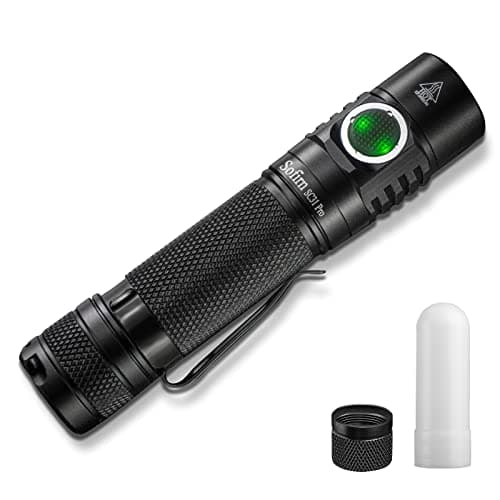
Two thousand published lumens out of a standard 18650 you can buy anywhere for a few dollars, in a light that costs less than most brands charge for a keychain. The cell is the whole argument: when it dies in three years you replace a battery, not a flashlight.
Price as of October 18, 2026 — 47 lumens per dollar. #ad How we earn
Disclosure — we earn a commission on qualifying purchases made through the Amazon links on this page, at no extra cost to you. It does not change which lights we pick or what we say about them. The full version.
How we rank. Published ANSI FL1 output divided by the live retail price, with sealed-battery lights marked down because a light you cannot re-cell is a light with an expiry date. Units we claim to have tested: 0 — we compile manufacturers' published figures and show the arithmetic instead. How we work this out.
The three things fifty dollars should buy
Under fifty dollars, insist on three things: a standard replaceable cell (18650, 21700, 14500 or 16340), a published IP water rating, and USB-C charging built into the light. All three are available at this price. A light missing any of them is asking you to pay full price for a partial specification.
This is the band where the category is genuinely good, and it is good for an unglamorous reason. The emitter, the driver and the lithium cell in a thirty-dollar light are commodity parts bought from the same suppliers that sell to the expensive brands. What separates a thirty-dollar light from a hundred-and-fifty-dollar one is not the LED. It is the testing, the tolerances between units, the documentation and the warranty.
| # | Light | Max output | Battery | Lumens / $ | Price |
|---|---|---|---|---|---|
| 1 | Sofirn SC31 Pro Best lumens per dollar overall | 2,000 | Replaceable | 47 | $42.99 on Amazon Price as of October 18, 2026 — 47 lumens per dollar. #ad How we earn |
| 2 | 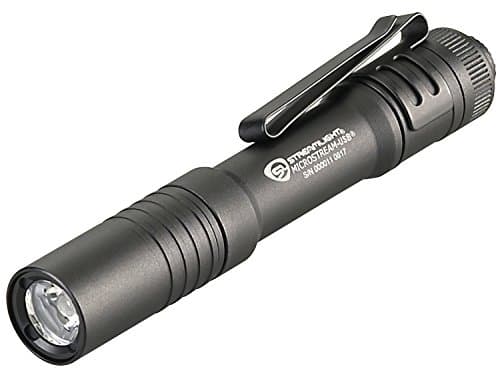 Streamlight MicroStream USB Best pen-clip light with published runtimes | 250 | Sealed | 7 | $37.81 on Amazon Price as of October 18, 2026 — 7 lumens per dollar. #ad How we earn |
| 3 | No listing image Wurkkos FC11 Best color quality per dollar | 1,300 | Replaceable | Needs a live price | Check price on Amazon We show a price only when we have pulled a live one. #ad How we earn |
| 4 | No listing image Wurkkos TS10 V2 Best pocket light under two ounces | 1,400 | Replaceable | Needs a live price | Check price on Amazon We show a price only when we have pulled a live one. #ad How we earn |
| 5 | No listing image Sofirn SC21 Pro Best keychain light with a replaceable cell | 1,100 | Replaceable | Needs a live price | Check price on Amazon We show a price only when we have pulled a live one. #ad How we earn |
Prices pulled October 18, 2026. Lumens per dollar is the manufacturer's published maximum output divided by that price, recomputed every time the price moves.
What starts disappearing as the price falls
| Price falls below | What usually goes first | Why it matters |
|---|---|---|
| $50 | Nothing yet — this is the sweet spot | Replaceable cell, IP rating and USB-C are all normal here |
| $30 | Published per-mode runtime | You can no longer check what turbo actually costs you |
| $20 | The replaceable cell | The light becomes a consumable with a two-to-three-year life |
| $15 | The published water rating | You are guessing about rain, and so is the seller |
| $10 | Meaningful thermal management | Turbo becomes a burst measured in seconds, undocumented |
The pattern is consistent enough to shop by. If a light under fifty dollars is missing something from the top of that list, the saving is not coming from efficiency — it is coming from something you would have wanted.
1. Best lumens per dollar overall
Sofirn SC31 Pro
Lumens per dollar
47
Two thousand published lumens out of a standard 18650 you can buy anywhere for a few dollars, in a light that costs less than most brands charge for a keychain. The cell is the whole argument: when it dies in three years you replace a battery, not a flashlight.
- Max output
- 2,000 lm
- Runtime
- Not published per mode
- Battery
- Replaceable cell
- Water rating
- IPX8
What it gets right
- Standard 18650 cell — replacements cost a few dollars and are sold everywhere
- IPX8, the strongest water rating in this price class
- USB-C charging built into the light, so no separate charger to lose
- Anduril firmware gives real ramping control rather than four fixed steps
What it gets wrong
- Sofirn publishes no per-mode runtime figures on the product page
- Anduril is genuinely confusing for the first week
- Tint varies between batches, which is the price of this price
Published specification
- Maximum output: 2,000 lumens — Sofirn published specification
- Beam distance: 226 m — Sofirn published specification
- Battery: 1 x 18650 Li-ion, user replaceable — Sofirn published specification
- Charging: USB-C, 2.5 hours with a 2A adapter — Sofirn published specification
- Water rating: IPX8 — Sofirn published specification
- Weight: 59 g without battery — Sofirn published specification
- Length: 117.5 mm — Sofirn published specification
- Emitter: SST40, 5000K or 6500K — Sofirn published specification
- Per-mode runtime: Not published on the product page
Skip this one if
you want to press one button and get one brightness. Anduril has a shortcut for everything and a menu for everything else, and if that sounds tiring you will be happier with a three-mode light.
Buy it if: anyone who intends to keep the light for longer than the battery lasts, and does not mind reading a manual once.
- Output 9.0
- Battery 9.5
- Build 8.0
- Usability 7.0
- Overall 8.6
Price as of October 18, 2026 — 47 lumens per dollar. #ad How we earn
2. Best pen-clip light with published runtimes
Streamlight MicroStream USB
Lumens per dollar
7
Two hundred and fifty lumens for an hour and a half, fifty for three and a half, at 1.2 ounces. The battery is sealed, which caps its lifespan, but every other number on the sheet is published and checkable.
- Max output
- 250 lm
- Runtime
- 1 h 30 min
- Battery
- Sealed
- Water rating
- IPX4
What it gets right
- Every mode's runtime is published, which is why it scores well here despite modest output
- Deep pocket clip that actually holds in a shirt pocket
- 1.2 ounces — it is easy to forget you have it
What it gets wrong
- The cell is sealed in; when it fails the light is finished
- IPX4 splash rating only
- 250 lumens is not enough to light a yard
Published specification
- High: 250 lumens, 68 m, 1.5 hours — Streamlight published specification
- Low: 50 lumens, 31 m, 3.5 hours — Streamlight published specification
- Battery: Lithium-ion, charges in-product in 4 hours — Streamlight published specification
- Water rating: IPX4 — Streamlight published specification
- Impact: 1 m tested — Streamlight published specification
- Weight: 1.2 oz (34.1 g) — Streamlight published specification
- Length: 3.87 in (9.83 cm) — Streamlight published specification
Skip this one if
you want a light you can re-cell. For a keychain-sized light with a replaceable battery, look at the Sofirn SC21 Pro instead.
Buy it if: a shirt pocket, a scrubs pocket, or anyone who wants a light without a bulge.
- Output 5.5
- Battery 4.5
- Build 8.5
- Usability 9.0
- Overall 7.2
Price as of October 18, 2026 — 7 lumens per dollar. #ad How we earn
listing
image
3. Best color quality per dollar
Wurkkos FC11
Lumens per dollar
Computed the moment we have a live price for it
A 90-CRI emitter at a price where nobody else bothers, which means colors look like colors rather than like a parking lot. Same replaceable 18650 story as the Sofirn, plus a magnetic tail that turns it into a work light.
- Max output
- 1,300 lm
- Runtime
- Not published per mode
- Battery
- Replaceable cell
- Water rating
- IPX7
What it gets right
- 90 CRI at a price where 70 CRI is normal — skin, wiring and paint read correctly
- Magnetic tailcap sticks it to anything ferrous and frees both hands
- Standard 18650, USB-C charging in the light
- Two mode groups, so you can pick a simple ramp or a stepped set
What it gets wrong
- IPX7 rather than IPX8 — fine for rain, not for a river
- High CRI costs raw lumens; the Sofirn is visibly brighter on turbo
- No per-mode runtime published on the product page
Published specification
- Maximum output: 1,300 lumens — Wurkkos published specification
- Beam distance: 144 m (157 yd) — Wurkkos published specification
- Battery: 1 x 18650 Li-ion, user replaceable — Wurkkos published specification
- Water rating: IPX7 — Wurkkos published specification
- Weight: 65 g +/- 1 g without battery — Wurkkos published specification
- Length: 116.23 mm — Wurkkos published specification
- Emitter: Nichia 519A / LH351D, 90 CRI — Wurkkos published specification
- Body: 6061 aluminum, type III hard anodized — Wurkkos published specification
Skip this one if
the only number you care about is peak output. You are paying part of this light's budget for color accuracy, and if you will never notice that, the money is better spent elsewhere.
Buy it if: anyone who uses a flashlight to look at things closely — wiring, paint, engine bays, a face — rather than to light up a field.
- Output 7.5
- Battery 9.5
- Build 8.0
- Usability 8.0
- Overall 8.4
We show a price only when we have pulled a live one. #ad How we earn
listing
image
4. Best pocket light under two ounces
Wurkkos TS10 V2
Lumens per dollar
Computed the moment we have a live price for it
Thirty-two grams, three 90-CRI emitters, and one of the very few budget lights whose maker publishes the runtime at maximum output: one hour fourteen at 1,400 lumens. Publishing that number at all puts Wurkkos ahead of several brands ten times its size.
- Max output
- 1,400 lm
- Runtime
- 1 h 14 min
- Battery
- Replaceable cell
- Water rating
- IPX8
What it gets right
- Wurkkos publishes runtime at maximum output, which most brands quietly do not
- Thirty-two grams — light enough that you stop noticing it in a pocket
- Standard 14500 cell, replaceable
- Documented automatic step-down instead of an undocumented one
What it gets wrong
- A 14500 is a small cell; sustained output is not this light's job
- RGB auxiliary LEDs are a toy, and they draw from the same cell
- Anduril again, with the same learning curve
Published specification
- Maximum output: 1,400 lumens — Wurkkos published specification
- Runtime at maximum: 1 h 14 min — Wurkkos published specification
- Runtime at 1 lumen: 6 h 43 min — Wurkkos published specification
- Battery: 1 x 14500 Li-ion, user replaceable — Wurkkos published specification
- Water rating: IPX8, 2 m — Wurkkos published specification
- Weight: 32 g +/- 1 g without battery — Wurkkos published specification
- Length: 71.5 mm — Wurkkos published specification
- Thermal behavior: Automatic step-down from turbo to high — Wurkkos published specification
Skip this one if
you need something to run for an hour on high without getting hot. A light this small has nowhere to put the heat, and the step-down is not optional.
Buy it if: the person who wants a real light on them at all times and will not carry anything heavier than a pen.
- Output 8.0
- Battery 8.0
- Build 7.5
- Usability 7.5
- Overall 8.2
We show a price only when we have pulled a live one. #ad How we earn
listing
image
5. Best keychain light with a replaceable cell
Sofirn SC21 Pro
Lumens per dollar
Computed the moment we have a live price for it
Eleven hundred lumens from a keyring-sized body with a 16340 you can actually swap. Almost every rival at this size seals the battery in, which turns the light into a two-year consumable.
- Max output
- 1,100 lm
- Runtime
- Not published per mode
- Battery
- Replaceable cell
- Water rating
- None published
What it gets right
- A replaceable cell in a keychain-sized light, which is genuinely rare
- Magnetic tail, so it doubles as a hands-free task light
- USB-C in the light rather than a proprietary dock
What it gets wrong
- Sofirn publishes neither runtime nor a water rating for this model
- 1,100 lumens out of a 16340 is a very short-lived 1,100 lumens
- Anduril on a light this small means a lot of clicking
Published specification
- Maximum output: 1,100 lumens — Sofirn published specification
- Beam distance: 131 m — Sofirn published specification
- Battery: 1 x 16340 Li-ion, included and replaceable — Sofirn published specification
- Charging: USB-C into the light — Sofirn published specification
- Fittings: Magnetic tailcap and pocket clip — Sofirn published specification
- Water rating: Not published on the product page
- Per-mode runtime: Not published on the product page
Skip this one if
you want a published IP rating. Sofirn does not state one for this model, and we are not going to guess on your behalf.
Buy it if: someone who wants keychain size without accepting a disposable battery.
- Output 7.5
- Battery 8.5
- Build 7.0
- Usability 7.0
- Overall 7.8
We show a price only when we have pulled a live one. #ad How we earn
How we ranked these
Published output divided by live price, then adjusted for battery architecture, published ratings and how pleasant the light is to operate. In this price band the ranking is unusually sensitive to the cell: an 18650 light and a 16340 light can publish similar lumen figures, and the 18650 will hold its output for several times as long because it carries several times the energy.
Units we claim to have tested: 0
Every publisher in this category says they tested twenty flashlights. We have not tested any, and we say so. What we do instead: compile the manufacturer's own published ANSI FL1 figures, pull the price the light is selling for right now, and divide one by the other. Every number on this page is one you can check yourself in about two minutes.
The 18650 question, settled
Most of the lights on this page take an 18650: a cylindrical lithium cell 18mm across and 65mm long, the same format used in cordless tools and laptop packs for two decades. It is the single most available rechargeable cell in the world, it costs a few dollars, and it is the reason a thirty-dollar light can still be a working light in 2034.
The alternative you will see at this price is a smaller 14500 (the size of an AA) or 16340 (the size of a CR123A). Both are legitimate; both carry far less energy. A 14500 light putting out 1,400 lumens is doing something impressive and cannot do it for long — Wurkkos publishes one hour fourteen minutes for the TS10 at maximum, which is admirably specific and also short. Size the cell to the job.
What to spend the last ten dollars on
If you are at forty dollars and wondering where the last ten should go, the answer is almost never more lumens. It is a better emitter. A 90-CRI light shows you what color things are — wiring, paint, an engine bay, a face — and the difference is immediately obvious in a way that another five hundred lumens is not. That is the whole argument for the Wurkkos FC11 sitting where it does in this table despite publishing seven hundred fewer lumens than the Sofirn.
Common questions
Are cheap rechargeable flashlights any good?
Many are, and for a specific reason: the LED emitters, drivers and 18650 cells that budget brands buy are the same commodity parts the expensive brands buy. What you give up at the low end is documentation, quality control between batches, and a warranty worth using. The way to shop it is to look for a brand that publishes runtime figures — a manufacturer willing to print how long the turbo mode lasts is telling you something about the rest of the specification.
Is $50 enough for a good rechargeable flashlight?
It is more than enough. Fifty dollars buys a light with a standard replaceable cell, a published water rating, USB-C charging and output in the one-to-two-thousand lumen range. Above this price you are mostly buying documentation, warranty and consistency rather than performance — real things, but not brightness.
Should I buy one $50 light or two $25 lights?
Two, in most households. The most common lighting failure is not a dim light, it is no light within reach — a flashlight in the kitchen drawer does nothing for you in the basement. Two adequate lights in two places beat one excellent light in one place, and both should take the same size cell so a single spare covers both.
Can you replace the battery in a rechargeable flashlight?
It depends entirely on the model, and it is the single most consequential thing to check before buying. Lights built around a standard cell — an 18650, a 21700, a 14500, a 16340 — take a screw-off tailcap and a five-dollar replacement. Lights with a built-in cell, which manufacturers describe as 'integrated' or 'non-removable', cannot be re-celled by an ordinary owner: when the battery reaches the end of its cycle life the whole light is refuse. Energizer, for example, states plainly that the Vision HD Rechargeable uses non-removable lithium-ion batteries.
Sources
- Sofirn published product specifications — read 2026-09-01
- Wurkkos published product specifications and user manuals — FC11 and TS10 read 2026-09-01; FC11C read 2026-09-21
- Streamlight published product specifications — per-mode lumens, runtime, beam distance, impact and IP ratings, read 2026-09-01; Waypoint 400 and Waypoint C-cell read 2026-09-22; FlipMate read 2026-10-18
- Lumen & Ledger method — how every figure on this page is derived
Who writes this
Scooter M. — I am an enthusiast who is genuinely into this. I read the manuals, compile the published specs, and do the math. No lab coat, no test bench, no drawer of free samples. What I can tell you is exactly what a light claims on paper, exactly what it costs right now, and what those two numbers mean when you divide one by the other.
Read next
Best rechargeable flashlights under $30
The floor at which a replaceable cell is still possible, and what you give up below it.
The best rechargeable flashlights for the money
The flagship ranking: every pick scored on output over price, with the arithmetic shown.
Wurkkos FC11 review
Ninety CRI at a price where seventy is normal, and what those seven hundred missing lumens buy you.
Best flashlights under $100
Where you stop buying lumens and start buying documentation, sealing and spare parts.
Best budget EDC flashlights
The light you carry beats the light you own. Ranked on carryability first.
The Ledger
Every light we cover in one ranked table, sorted by lumens per dollar.