Flashlights
Fenix PD36R Pro Review: The Spec Sheet You Can Check Line by Line
Most brands publish a headline lumen figure and leave you to guess the rest. Fenix publishes lumens, runtime, reach and beam intensity for all five modes of this light — and that, not the 2,800, is what you are paying for.
By Scooter M. · Published October 18, 2026
Short answer
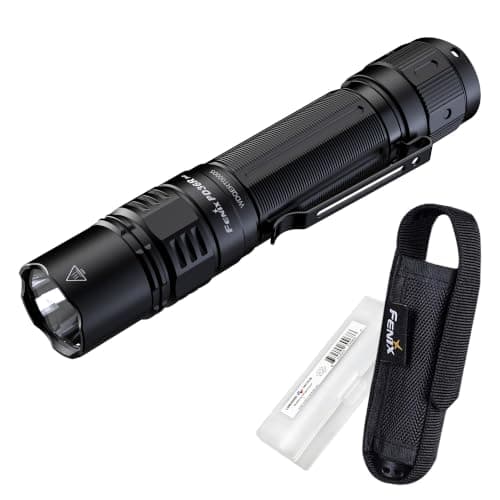
Fenix PD36R Pro
Fenix publishes lumens, runtime, beam distance AND candela for all five modes of this light — a table only four handheld spotlights on this site can match, and no other pocket light. It is not the cheapest 2,800 lumens you can buy. It is the only 2,800 lumens where you can check every claim before you spend the money.
Price as of October 18, 2026 — 23 lumens per dollar. #ad How we earn
Disclosure — we earn a commission on qualifying purchases made through the Amazon links on this page, at no extra cost to you. It does not change which lights we pick or what we say about them. The full version.
How we rank. Published ANSI FL1 output divided by the live retail price, with sealed-battery lights marked down because a light you cannot re-cell is a light with an expiry date. Units we claim to have tested: 0 — we compile manufacturers' published figures and show the arithmetic instead. How we work this out.
The verdict
Buy the Fenix PD36R Pro if you want to know exactly what a light does before you own it. It is the only pocket-sized light we cover that publishes lumens, runtime, beam distance AND candela for every one of its modes: 2,800 lumens for 3 hours 30 minutes at 380 meters and 36,600 candela on turbo, down to 30 lumens for 42 hours on Eco. It takes a removable 5,000 mAh 21700 cell, it is IP68, and it costs three to four times what the budget lights on this site cost. If you will never read a candela figure, that premium buys you nothing and a Sofirn SC31 Pro is the better purchase.
That is an unusual way to recommend a flashlight, so it is worth being precise about why. This site exists because the category sells a single number — the lumen count on the front of the box — and then declines to print the three numbers that decide whether the first one means anything. The PD36R Pro is the counterexample. Everything below is what happens when a manufacturer prints all four.
What Fenix actually publishes
Here is the whole mode table, exactly as Fenix gives it in the PD36R Pro reference manual. Read across any row: the output, how long it lasts, how far it reaches, and how intense the beam is at its center.
| Mode | Output | Runtime | Beam distance | Peak intensity |
|---|---|---|---|---|
| Turbo | 2,800 lm | 3 h 30 min | 380 m | 36,600 cd |
| High | 1,000 lm | 3 h 55 min | 225 m | 12,800 cd |
| Medium | 350 lm | 8 h 15 min | 130 m | 4,300 cd |
| Low | 150 lm | 19 hours | 90 m | 1,900 cd |
| Eco | 30 lm | 42 hours | 40 m | 400 cd |
| Strobe | 2,500 lm | Not published | Not published | Not published |
Four complete columns across five modes. For comparison: of the forty-nine lights in our registry, thirteen publish a candela figure of any kind, and only five publish one for every mode — this light and four handheld spotlights, where throw is the entire purpose of the product. Among pocket-sized lights the PD36R Pro is alone, and several of the best-selling lights we cover publish no runtime whatsoever at their headline output.
Why the candela column is the one that matters
Lumens measure the total light leaving the head. Candela measures how intense the beam is in the direction you point it, and that is what sets how far you can see. The two are not interchangeable and the ratio between them is a design decision, not a quality ranking.
Watch what happens down the PD36R Pro's own table. Turbo is 2,800 lumens and reaches 380 meters. High is 1,000 lumens — just over a third of the output — and still reaches 225 meters, nearly sixty percent of the distance. The relationship is a square root: to double your reach you need roughly four times the intensity. Which means High is the mode to use for almost everything, because it gives up two-fifths of the distance in exchange for a runtime you can plan an evening around.
| # | Light | Max output | Battery | Lumens / $ | Price |
|---|---|---|---|---|---|
| 1 | Fenix PD36R Pro The most completely documented light on this site | 2,800 | Replaceable | 23 | $120.45 on Amazon Price as of October 18, 2026 — 23 lumens per dollar. #ad How we earn |
| 2 | 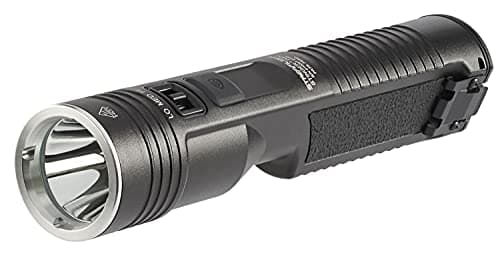 Streamlight Stinger 2020 Highest output with a published runtime to match | 2,000 | Replaceable | 16 | $127.92 on Amazon Price as of October 18, 2026 — 16 lumens per dollar. #ad How we earn |
| 3 | 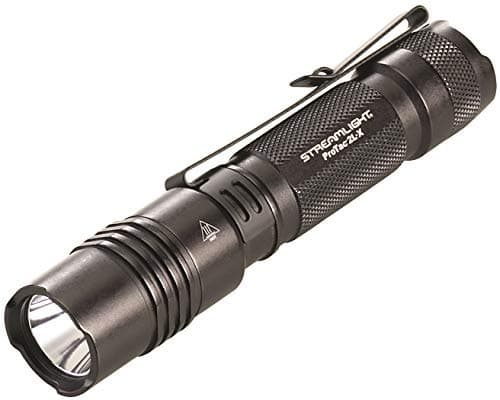 Streamlight ProTac 2L-X Best documented tactical light | 500 | Replaceable | 7 | $66.99 on Amazon Price as of October 18, 2026 — 7 lumens per dollar. #ad How we earn |
Prices pulled October 18, 2026. Lumens per dollar is the manufacturer's published maximum output divided by that price, recomputed every time the price moves.
The asterisk on the turbo runtime, which Fenix prints and most buyers will misread
Fenix states that the 3 hour 30 minute turbo figure is "a total of runtime including output at reduced levels due to temperature or protection mechanism in the design." In plain terms: the light does not hold 2,800 lumens for three and a half hours. It produces 2,800 lumens, heats up, steps down to a level it can sustain, and the published figure counts the whole period until the cell is empty.
Every compact aluminum light behaves this way — an object this size physically cannot shed the heat of 2,800 lumens continuously. The difference here is that Fenix says so in writing. Most manufacturers publish the same kind of composite figure and say nothing, which is how a buyer ends up believing a pocket light holds four figures of output for hours. Treat turbo as a burst you reach for, and treat High at 1,000 lumens for 3 hours 55 minutes as the real specification of the light.
It is worth noticing that High runs only twenty-five minutes longer than turbo. That is not a mistake in the table: on turbo the light spends most of its time stepped down anyway, so the two modes converge on a similar average draw. The honest reading is that this is a four-hour light at any output you would actually use.
1. The most completely documented light on this site
Fenix PD36R Pro
Lumens per dollar
23
Fenix publishes lumens, runtime, beam distance AND candela for all five modes of this light — a table only four handheld spotlights on this site can match, and no other pocket light. It is not the cheapest 2,800 lumens you can buy. It is the only 2,800 lumens where you can check every claim before you spend the money.
- Max output
- 2,800 lm
- Runtime
- 3 h 30 min
- Battery
- Replaceable cell
- Water rating
- IP68
What it gets right
- Candela published for every mode — the figure that decides throw, and almost nobody prints it
- A runtime beside every lumen figure, including the 42-hour Eco mode
- Removable 21700 cell, so the light outlives its battery
- IP68 and a stated 1-meter impact rating, both numbered rather than described
What it gets wrong
- Three to four times the price of the budget 2,000-lumen lights this site usually ranks first
- The 3 h 30 min turbo figure is a total that includes the reduced output after thermal step-down, which Fenix says plainly and most buyers will still misread
- No runtime published for the 2,500-lumen strobe
- The ARB-L21-5000 is a protected button-top cell; flat-top 21700s may not make contact
Published specification
- Turbo: 2,800 lumens, 3 h 30 min, 380 m, 36,600 cd — Fenix published specification
- High: 1,000 lumens, 3 h 55 min, 225 m, 12,800 cd — Fenix published specification
- Medium: 350 lumens, 8 h 15 min, 130 m, 4,300 cd — Fenix published specification
- Low: 150 lumens, 19 hours, 90 m, 1,900 cd — Fenix published specification
- Eco: 30 lumens, 42 hours, 40 m, 400 cd — Fenix published specification
- Strobe: 2,500 lumens; no runtime published — Fenix published specification
- Emitter: Luminus SFT70, around 6500K — Fenix published specification
- Battery: 1 x ARB-L21-5000 21700 Li-ion, 5,000 mAh, removable — Fenix published specification
- Charging: USB-C, approximately 3 hours from empty with a 2A adapter — Fenix published specification
- Water rating: IP68, submersible — Fenix published specification
- Impact resistance: 1 meter — Fenix published specification
- Weight: 169 g (5.96 oz) including battery — Fenix published specification
- Length: 145.8 mm (5.74 in) — Fenix published specification
- Switches: Two tail switches: round tactical, oval functional — Fenix published specification
- Standard: Fenix states the runtime data were produced according to ANSI/PLATO FL1 at 21 +/- 3 C — Fenix published specification
Skip this one if
your budget is the point. A Sofirn SC31 Pro publishes 2,000 lumens for roughly a third of the money, and if you are never going to check a candela figure you are paying for documentation you will not read.
Buy it if: anyone who wants to know exactly what they are buying before they buy it, and who keeps a light long enough for a replaceable cell to matter.
- Output 9.5
- Battery 9.0
- Build 9.5
- Usability 9.0
- Overall 9.0
Price as of October 18, 2026 — 23 lumens per dollar. #ad How we earn
2. Highest output with a published runtime to match
Streamlight Stinger 2020
Lumens per dollar
16
Two thousand lumens for two hours, 850 for four, 100 for twenty-four, 315 meters of throw, IPX7. This is what a 2,000-lumen claim looks like when the manufacturer stands behind it with a duration.
- Max output
- 2,000 lm
- Runtime
- 2 h
- Battery
- Replaceable cell
- Water rating
- IPX7
What it gets right
- Two thousand lumens with two hours beside it, published together
- Twenty-four hours on low makes it viable as an outage light
- Duty-grade build with the warranty and spares to match
What it gets wrong
- Twelve and a half ounces — this is a belt light, not a pocket light
- Priced well above everything else in the value tier
- Charging is via a cradle, which is another thing to own
Published specification
- High: 2,000 lumens, 315 m, 2 hours — Streamlight published specification
- Medium: 850 lumens, 200 m, 4 hours — Streamlight published specification
- Low: 100 lumens, 70 m, 24 hours — Streamlight published specification
- Strobe: 3.25 hours — Streamlight published specification
- Water rating: IPX7 — Streamlight published specification
- Impact: 2 m tested — Streamlight published specification
- Weight: 12.3 oz (350 g) — Streamlight published specification
- Length: 7.67 in (19.48 cm) — Streamlight published specification
Skip this one if
you want value. On lumens per dollar it will lose to a Sofirn every time; what it buys is the certainty that the number is real.
Buy it if: professional use, and anyone comparing a budget light's 2,000-lumen claim against a documented one.
- Output 9.5
- Battery 8.5
- Build 9.5
- Usability 7.5
- Overall 8.4
Price as of October 18, 2026 — 16 lumens per dollar. #ad How we earn
3. Best documented tactical light
Streamlight ProTac 2L-X
Lumens per dollar
7
Five hundred lumens with the runtime published for both battery types, 165 meters of throw, IPX7 and a 2-meter impact rating. Streamlight publishes what most brands leave out, and the numbers hold up when you divide them.
- Max output
- 500 lm
- Runtime
- 2 h 45 min (CR123A) / 3 h 15 min (SL-B26)
- Battery
- Replaceable cell
- Water rating
- IPX7
What it gets right
- Runtime published for every mode and both battery chemistries
- IPX7 plus a stated 2 m impact test, not a vague claim of toughness
- Runs on CR123A primaries when the rechargeable pack is flat
What it gets wrong
- Five hundred lumens is modest for the money in raw terms
- CR123A cells are expensive if you run it on primaries
- No high-CRI option
Published specification
- High: 500 lumens, 165 m, 2.75 h on CR123A / 3.25 h on SL-B26 — Streamlight published specification
- Low: 40 lumens, 49 m, 30 hours on either battery — Streamlight published specification
- Strobe: Up to 3.25 h (CR123A) / 4.5 h (SL-B26) — Streamlight published specification
- Battery: 2 x CR123A or the SL-B26 rechargeable pack — Streamlight published specification
- Water rating: IPX7, 1 m for 30 minutes — Streamlight published specification
- Impact: 2 m tested — Streamlight published specification
- Weight: 3.9 oz with CR123A / 4.4 oz with SL-B26 — Streamlight published specification
Skip this one if
you want the biggest number per dollar. Streamlight charges for documentation, warranty and consistency, and none of those show up in a lumens-per-dollar column.
Buy it if: someone whose light has to work every time and who would rather have a small honest number than a large unverifiable one.
- Output 6.5
- Battery 8.5
- Build 9.0
- Usability 8.5
- Overall 8.1
Price as of October 18, 2026 — 7 lumens per dollar. #ad How we earn
The cell is removable, and that is half the purchase
The PD36R Pro ships with a Fenix ARB-L21-5000: a 21700 lithium-ion cell, 5,000 mAh, which you reach by unscrewing the tail. Charging is USB-C in the light, about three hours from empty with a 2A adapter.
That matters more than any single mode on the table. A light with a sealed battery is a consumable with a lifespan set by the cell: when the cell tires, the light is refuse. A 21700 is a commodity cell with years of availability ahead of it, so the four-hour runtime you buy today is the four-hour runtime you will still have in 2030 for the price of a replacement battery. On a light at this price that is the difference between an expensive purchase and an expensive mistake.
One caveat that costs people money: the supplied cell is a protected button-top. Some flat-top 21700s are a millimeter shorter and will not reliably make contact. Buy a protected button-top replacement and the problem does not arise.
Two switches, and why the layout is the usability argument
There are two switches on the tail. The round one is the tactical switch — press it and the light is on for as long as you hold it. The oval one is the functional switch, which cycles output and reaches strobe directly. The practical effect is that momentary light and mode selection never compete for the same button, which is the single most common usability complaint about single-switch lights with more than three modes.
It costs something. Two tail switches mean the light will not tail-stand, so it cannot be set down pointing at a ceiling to light a room. If that is how you use a flashlight most often, this is the wrong shape of light and a lantern is the right one.
What it is up against, and where the budget tier wins
Set the PD36R Pro beside the two Streamlights on this page and the documentation argument holds up: Streamlight publishes per-mode runtimes and impact ratings on both the Stinger 2020 and the ProTac 2L-X, but neither publishes candela. Set it beside the budget tier and the value argument collapses, and it should.
| Fenix PD36R Pro | Streamlight Stinger 2020 | Sofirn SC31 Pro | |
|---|---|---|---|
| Maximum output | 2,800 lm | 2,000 lm | 2,000 lm |
| Runtime at maximum | 3 h 30 min (incl. step-down) | 2 h | Not published |
| Beam distance | 380 m | Not published | 226 m |
| Candela | 36,600 cd | Not published | Not published |
| Water rating | IP68 | IPX7 | IPX8 |
| Cell | Removable 21700, 5,000 mAh | Removable | Removable 18650 |
| Impact rating | 1 m | 2 m | Not published |
The Sofirn is the uncomfortable comparison and we are not going to dodge it. It publishes the same 2,000 lumens as the Streamlight, a stronger water rating than either, and a replaceable 18650, for roughly a third of the Fenix's price. On this site's own metric — published output divided by live price — it beats the PD36R Pro by a wide margin and always will.
What the Sofirn does not publish is a runtime at any mode, a candela figure, or an impact rating. So the real question is not which light is better. It is whether a complete specification is worth paying for, and that depends entirely on whether you are the sort of buyer who would check it.
Units we claim to have tested: 0
Every publisher in this category says they tested twenty flashlights. We have not tested any, and we say so. What we do instead: compile the manufacturer's own published ANSI FL1 figures, pull the price the light is selling for right now, and divide one by the other. Every number on this page is one you can check yourself in about two minutes.
What we cannot tell you
We have not had this light in our hands. We cannot tell you how hot the head gets on turbo or how quickly it steps down in a room at 25 degrees rather than a lab at 21, how the SFT70's tint reads in person, how the knurling feels in a wet glove, how loud the switches are, or how Fenix handles a warranty claim in the United States. Every figure on this page is Fenix's own, read from Fenix's own documents, and the only thing we have added is the arithmetic between the columns.
The bottom line
The PD36R Pro is the best-documented light we cover and a genuinely good one, and it is poor value by the only metric this site ranks on. Both of those are true. Buy it if you want reach you can verify, a cell you can replace and a spec sheet with nothing missing from it. Buy a Sofirn if you want the most lumens your money can reach and are content to find out the rest by using it.
Common questions
Is the Fenix PD36R Pro worth it?
It is worth it if you value documentation and a replaceable cell, and not if you value lumens per dollar. Fenix publishes lumens, runtime, beam distance and candela for all five modes — 2,800 lumens for 3 h 30 min at 380 m and 36,600 cd on turbo, 30 lumens for 42 hours on Eco — a table matched only by four handheld spotlights on this site and by no other pocket light. A Sofirn SC31 Pro publishes 2,000 lumens for roughly a third of the price, with no runtime figure at all. Decide which of those two blanks you mind more.
How long does the Fenix PD36R Pro run on turbo?
Fenix publishes 3 hours 30 minutes, and states plainly that this is a total that includes the reduced output after the light steps down for temperature. It does not hold 2,800 lumens for three and a half hours; no compact aluminum light can. The mode to plan around is High: 1,000 lumens for 3 hours 55 minutes, published separately.
How far does the Fenix PD36R Pro throw?
380 meters on turbo, from a published peak intensity of 36,600 candela. High reaches 225 meters at 12,800 candela, Medium 130 meters, Low 90 meters and Eco 40 meters. Beam distance follows the square root of intensity, which is why cutting the output from 2,800 to 1,000 lumens costs only about forty percent of the reach.
Does the Fenix PD36R Pro have a replaceable battery?
Yes. It uses a Fenix ARB-L21-5000, a 5,000 mAh 21700 lithium-ion cell, reached by unscrewing the tail, and it charges over USB-C in about three hours with a 2A adapter. Use a protected button-top replacement: some flat-top 21700 cells are slightly shorter and may not make contact.
Is the Fenix PD36R Pro waterproof?
Fenix publishes IP68 and describes the light as submersible to 2 meters. The 8 in IP68 means immersion beyond one meter at a depth the manufacturer defines, which is the strongest water rating in common use on flashlights. It is not a dive light.
Can you replace the battery in a rechargeable flashlight?
It depends entirely on the model, and it is the single most consequential thing to check before buying. Lights built around a standard cell — an 18650, a 21700, a 14500, a 16340 — take a screw-off tailcap and a five-dollar replacement. Lights with a built-in cell, which manufacturers describe as 'integrated' or 'non-removable', cannot be re-celled by an ordinary owner: when the battery reaches the end of its cycle life the whole light is refuse. Energizer, for example, states plainly that the Vision HD Rechargeable uses non-removable lithium-ion batteries.
Sources
- Fenix published product specifications — read 2026-09-01; PD36R Pro product page read 2026-10-18
- Fenix PD36R Pro reference manual and specifications — the manufacturer's own reference manual, which is where the per-mode lumen, runtime, beam-distance and candela table lives — the retail product page publishes only the maximums. Read 2026-10-18
- Streamlight published product specifications — per-mode lumens, runtime, beam distance, impact and IP ratings, read 2026-09-01; Waypoint 400 and Waypoint C-cell read 2026-09-22; FlipMate read 2026-10-18
- Sofirn published product specifications — read 2026-09-01
- Streamlight, ANSI Information — definitions of light output, beam distance, run time, impact and water resistance under the FL1 standard, read 2026-09-01
- Lumen & Ledger method — how every figure on this page is derived
Who writes this
Scooter M. — I am an enthusiast who is genuinely into this. I read the manuals, compile the published specs, and do the math. No lab coat, no test bench, no drawer of free samples. What I can tell you is exactly what a light claims on paper, exactly what it costs right now, and what those two numbers mean when you divide one by the other.
Read next
Lumens vs candela
One measures how much light there is. The other measures how far it goes.
Streamlight vs Fenix
Fenix publishes the bigger numbers. Streamlight publishes how long they last.
NITECORE vs Fenix
Two enthusiast brands that both publish properly. The split is dual power against raw output.
How to choose a flashlight
The five questions that decide it, answered in order, with a pick at the end of each.
Best high-lumen rechargeable flashlights
High output judged on sustained performance rather than a thirty-second peak.
The Ledger
Every light we cover in one ranked table, sorted by lumens per dollar.