Flashlights
NITECORE vs Streamlight
Almost every brand comparison on this site turns into an argument about what a company refuses to publish. This one does not, which makes it a genuinely harder choice.
By Scooter M. · Published October 3, 2026
Short answer
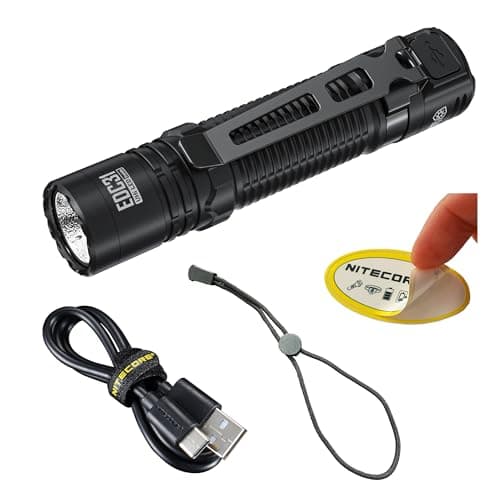
NITECORE EDC31
Thirty-five hundred lumens and 35,630 candela out of a 113-millimeter flat body, with IP68 to two meters and a 2-meter impact rating. NITECORE publishes the figures that describe the beam and then publishes a runtime for exactly one of its four modes, which is the pattern that keeps this brand off the top of our tables.
Price as of October 3, 2026 — 64 lumens per dollar. #ad How we earn
Disclosure — we earn a commission on qualifying purchases made through the Amazon links on this page, at no extra cost to you. It does not change which lights we pick or what we say about them. The full version.
How we rank. Published ANSI FL1 output divided by the live retail price, with sealed-battery lights marked down because a light you cannot re-cell is a light with an expiry date. Units we claim to have tested: 0 — we compile manufacturers' published figures and show the arithmetic instead. How we work this out.
The short answer
Buy Streamlight if you need to plan around how long a light runs: it publishes a runtime for every mode of every model we cover, and the ProTac 2L-X publishes one for each of its two battery types. Buy NITECORE if you need sealing, throw or raw output: it publishes IP68 to two meters where Streamlight publishes IPX7, it publishes peak beam intensity in candela, and the EDC31 reaches 3,500 lumens and 380 meters. The decisive gap is that NITECORE publishes a runtime for its dimmest mode only.
This is an unusual comparison for this site. Most of the brand pages here end up being about disclosure — which company is willing to print the number that makes its headline look worse. Olight publishes no water rating on the models we carry. Fenix publishes no per-mode runtime at all. NEBO names a light the TORCHY 3K and publishes a runtime for every mode except the 3,000-lumen one.
NITECORE and Streamlight both publish more than that. Neither is hiding, both state ingress ratings and impact figures, and the specification sheets are detailed enough to argue over. So this page is not about which brand to trust. It is about which kind of completeness you actually need, and they are strong in different columns.
Published specifications, side by side
| Streamlight ProTac 2L-X | NITECORE MT2A Pro | Streamlight Wedge | NITECORE EDC31 | |
|---|---|---|---|---|
| Maximum output | 500 lumens | 1,000 lumens | 1,000 lumens (burst) | 3,500 lumens |
| Peak beam intensity | Not published | 16,500 cd | Not published | 35,630 cd |
| Beam distance | 165 m | 255 m | 110 m | 380 m |
| Runtime at maximum | 2 h 45 min on CR123A | Not published | 35 seconds, stated | Not published |
| Runtime for every mode? | Yes, and for both cells | No — maximum only | Yes | No — ultralow only |
| Battery | 2 x CR123A or SL-B26 pack | 2 x AA or NL1416R 14500 | Built-in, USB-C | Built-in 3,800 mAh, non-removable |
| Water rating | IPX7 | IP68, 2 m | IPX7 | IP68, 2 m |
| Impact rating | 2 m tested | 1 m | 1 m tested | 2 m |
| Weight | 3.9 oz with CR123A | 40 g without battery | 3.3 oz | 100 g |
Streamlight wins the runtime column, completely
Look at the two runtime rows together, because they are the reason this site exists. Streamlight publishes 500 lumens for two hours forty-five minutes on CR123A primaries and three hours fifteen on its rechargeable pack, 40 lumens for thirty hours, and a strobe duration for both cells. For the Wedge it publishes 300 lumens for three hours and then states the boost mode as a 35-second burst.
NITECORE publishes 20 hours at 50 lumens for the MT2A Pro and 57 hours at 5 lumens for the EDC31. Those are the dimmest modes on each light, and nothing is published for the three or four settings in between.
That matters in a specific, practical way. A 3,500-lumen figure in a 100-gram body is a burst — nothing that size can shed the heat to sustain it — and the only question worth asking is how long it holds before stepping down and where it lands. Streamlight answers that question in seconds for the Wedge. NITECORE does not answer it at all for the EDC31, and you are told what the light does at five lumens instead.
So if your purchase depends on arithmetic — hours of usable light per charge, at a level you can work by — Streamlight is the brand whose numbers you can divide, and it is not close.
NITECORE wins sealing, throw and output
The other columns run the other way, and the gap is just as real.
IP68 against IPX7 is the clearest. Both digits matter: the X in IPX7 means no dust test was published, while NITECORE's 6 means dust-tight, and the 8 covers submersion beyond a meter to a stated depth rather than exactly one meter for thirty minutes. For anything dusty or genuinely wet, NITECORE publishes the stronger claim on both lights here.
NITECORE also publishes peak beam intensity in candela — 16,500 cd on the MT2A Pro and 35,630 cd on the EDC31 — and candela is the figure that actually governs throw. Streamlight publishes beam distance for these models but no candela figure, which means you can compare its lights to each other and not easily to anything else. For a brand that documents so well elsewhere, that is a surprising omission.
And on raw capability NITECORE is simply ahead: 3,500 lumens and 380 meters against a 1,000-lumen burst and 110 meters. If what you want is the most light and the most reach from a pocketable body, Streamlight does not make an answer to the EDC31 in the range we cover.
Both brands seal cells, and both have an escape route
It would be easy to frame this as one brand respecting repairability and the other not. Neither does, consistently. Streamlight's Wedge and MicroStream both seal their cells in. NITECORE's EDC31 and NU25 both seal theirs in, and NITECORE states the EDC31's 3,800 mAh 18650 is non-removable in as many words.
What each brand does have is one model that solves the problem properly, and they solve it differently. The Streamlight ProTac 2L-X takes two CR123A lithium primaries or Streamlight's SL-B26 rechargeable pack, and publishes a runtime for both. CR123A cells are expensive per hour and they sit on a shelf for years without self-discharging, which makes that light the right answer for a drawer, a glovebox or a go-bag.
The NITECORE MT2A Pro takes its own 14500 or two AA cells from any shop on earth. That is a weaker fallback in performance terms — alkaline voltage sags hard under the current a 1,000-lumen emitter draws, so AA cells give you a working light rather than a flagship one — and a stronger one in availability terms, because AA is the most widely stocked battery there is.
Pick by failure mode. If the light will wait months between uses, primaries that hold their charge win. If the light might go flat somewhere you can still buy batteries, AA wins.
| # | Light | Max output | Battery | Lumens / $ | Price |
|---|---|---|---|---|---|
| 1 | NITECORE EDC31 Most output from a flat pocket body | 3,500 | Sealed | 64 | $54.95 on Amazon Price as of October 3, 2026 — 64 lumens per dollar. #ad How we earn |
| 2 | 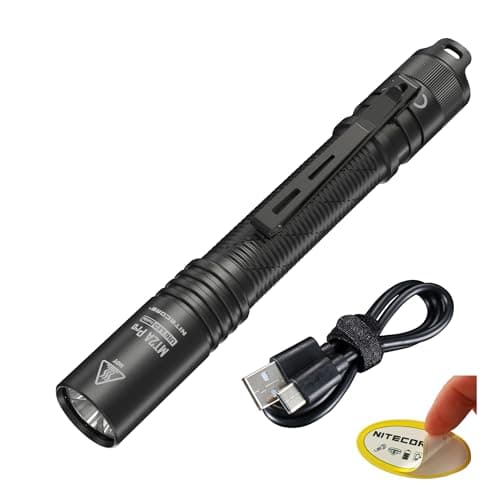 NITECORE MT2A Pro Best dual-power pocket light | 1,000 | Replaceable | 22 | $44.95 on Amazon Price as of October 3, 2026 — 22 lumens per dollar. #ad How we earn |
| 3 | 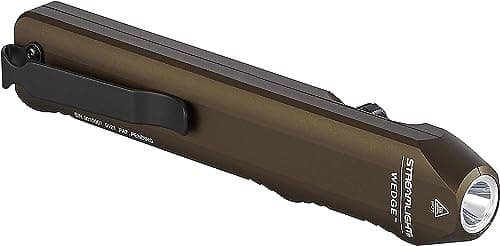 Streamlight Wedge The clearest published turbo duration anywhere | 1,000 | Sealed | 11 | $93.00 on Amazon Price as of October 3, 2026 — 11 lumens per dollar. #ad How we earn |
| 4 | 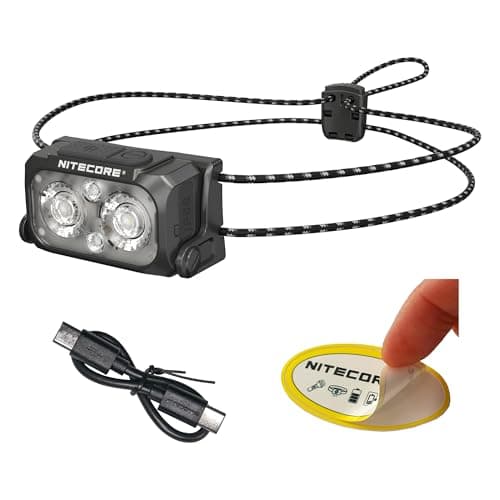 NITECORE NU25 MCT UL Lightest headlamp with a real published runtime | 400 | Sealed | 11 | $36.95 on Amazon Price as of October 3, 2026 — 11 lumens per dollar. #ad How we earn |
| 5 | 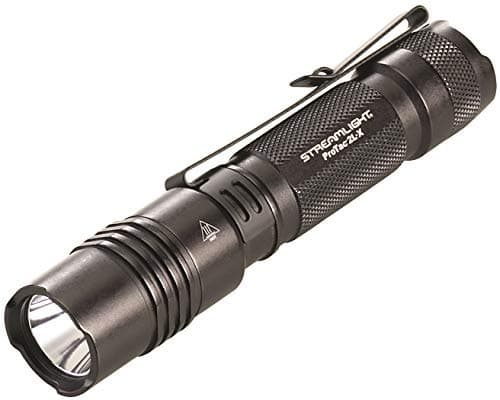 Streamlight ProTac 2L-X Best documented tactical light | 500 | Replaceable | 7 | $66.99 on Amazon Price as of October 3, 2026 — 7 lumens per dollar. #ad How we earn |
| 6 | 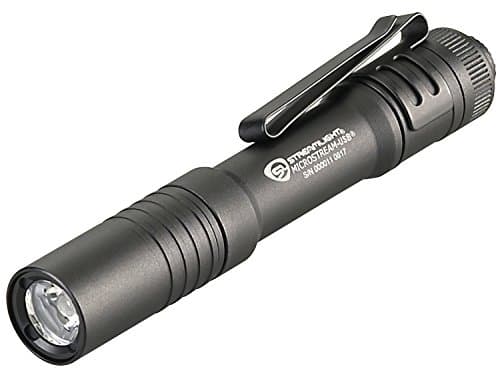 Streamlight MicroStream USB Best pen-clip light with published runtimes | 250 | Sealed | 7 | $37.81 on Amazon Price as of October 3, 2026 — 7 lumens per dollar. #ad How we earn |
Prices pulled October 3, 2026. Lumens per dollar is the manufacturer's published maximum output divided by that price, recomputed every time the price moves.
1. Most output from a flat pocket body
NITECORE EDC31
Lumens per dollar
64
Thirty-five hundred lumens and 35,630 candela out of a 113-millimeter flat body, with IP68 to two meters and a 2-meter impact rating. NITECORE publishes the figures that describe the beam and then publishes a runtime for exactly one of its four modes, which is the pattern that keeps this brand off the top of our tables.
- Max output
- 3,500 lm
- Runtime
- 57 h at 5 lm
- Battery
- Sealed
- Water rating
- IP68
What it gets right
- Thirty-five hundred lumens and 380 meters from a body that still fits a pocket
- IP68 to two meters plus a 2-meter impact rating — the strongest pair NITECORE publishes here
- Publishes peak beam intensity in candela, which is the figure that actually governs throw
- Fifty-seven hours at 5 lumens makes it usable as a long-reserve light as well as a bright one
What it gets wrong
- The 3,800 mAh 18650 is built in and NITECORE states it is non-removable, so the light has a service life
- A runtime is published for the ultralow mode only — nothing for the three modes you will actually use
- Three and a half thousand lumens in a 100-gram body is a burst, and NITECORE does not say how long it lasts
- Two separate momentary modes on top of four levels is a lot of interface for a pocket light
Published specification
- Maximum output: 3,500 lumens — NITECORE published specification
- Peak beam intensity: 35,630 cd — NITECORE published specification
- Beam distance: 380 m — NITECORE published specification
- Maximum runtime: 57 hours at 5 lumens — NITECORE published specification
- Battery: Built-in 3,800 mAh 18650 Li-ion, non-removable — NITECORE published specification
- Charge time: About 1 h 45 min with a 5V/2A adapter — NITECORE published specification
- Water rating: IP68, submersible to 2 m — NITECORE published specification
- Impact: 2 m — NITECORE published specification
- Weight: 100 g (3.53 oz) — NITECORE published specification
- Length: 113.2 mm (4.46 in) — NITECORE published specification
- Emitter: NiteLab UHi 20 MAX — NITECORE published specification
- Per-mode runtime: Not published except the 5-lumen ultralow
Skip this one if
you want to re-cell the light rather than replace it. NITECORE states the 18650 is non-removable, which on an otherwise excellent specification is the one thing you cannot work around.
Buy it if: somebody who wants the most output and throw available in a flat pocket body and is willing to treat the light as a consumable to get it.
- Output 9.5
- Battery 4.5
- Build 9.0
- Usability 7.5
- Overall 8.0
Price as of October 3, 2026 — 64 lumens per dollar. #ad How we earn
2. Best dual-power pocket light
NITECORE MT2A Pro
Lumens per dollar
22
A thousand lumens and 255 meters out of a penlight body that runs on its own removable 14500 or on two AA cells from any shop on earth. IP68 on top. It is the rare light that answers the shelf-life problem and the output problem in the same package.
- Max output
- 1,000 lm
- Runtime
- 20 h
- Battery
- Replaceable cell
- Water rating
- IP68
What it gets right
- Dual power: a removable 14500 for output, or two AA cells when there is no charger
- IP68 to two meters, which almost nothing at this size publishes
- Two hundred and fifty-five meters of throw from a penlight-shaped body
- The charging port is in the cell, so a spare cell charges while the light is in use
What it gets wrong
- NITECORE publishes only the maximum runtime, not a figure per mode
- On alkaline AA cells the output is far below the 1,000-lumen headline
- A penlight body is long for its diameter and rolls off a sloped surface
Published specification
- Maximum output: 1,000 lumens — NITECORE published specification
- Peak beam intensity: 16,500 cd — NITECORE published specification
- Beam distance: 255 m — NITECORE published specification
- Battery: 2 x AA, or 1 x NL1416R 14500 Li-ion with USB-C charging in the cell — NITECORE published specification
- Water rating: IP68, submersible to 2 m — NITECORE published specification
- Impact: 1 m — NITECORE published specification
- Weight: 40 g (1.41 oz) without battery — NITECORE published specification
- Length: 142.8 mm — NITECORE published specification
- Modes: Three brightness levels, single tail switch — NITECORE published specification
- Maximum runtime: 20 hours at 50 lumens — NITECORE published specification
- Per-mode runtime: Not published on the product page
Skip this one if
you want the smallest possible pocket light. At 142.8 mm this is a long, thin light rather than a short one, and that shape suits a shirt pocket better than a jeans pocket.
Buy it if: anyone who wants one light for both daily use and the drawer, and refuses to be stopped by a flat cell.
- Output 8.0
- Battery 9.5
- Build 9.0
- Usability 8.0
- Overall 8.6
Price as of October 3, 2026 — 22 lumens per dollar. #ad How we earn
3. The clearest published turbo duration anywhere
Streamlight Wedge
Lumens per dollar
11
Three hundred lumens for three hours in normal use, and a boost mode Streamlight publishes as a 1,000-lumen, 35-second burst. Not a footnote, not buried in a manual — printed as the specification. Every brand knows their turbo behaves like this; this one says so.
- Max output
- 1,000 lm
- Runtime
- 35 seconds at 1,000 lm; 3 h at 300 lm
- Battery
- Sealed
- Water rating
- IPX7
What it gets right
- The 35-second burst duration is published outright — an unusual piece of honesty
- Flat, wedge-shaped body sits in a pocket without rolling
- IPX7 in a light this thin
What it gets wrong
- Sealed cell, so the light has a service life
- Three hundred lumens constant is its real specification
- Thumb-wheel switch is divisive and cannot be locked out mechanically
Published specification
- Constant: 300 lumens, 69 m, 3 hours — Streamlight published specification
- THRO boost: 1,000 lumens, 110 m, 35-second burst — Streamlight published specification
- Battery: Built-in lithium-ion, USB-C — Streamlight published specification
- Water rating: IPX7, 1 m — Streamlight published specification
- Impact: 1 m tested — Streamlight published specification
- Weight: 3.3 oz (93.6 g) — Streamlight published specification
Skip this one if
you plan to use the 1,000-lumen mode as a mode. It is a burst by design and Streamlight tells you the duration in seconds.
Buy it if: someone who wants a flat pocket light and appreciates a manufacturer that publishes the uncomfortable number.
- Output 6.5
- Battery 4.5
- Build 8.5
- Usability 8.0
- Overall 7.3
Price as of October 3, 2026 — 11 lumens per dollar. #ad How we earn
4. Lightest headlamp with a real published runtime
NITECORE NU25 MCT UL
Lumens per dollar
11
Forty-seven grams including the headband, 400 lumens, and 45 hours at its 6-lumen setting. On a headlamp the weight figure matters more than the lumen figure, because the lamp you stop wearing produces no light at all.
- Max output
- 400 lm
- Runtime
- 45 h at 6 lm
- Battery
- Sealed
- Water rating
- IP66
What it gets right
- Forty-seven grams with the band on — you forget it is there
- Three color temperatures plus red, which is unusual at any price
- IP66 and a published 45-hour low-mode runtime
What it gets wrong
- Sealed 700 mAh cell; no way to carry a spare
- Four hundred lumens is modest for trail running at speed
- Flat band with no over-the-top strap on the ultralight version
Published specification
- Maximum output: 400 lumens — NITECORE published specification
- Beam distance: 132 m — NITECORE published specification
- Runtime: Up to 45 hours at 6 lumens — NITECORE published specification
- Battery: Built-in 700 mAh Li-ion, USB-C — NITECORE published specification
- Weight: 47 g (1.66 oz) including bracket and headband — NITECORE published specification
- Water rating: IP66 — NITECORE published specification
- Color temperatures: 3,000K / 4,500K / 6,500K plus auxiliary red — NITECORE published specification
Skip this one if
you need to swap a battery mid-shift. A sealed 700 mAh cell means your night ends when it does.
Buy it if: hikers, campers and anyone whose complaint about headlamps is that they bounce.
- Output 6.5
- Battery 4.5
- Weight 9.5
- Usability 8.5
- Overall 7.8
Price as of October 3, 2026 — 11 lumens per dollar. #ad How we earn
5. Best documented tactical light
Streamlight ProTac 2L-X
Lumens per dollar
7
Five hundred lumens with the runtime published for both battery types, 165 meters of throw, IPX7 and a 2-meter impact rating. Streamlight publishes what most brands leave out, and the numbers hold up when you divide them.
- Max output
- 500 lm
- Runtime
- 2 h 45 min (CR123A) / 3 h 15 min (SL-B26)
- Battery
- Replaceable cell
- Water rating
- IPX7
What it gets right
- Runtime published for every mode and both battery chemistries
- IPX7 plus a stated 2 m impact test, not a vague claim of toughness
- Runs on CR123A primaries when the rechargeable pack is flat
What it gets wrong
- Five hundred lumens is modest for the money in raw terms
- CR123A cells are expensive if you run it on primaries
- No high-CRI option
Published specification
- High: 500 lumens, 165 m, 2.75 h on CR123A / 3.25 h on SL-B26 — Streamlight published specification
- Low: 40 lumens, 49 m, 30 hours on either battery — Streamlight published specification
- Strobe: Up to 3.25 h (CR123A) / 4.5 h (SL-B26) — Streamlight published specification
- Battery: 2 x CR123A or the SL-B26 rechargeable pack — Streamlight published specification
- Water rating: IPX7, 1 m for 30 minutes — Streamlight published specification
- Impact: 2 m tested — Streamlight published specification
- Weight: 3.9 oz with CR123A / 4.4 oz with SL-B26 — Streamlight published specification
Skip this one if
you want the biggest number per dollar. Streamlight charges for documentation, warranty and consistency, and none of those show up in a lumens-per-dollar column.
Buy it if: someone whose light has to work every time and who would rather have a small honest number than a large unverifiable one.
- Output 6.5
- Battery 8.5
- Build 9.0
- Usability 8.5
- Overall 8.1
Price as of October 3, 2026 — 7 lumens per dollar. #ad How we earn
6. Best pen-clip light with published runtimes
Streamlight MicroStream USB
Lumens per dollar
7
Two hundred and fifty lumens for an hour and a half, fifty for three and a half, at 1.2 ounces. The battery is sealed, which caps its lifespan, but every other number on the sheet is published and checkable.
- Max output
- 250 lm
- Runtime
- 1 h 30 min
- Battery
- Sealed
- Water rating
- IPX4
What it gets right
- Every mode's runtime is published, which is why it scores well here despite modest output
- Deep pocket clip that actually holds in a shirt pocket
- 1.2 ounces — it is easy to forget you have it
What it gets wrong
- The cell is sealed in; when it fails the light is finished
- IPX4 splash rating only
- 250 lumens is not enough to light a yard
Published specification
- High: 250 lumens, 68 m, 1.5 hours — Streamlight published specification
- Low: 50 lumens, 31 m, 3.5 hours — Streamlight published specification
- Battery: Lithium-ion, charges in-product in 4 hours — Streamlight published specification
- Water rating: IPX4 — Streamlight published specification
- Impact: 1 m tested — Streamlight published specification
- Weight: 1.2 oz (34.1 g) — Streamlight published specification
- Length: 3.87 in (9.83 cm) — Streamlight published specification
Skip this one if
you want a light you can re-cell. For a keychain-sized light with a replaceable battery, look at the Sofirn SC21 Pro instead.
Buy it if: a shirt pocket, a scrubs pocket, or anyone who wants a light without a bulge.
- Output 5.5
- Battery 4.5
- Build 8.5
- Usability 9.0
- Overall 7.2
Price as of October 3, 2026 — 7 lumens per dollar. #ad How we earn
The headlamp question
NITECORE has one more advantage that does not appear in the table: it makes head-worn light and Streamlight, in the range we cover, does not. The NU25 MCT UL is 47 grams including the headband, publishes IP66 and 45 hours at 6 lumens, and offers three color temperatures plus an auxiliary red, which is a specification almost nobody at this price publishes.
If you want one brand for both a handheld and a headlamp, that settles it in NITECORE's favor by default. It is worth saying that the lamps we rate highest overall come from Black Diamond and Petzl rather than from either brand here, and both of those publish a full per-mode table that NITECORE does not.
What each brand is actually for
The split in the specification sheets reflects a split in who the brands sell to, and it is a useful shortcut.
Streamlight sells heavily into duty and trade use — police, fire, EMS, industrial — through distribution rather than direct. That channel cares about documentation, spares availability, warranty and a predictable street price, and it does not care much about having the highest number on the box. It explains both the complete runtime tables and the modest outputs.
NITECORE sells to enthusiasts and outdoor users, where the competition is on output, throw, sealing and features. That explains the 3,500 lumens, the published candela, the IP68 ratings, and also the four-mode interfaces with two extra momentary functions layered on top — more capability and more to learn.
Neither audience is wrong. But if you are buying a light because its failure would matter rather than because flashlights interest you, the duty-oriented brand is usually the better fit, and we rank duty lighting separately for that reason.
Which one to buy
- If you need to know how long a usable mode lasts: Streamlight, the only one of the two that publishes it for every mode.
- If the light will be submerged or used in dust: NITECORE, for the IP68 against IPX7.
- If you want the most output and reach from a pocket light: NITECORE EDC31, at 3,500 lumens and 380 meters.
- If the light waits months in a drawer or a vehicle: Streamlight ProTac 2L-X, on CR123A primaries that keep.
- If it might go flat far from a charger but near a shop: NITECORE MT2A Pro, which takes two AA cells.
- If you want a headlamp from the same brand: NITECORE, because Streamlight does not compete here in our coverage.
- If you want the lightest documented pocket light: Streamlight MicroStream at 1.2 ounces, with every mode published.
How we ranked these
Published output over the live price, adjusted for cell architecture and published ratings, with completeness of the specification weighted deliberately. That weighting favors Streamlight on runtime and NITECORE on ingress and beam intensity, which is why the two brands finish closer together here than the raw lumen figures suggest — a 3,500-lumen light with no runtime for that mode does not score as 3,500 usable lumens.
Units we claim to have tested: 0
Every publisher in this category says they tested twenty flashlights. We have not tested any, and we say so. What we do instead: compile the manufacturer's own published ANSI FL1 figures, pull the price the light is selling for right now, and divide one by the other. Every number on this page is one you can check yourself in about two minutes.
What we cannot tell you
We have not used any of these six lights. We cannot tell you how either brand's anodizing wears, whose switches last, whose tint you will prefer, or how either company handles a warranty claim — Streamlight's reputation in duty use and NITECORE's range are both things we have read rather than tested, and neither is in the scoring above.
Two specific gaps are worth naming because they cut against each brand. We cannot tell you how long the EDC31 holds 3,500 lumens, because NITECORE does not publish it. And we cannot compare either brand's throw to the rest of the market on equal terms, because Streamlight publishes beam distance without the candela figure behind it. Neither brand publishes a CRI figure for any light here, so how accurately either renders color is unknown to us.
Common questions
Is Streamlight a good brand?
On the evidence a buyer can check before paying, yes — and it is strongest on the thing most brands avoid. Streamlight publishes a runtime for every mode of every model we cover, publishes it for both battery types where a light takes two, and states its turbo durations outright: the Wedge's 1,000-lumen mode is printed as a 35-second burst. It also publishes IPX7 water ratings and 1-to-2-meter impact figures. Its weaknesses are modest maximum outputs by enthusiast standards and no published candela figure. We have not tested any Streamlight, so this is an assessment of its disclosure rather than its durability.
Is NITECORE or Streamlight better?
They are strong in different columns. Streamlight publishes a runtime for every mode, which is the figure you need to plan around a shift or an evening, and NITECORE publishes only its dimmest mode. NITECORE publishes IP68 to two meters against Streamlight's IPX7, publishes peak beam intensity in candela, and reaches far higher output — 3,500 lumens and 380 meters on the EDC31. If your light has to work on a schedule, Streamlight. If it has to be sealed, throw a long way, or be very bright, NITECORE.
Which brand has better batteries, NITECORE or Streamlight?
Neither is consistently better, and both seal cells into some models — Streamlight in the Wedge and MicroStream, NITECORE in the EDC31 and NU25, where it states the 18650 is non-removable. Each has one model that solves it: the ProTac 2L-X runs on CR123A primaries that keep for years on a shelf, and the MT2A Pro runs on two AA cells you can buy anywhere. Primaries are better for a light that waits; AA is better for a light that might go flat away from a charger.
Can you replace the battery in a rechargeable flashlight?
It depends entirely on the model, and it is the single most consequential thing to check before buying. Lights built around a standard cell — an 18650, a 21700, a 14500, a 16340 — take a screw-off tailcap and a five-dollar replacement. Lights with a built-in cell, which manufacturers describe as 'integrated' or 'non-removable', cannot be re-celled by an ordinary owner: when the battery reaches the end of its cycle life the whole light is refuse. Energizer, for example, states plainly that the Vision HD Rechargeable uses non-removable lithium-ion batteries.
Sources
- NITECORE published product specifications — NU25 MCT UL read 2026-09-01; MT2A Pro read 2026-09-13; EDC31 read 2026-10-03
- Streamlight published product specifications — per-mode lumens, runtime, beam distance, impact and IP ratings, read 2026-09-01; Waypoint 400 and Waypoint C-cell read 2026-09-22
- Streamlight, ANSI Information — definitions of light output, beam distance, run time, impact and water resistance under the FL1 standard, read 2026-09-01
- Lumen & Ledger method — how every figure on this page is derived
Who writes this
Scooter M. — I am an enthusiast who is genuinely into this. I read the manuals, compile the published specs, and do the math. No lab coat, no test bench, no drawer of free samples. What I can tell you is exactly what a light claims on paper, exactly what it costs right now, and what those two numbers mean when you divide one by the other.
Read next
NITECORE vs Olight
Batteries you can buy anywhere against cells only one company sells.
Olight vs Streamlight
Convenience against documentation, and the one spec column that settles it.
NITECORE vs Fenix
Two enthusiast brands that both publish properly. The split is dual power against raw output.
Best duty flashlights
Where cheapest lumens per dollar is the wrong answer, and what replaces it.
Best AA flashlights
The cell that is never flat when you need it, and the six lights worth putting it in.
The Ledger
Every light we cover in one ranked table, sorted by lumens per dollar.