Headlamps
Best Rechargeable Headlamps for Running
The thing that ruins a night run is a lamp that moves on your head. That makes this the one ranking where grams matter more than anything on the front of the box.
By Scooter M. · Published September 13, 2026

Short answer
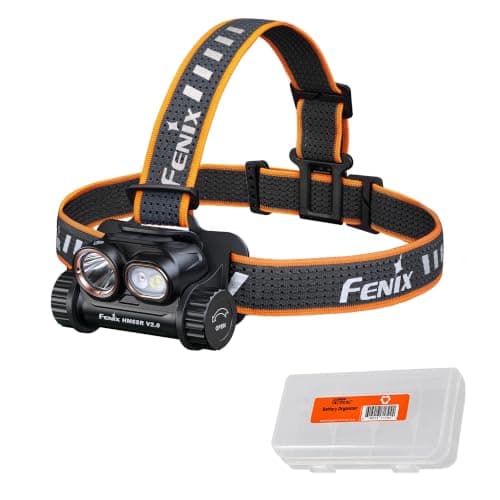
Fenix HM65R V2.0
Twenty-two hundred lumens, 226 meters, IP68, a 2-meter impact rating and a removable 3,400 mAh 21700. It costs several times what a budget headlamp costs and it is the only one here you can carry a spare cell for.
Price as of September 14, 2026 — 22 lumens per dollar. #ad How we earn
Disclosure — we earn a commission on qualifying purchases made through the Amazon links on this page, at no extra cost to you. It does not change which lights we pick or what we say about them. The full version.
How we rank. Published ANSI FL1 output divided by the live retail price, with sealed-battery lights marked down because a light you cannot re-cell is a light with an expiry date. Units we claim to have tested: 0 — we compile manufacturers' published figures and show the arithmetic instead. How we work this out.
What actually decides a running headlamp
Rank a running headlamp on mass first, strap design second, the runtime of the 100-to-300-lumen mode you will actually cruise on third, and maximum output a distant fourth. NITECORE publishes 47 grams including bracket and headband for the NU25 MCT UL; Black Diamond publishes 86 grams for the Spot 400-R and Petzl 88 grams for the ACTIK CORE. That spread is nearly double, and you feel it in the first mile, not the last.
Every other headlamp ranking on the internet sorts by lumens. For running that is close to the wrong order, because the failure mode is not darkness. It is a lamp that bounces with your stride until you are aware of it on every footfall, and then you stop wearing it, and a lamp in a pocket produces no light at all.
Criterion one: mass, because bounce is mass on elastic
A headlamp on a stretchy band is a mass on a spring, and your stride is the forcing function. The heavier the mass, the more energy goes into the oscillation and the tighter you have to cinch the band to control it — which trades bounce for a headache. There is no way to design around the physics; you can only reduce the mass.
That is why the NU25 MCT UL leads this page despite having a sealed battery, which this site otherwise marks down hard. Forty-seven grams with the band on is in a different category from eighty-eight, and for a one-to-two-hour run the sealed cell simply never becomes the problem it is on a three-day trip. Our hiking and backpacking ranking reverses this exact judgment for exactly that reason, and it is worth reading if your runs turn into overnights.
Criterion two: where the weight sits
Two lamps of identical mass do not feel identical. A lamp with its battery at the back of the strap balances front to back and sits far more calmly than one with everything on your forehead, because the load is distributed and the moment arm is shorter. An over-the-top strap does the same job by a different route.
No manufacturer publishes a figure for this and we have not run in any of these lamps, so we cannot rank on it and will not pretend to. What we can tell you is what to look at: where the cell is, whether there is a top strap, and whether the band is a flat single strip or a split one. NITECORE's ultralight version ships a flat band with no over-the-top strap, which is part of how it reaches 47 grams and is also the most common complaint about ultralight lamps generally.
Criterion three: the mode you actually run on
Nobody runs on turbo. On a trail at a steady pace, something in the region of 100 to 300 lumens shows you the ground and the next few strides, and running any brighter mostly buys glare off dust and your own breath. So the number to compare is the runtime at that level, not at maximum.
| Lamp | Published weight | Mid-mode figure | Longest published mode |
|---|---|---|---|
| NITECORE NU25 MCT UL | 47 g with band | Not published per mode | 45 h at 6 lm |
| Black Diamond Spot 400-R | 86 g | 200 lm for 8 h | 225 h at 6 lm |
| Petzl ACTIK CORE | 88 g | Published per level by Petzl | Published per level by Petzl |
| Fenix HM65R V2.0 | Heaviest here | Not published per mode | Not published |
Black Diamond publishes the most complete table of the four — 400 lumens for four hours, 200 for eight, 6 for two hundred and twenty-five — and eight hours at 200 lumens covers any run you are likely to do on one charge, with a very large margin. Petzl publishes by named lighting level and states ANSI/PLATO FL 1 conformity outright, which almost nothing else here does. NITECORE publishes a maximum and a minimum but nothing between them, and Fenix publishes no per-mode runtime on the retail page we read. Both of those gaps are marked against them below.
| # | Light | Max output | Battery | Lumens / $ | Price |
|---|---|---|---|---|---|
| 1 | Fenix HM65R V2.0 Most output with a removable 21700 | 2,200 | Replaceable | 22 | $100.45 on Amazon Price as of September 14, 2026 — 22 lumens per dollar. #ad How we earn |
| 2 | 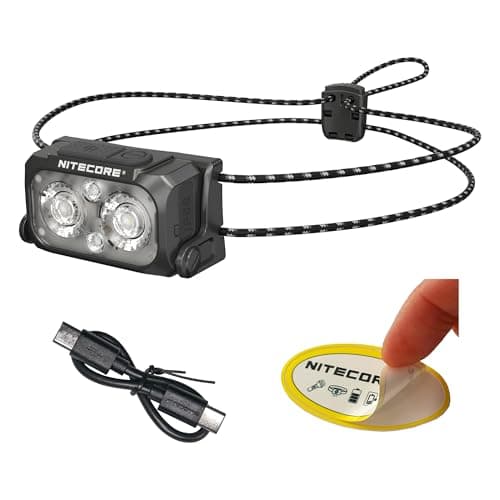 NITECORE NU25 MCT UL Lightest headlamp with a real published runtime | 400 | Sealed | 11 | $36.95 on Amazon Price as of September 14, 2026 — 11 lumens per dollar. #ad How we earn |
| 3 | 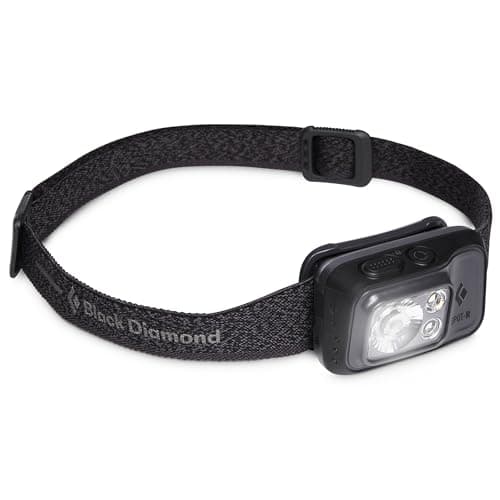 Black Diamond Spot 400-R Most complete published runtime table | 400 | Sealed | 7 | $59.88 on Amazon Price as of September 14, 2026 — 7 lumens per dollar. #ad How we earn |
| 4 | 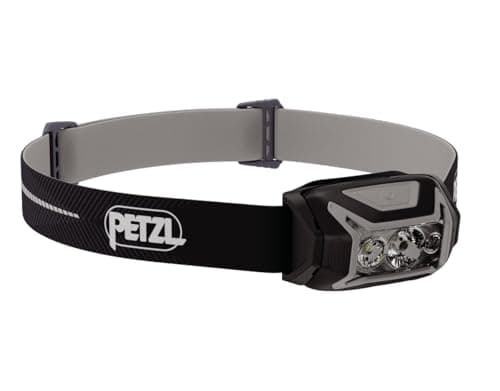 Petzl ACTIK CORE Best hybrid: rechargeable or AAA cells | 625 | Replaceable | 7 | $84.96 on Amazon Price as of September 14, 2026 — 7 lumens per dollar. #ad How we earn |
Prices pulled September 14, 2026. Lumens per dollar is the manufacturer's published maximum output divided by that price, recomputed every time the price moves.
Criterion four: being seen, not just seeing
If any part of your route is on a road or a shared path, the lamp is safety equipment in two directions, and a rear red light is the half most buyers forget. A white beam pointed forward does nothing to tell a driver approaching from behind that you exist.
Every lamp on this page has a red mode, but a front red mode and a rear red light are different features solving different problems, and manufacturers describe both with the same word. Check which one the specific model has before you rely on it. Where a lamp has only a forward red, the honest fix is a separate clip-on rear light rather than buying a brighter headlamp, and that is a cheaper purchase than any lamp here.
Criterion five: rain, because you will run in it
Fenix publishes IP68 on the HM65R V2.0 and Black Diamond IP67 on the Spot 400-R, tested to one meter for thirty minutes. NITECORE publishes IP66 on the NU25, which covers powerful jets but is not an immersion rating. Petzl publishes IPX4 on the ACTIK CORE — weather resistant, rain only.
For running, IPX4 is genuinely enough. Your head stays above the weather, the lamp is not going swimming, and rain is exactly what IPX4 describes. This is the rare page where the weakest water rating in the field is not a real mark against the lamp, and it would be dishonest to imply otherwise just because the number is smaller. Our guide to IP ratings sets out what each figure does and does not promise.
1. Most output with a removable 21700
Fenix HM65R V2.0
Lumens per dollar
22
Twenty-two hundred lumens, 226 meters, IP68, a 2-meter impact rating and a removable 3,400 mAh 21700. It costs several times what a budget headlamp costs and it is the only one here you can carry a spare cell for.
- Max output
- 2,200 lm
- Runtime
- Not published per mode on the retail page
- Battery
- Replaceable cell
- Water rating
- IP68
What it gets right
- Removable 21700, so a spare cell turns a four-hour night into an eight-hour one
- IP68 — the strongest water rating in this roundup
- Independent spot and flood control, which is what work actually needs
What it gets wrong
- Its lumens-per-dollar figure will be poor against any budget lamp
- Heavy on the head compared with the ultralight class
- No per-mode runtime on the page we read
Published specification
- Maximum output: 2,200 lumens, spot and flood combined — Fenix published specification
- Beam distance: 741 ft (226 m) — Fenix published specification
- Battery: 3,400 mAh 21700, removable, USB-C — Fenix published specification
- Water rating: IP68 — Fenix published specification
- Impact: 2 m — Fenix published specification
- Body: Magnesium alloy — Fenix published specification
- Per-mode runtime: Not published on the retail page we read
Skip this one if
you are buying on value. This is a work tool priced as one.
Buy it if: night shifts, cave work and anyone who has run a headlamp flat halfway through a job.
- Output 9.5
- Battery 9.0
- Weight 5.5
- Usability 8.5
- Overall 8.4
Price as of September 14, 2026 — 22 lumens per dollar. #ad How we earn
2. Lightest headlamp with a real published runtime
NITECORE NU25 MCT UL
Lumens per dollar
11
Forty-seven grams including the headband, 400 lumens, and 45 hours at its 6-lumen setting. On a headlamp the weight figure matters more than the lumen figure, because the lamp you stop wearing produces no light at all.
- Max output
- 400 lm
- Runtime
- 45 h at 6 lm
- Battery
- Sealed
- Water rating
- IP66
What it gets right
- Forty-seven grams with the band on — you forget it is there
- Three color temperatures plus red, which is unusual at any price
- IP66 and a published 45-hour low-mode runtime
What it gets wrong
- Sealed 700 mAh cell; no way to carry a spare
- Four hundred lumens is modest for trail running at speed
- Flat band with no over-the-top strap on the ultralight version
Published specification
- Maximum output: 400 lumens — NITECORE published specification
- Beam distance: 132 m — NITECORE published specification
- Runtime: Up to 45 hours at 6 lumens — NITECORE published specification
- Battery: Built-in 700 mAh Li-ion, USB-C — NITECORE published specification
- Weight: 47 g (1.66 oz) including bracket and headband — NITECORE published specification
- Water rating: IP66 — NITECORE published specification
- Color temperatures: 3,000K / 4,500K / 6,500K plus auxiliary red — NITECORE published specification
Skip this one if
you need to swap a battery mid-shift. A sealed 700 mAh cell means your night ends when it does.
Buy it if: hikers, campers and anyone whose complaint about headlamps is that they bounce.
- Output 6.5
- Battery 4.5
- Weight 9.5
- Usability 8.5
- Overall 7.8
Price as of September 14, 2026 — 11 lumens per dollar. #ad How we earn
3. Most complete published runtime table
Black Diamond Spot 400-R
Lumens per dollar
7
Four hundred lumens for four hours, 200 for eight, 6 for two hundred and twenty-five. Black Diamond publishes lumens, runtime and beam distance for all three modes, and IP67 on top. There is nothing to guess at here.
- Max output
- 400 lm
- Runtime
- 4 h
- Battery
- Sealed
- Water rating
- IP67
What it gets right
- Lumens, runtime and distance published for every mode
- Two hundred and twenty-five hours on low is a genuine emergency reserve
- IP67 and a battery meter that shows an actual percentage
What it gets wrong
- Micro-USB in a year when everything else is USB-C
- Integrated battery — no spare, no re-cell
- Eighty-six grams is heavy next to the ultralight class
Published specification
- High: 400 lumens, 4 hours, 100 m — Black Diamond published specification
- Medium: 200 lumens, 8 hours, 60 m — Black Diamond published specification
- Low: 6 lumens, 225 hours, 12 m — Black Diamond published specification
- Battery: Integrated 1,500 mAh Li-ion, micro-USB — Black Diamond published specification
- Water rating: IP67, tested to 1.0 m for 30 minutes — Black Diamond published specification
- Weight: 86 g — Black Diamond published specification
Skip this one if
you have standardized on USB-C. Carrying a second cable for one device is a small annoyance that compounds on a long trip.
Buy it if: camp, dog walks and anyone who wants a headlamp whose numbers are all on the box.
- Output 6.5
- Battery 5.5
- Weight 7.0
- Usability 9.0
- Overall 7.7
Price as of September 14, 2026 — 7 lumens per dollar. #ad How we earn
4. Best hybrid: rechargeable or AAA cells
Petzl ACTIK CORE
Lumens per dollar
7
Six hundred and twenty-five lumens stated to ANSI/PLATO FL1, 88 grams, and — the part that matters — it runs on the CORE rechargeable pack or on three AAA cells when the pack is flat. That is the answer to the sealed-battery problem, from the only brand here that bothered.
- Max output
- 625 lm
- Runtime
- Published per mode by Petzl
- Battery
- Replaceable cell
- Water rating
- IPX4
What it gets right
- Explicitly states ANSI/PLATO FL1 conformity, which most brands here do not
- Hybrid power: the pack for daily use, AAA cells as the fallback that never fails
- Petzl publishes the CORE pack's cycle rating, so its service life is a stated number
What it gets wrong
- IPX4 — weather resistant, not submersible
- Eighty-eight grams is not ultralight
- The CORE pack is a Petzl part rather than a standard cell
Published specification
- Maximum output: 625 lumens (ANSI/PLATO FL1) — Petzl published specification
- Weight: 88 g — Petzl published specification
- Battery: CORE rechargeable 1,250 mAh / 3.6 V / 4.5 Wh, or 3 x AAA — Petzl published specification
- Battery compatibility: Alkaline, lithium or Ni-MH — Petzl published specification
- Water rating: IPX4, weather resistant — Petzl published specification
- Warranty: Lamp 5 years; CORE battery 2 years or 300 cycles — Petzl published specification
- Lighting levels: MAX BURN TIME, STANDARD, MAX POWER, plus red — Petzl published specification
Skip this one if
you want a submersible headlamp. IPX4 covers rain and nothing beyond it.
Buy it if: anyone whose headlamp has to work at the end of a long trip, when charging is not an option.
- Output 7.5
- Battery 9.0
- Weight 7.0
- Usability 8.5
- Overall 8.3
Price as of September 14, 2026 — 7 lumens per dollar. #ad How we earn
The beam you want is wider than you think
Running is a close-range visual task, which surprises people who buy on beam distance. At eight minutes a mile you are reading the ground roughly three to six meters ahead — far enough to react to a root, a pothole or a patch of ice. Nothing useful happens at 130 meters, and a tight hotspot thrown that far is actively unhelpful because it lights a small bright circle while your actual landing zone stays dim.
So a flood-weighted beam beats a thrower here, and this is one of the few places on this site where a lower beam-distance figure is a point in a lamp's favor rather than against it. NITECORE publishes 132 meters for the NU25, which is plenty and not the point; what matters is the spill around it. Our guide to lumens versus candela explains why those two figures move independently and which one to read for a given job.
The related mistake is aiming. A lamp tilted level throws your light at the horizon and leaves your feet dark; tilted too far down it gives you a bright patch a meter ahead and no warning of anything. Every lamp here has a tilting bracket, and setting it once, on a run, is worth more than any specification on this page.
Sweat, rain and the part that actually fails
Headlamps bought for running rarely die from their electronics. They die from the band — elastic that has been soaked in sweat, dried stiff, stretched and soaked again for a season loses its recovery, and a band that no longer grips is a lamp that bounces no matter how light it is.
That makes two unglamorous things worth checking before you buy: whether the band detaches from the housing for rinsing, and whether the manufacturer sells a replacement band at all. Neither appears in any specification table and neither is something we can rank, but a lamp with a replaceable band has a service life measured in years rather than seasons — which is the same argument this site makes about replaceable cells, applied to the part that actually wears out first on a running lamp.
One more thing the band decides: whether the lamp works over a hat. A beanie in winter and a cap in summer both change the circumference you need, and a band set up bare-headed in a warm room will be wrong on the first cold morning. Set it wearing what you actually run in, and if the lamp has an over-the-top strap, use it rather than cinching the main band tighter.
The lamp on this page you should not buy for running
The Fenix HM65R V2.0 is an excellent headlamp and the wrong tool here. It publishes 2,200 lumens, IP68, a two-meter impact rating and a removable 3,400 mAh 21700, and all of that costs mass — it is the heaviest lamp on this page by a wide margin, because a 21700 cell is a large object to carry on your forehead.
It is included rather than quietly dropped because it is the lamp a lot of people buy on the specification sheet and then regret on a run. If your night activity is work, caving or search rather than running, it is the strongest lamp we cover and our work ranking says so. For running it is the wrong shape of answer.
How we ranked these
The four scored attributes published on our methodology page — output against live price, battery architecture, weight, and usability — with one override stated openly for this use case: weight is promoted above battery architecture. That is the reverse of every other page on this site, and it is why a lamp with a sealed 700 mAh cell finishes first here. A sealed cell is a service-life problem measured in years; bounce is a problem measured in minutes, and only one of those stops you using the lamp tonight.
Units we claim to have tested: 0
Every publisher in this category says they tested twenty flashlights. We have not tested any, and we say so. What we do instead: compile the manufacturer's own published ANSI FL1 figures, pull the price the light is selling for right now, and divide one by the other. Every number on this page is one you can check yourself in about two minutes.
What we cannot tell you
We have not run in any of these lamps, and bounce is the single most important attribute on this page. No manufacturer publishes a figure for it, there is no standard to measure it against, and it interacts with your stride, your hair and whether you wear a hat. Everything above is an argument from published mass and from where the battery sits, which is a good predictor and not a substitute for wearing one. We also cannot tell you how any of these straps hold up to being soaked in sweat for a season, which is the other thing that ends a headlamp's life.
Common questions
How many lumens do you need for running at night?
Far fewer than the box is selling you. On a trail at a steady pace, 100 to 300 lumens shows the ground and your next few strides, and that is where you will spend the run. Higher output mostly buys glare off dust and your own breath. What matters more than the maximum is how long the lamp holds that middle setting — Black Diamond publishes 200 lumens for eight hours on the Spot 400-R, which covers any run on one charge.
What weight should a running headlamp be?
Under about 100 grams including the band, and the lighter the better. NITECORE publishes 47 grams for the NU25 MCT UL, Black Diamond 86 grams for the Spot 400-R and Petzl 88 grams for the ACTIK CORE. Mass on an elastic band is what bounces with your stride, and the only design fix is less of it. Where the battery sits matters too: a rear-mounted cell balances better than one on your forehead.
Is a sealed battery a problem in a running headlamp?
Less than anywhere else on this site. A sealed cell means the lamp has a service life measured in years and cannot be revived, which is a real cost — but a one-to-two-hour run never runs a lamp flat, so the fallback that matters on a multi-day trip does not matter here. That is why the lightest sealed lamp leads this page and the hybrid lamp leads our hiking and backpacking ranking.
Can you replace the battery in a rechargeable flashlight?
It depends entirely on the model, and it is the single most consequential thing to check before buying. Lights built around a standard cell — an 18650, a 21700, a 14500, a 16340 — take a screw-off tailcap and a five-dollar replacement. Lights with a built-in cell, which manufacturers describe as 'integrated' or 'non-removable', cannot be re-celled by an ordinary owner: when the battery reaches the end of its cycle life the whole light is refuse. Energizer, for example, states plainly that the Vision HD Rechargeable uses non-removable lithium-ion batteries.
Sources
- NITECORE published product specifications — NU25 MCT UL read 2026-09-01; MT2A Pro read 2026-09-13
- Black Diamond published product specifications — Spot 400-R read 2026-09-01; Storm 500-R read 2026-09-14
- Petzl published product specifications — ANSI/PLATO FL 1 conformity stated by the manufacturer, read 2026-09-01
- Fenix published product specifications — read 2026-09-01
- Lumen & Ledger method — how every figure on this page is derived
Who writes this
Scooter M. — I am an enthusiast who is genuinely into this. I read the manuals, compile the published specs, and do the math. No lab coat, no test bench, no drawer of free samples. What I can tell you is exactly what a light claims on paper, exactly what it costs right now, and what those two numbers mean when you divide one by the other.
Read next
Best rechargeable headlamps for hiking and backpacking
Days between chargers changes the answer: runtime per gram, and a cell you can feed.
Best rechargeable headlamps
Ranked on weight and published runtime, because a lamp you stop wearing lights nothing.
Headlamp vs flashlight
Hands beat lumens more often than people expect. The four jobs that decide which you buy.
Best budget rechargeable headlamps
What drops out of the spec sheet first when the price falls.
IP and IPX ratings explained
What IPX4, IPX7 and IP68 mean, and why a missing rating is information too.
The Ledger
Every light we cover in one ranked table, sorted by lumens per dollar.