Headlamps
How to Choose a Headlamp
Six decisions, taken in this order. Get the first one right and the rest are preferences; get it wrong and no amount of lumens will save the lamp.
By Scooter M. · Published October 18, 2026

Short answer
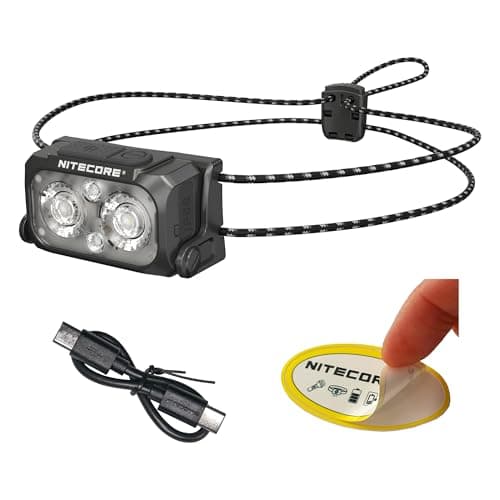
NITECORE NU25 MCT UL
Forty-seven grams including the headband, 400 lumens, and 45 hours at its 6-lumen setting. On a headlamp the weight figure matters more than the lumen figure, because the lamp you stop wearing produces no light at all.
Price as of October 18, 2026 — 11 lumens per dollar. #ad How we earn
Disclosure — we earn a commission on qualifying purchases made through the Amazon links on this page, at no extra cost to you. It does not change which lights we pick or what we say about them. The full version.
How we rank. Published ANSI FL1 output divided by the live retail price, with sealed-battery lights marked down because a light you cannot re-cell is a light with an expiry date. Units we claim to have tested: 0 — we compile manufacturers' published figures and show the arithmetic instead. How we work this out.
The short answer
Choose a headlamp on its battery architecture first, its low-mode runtime second, and its maximum output last. A hybrid lamp that runs on either a rechargeable pack or ordinary AAA cells — the Petzl ACTIK CORE, 625 lumens on the pack and 450 on AAAs — cannot strand you when the pack is flat, and that is the only failure that actually matters in the dark. If weight is the deciding factor, the NITECORE NU25 MCT UL is 47 grams with the headband and publishes 45 hours at 6 lumens. The lumen figure on the box should be the last thing you look at.
Headlamps are sold the way flashlights are sold: on a single peak number. For a lamp strapped to your head, that number is close to irrelevant. Almost nobody walks on maximum, every lamp steps down from it within minutes, and the modes you will actually live in sit between 5 and 100 lumens. What follows is the order that matters instead.
Decision 1: how it is powered — and this is most of the decision
There are three architectures and they fail in completely different ways.
- Sealed rechargeable. Lightest and cheapest to run. When the cell is flat you need a power bank and time, and when the cell wears out the lamp is refuse. NITECORE's NU25 MCT UL is the best of these at 47 grams.
- Hybrid. A rechargeable pack that can be swapped for ordinary AAA cells. Petzl's CORE system does this on the ACTIK CORE and TIKKA CORE: 625 or 450 lumens on the pack, 500 or 350 on three AAAs. Heavier and dearer, and it cannot strand you.
- Primary cells only. Nothing to charge, nothing to degrade, and you buy batteries forever. Rare now at the quality end.
The honest rule: if the lamp is safety-critical — a trail after dark, a night shift, a route you cannot stop on — buy hybrid. If it is for a tent, a dog walk or a loft, sealed rechargeable is lighter, cheaper and perfectly sensible. Our guide to rechargeable versus battery lights works through the economics.
Decision 2: the low mode, not the high one
The specification that predicts how useful a headlamp is day to day is the runtime at its lowest usable setting, because that is where it spends its life. Compare these four published figures and the differences are enormous.
| Lamp | Lowest published mode | Runtime there | Maximum output |
|---|---|---|---|
| Black Diamond Spot 400-R | 6 lumens | 225 hours | 400 lm for 4 h |
| Petzl TIKKA CORE | 7 lumens (MAX BURN TIME) | 110 hours | 450 lm for 2 h 30 min |
| NITECORE NU25 MCT UL | 6 lumens | 45 hours | 400 lm |
| Petzl ACTIK CORE | Published per mode by Petzl | See card | 625 lm on the CORE pack |
Two hundred and twenty-five hours against forty-five is not a rounding difference, and neither lamp advertises it. Both advertise 400 lumens.
Decision 3: weight, measured where it sits
A headlamp is the only light whose weight you feel continuously, and the band that matters is roughly 45 to 120 grams. Below about 60 grams the lamp disappears; above about 100 it bounces when you run and presses when you wear a hat under it. Petzl publishes 88 grams for the ACTIK CORE and 84 for the TIKKA CORE, Black Diamond 86 for the Spot 400-R, NITECORE 47 for the NU25 MCT UL including bracket and headband.
Weight and battery architecture are the same decision seen twice: hybrids carry the mass of a pack that a sealed lamp does not. Decide which failure you are buying against, then take the weight that comes with it.
| # | Light | Max output | Battery | Lumens / $ | Price |
|---|---|---|---|---|---|
| 1 | NITECORE NU25 MCT UL Lightest headlamp with a real published runtime | 400 | Sealed | 11 | $36.95 on Amazon Price as of October 18, 2026 — 11 lumens per dollar. #ad How we earn |
| 2 | 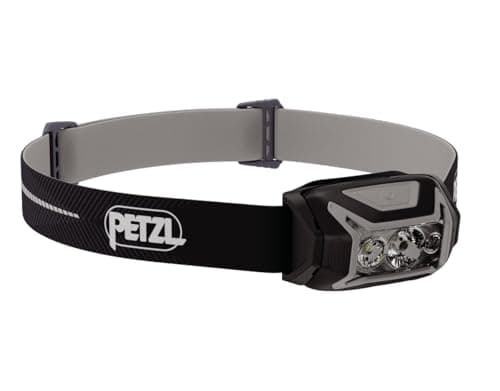 Petzl ACTIK CORE Best hybrid: rechargeable or AAA cells | 625 | Replaceable | 8 | $79.98 on Amazon Price as of October 18, 2026 — 8 lumens per dollar. #ad How we earn |
| 3 | 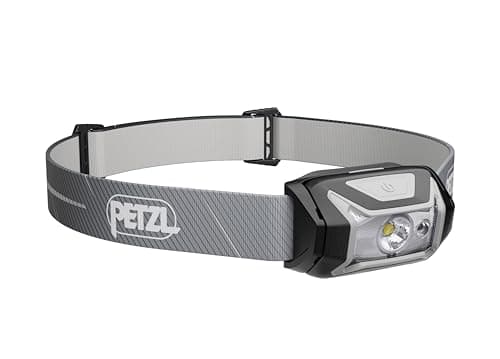 Petzl TIKKA CORE Best hybrid headlamp at the lower price | 450 | Replaceable | 8 | $54.95 on Amazon Price as of October 18, 2026 — 8 lumens per dollar. #ad How we earn |
| 4 | 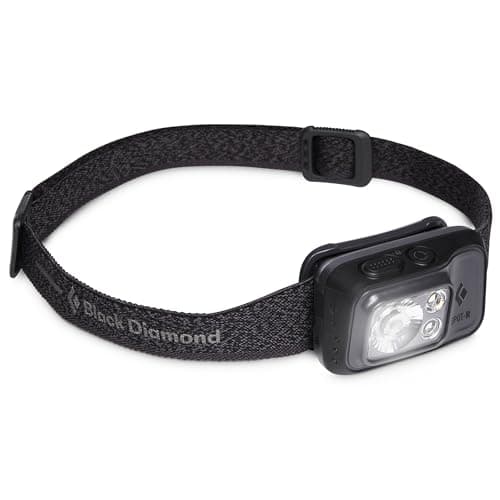 Black Diamond Spot 400-R Most complete published runtime table | 400 | Sealed | 7 | $57.88 on Amazon Price as of October 18, 2026 — 7 lumens per dollar. #ad How we earn |
Prices pulled October 18, 2026. Lumens per dollar is the manufacturer's published maximum output divided by that price, recomputed every time the price moves.
Decision 4: red light, and whether you can reach it
A red mode preserves dark adaptation because rod cells are far less sensitive at the red end of the spectrum, and it stops you blinding whoever is sitting opposite you. Nearly every lamp has one now. The specification that separates them is whether red is one press away or buried behind the white sequence — a red mode you have to cycle through 400 lumens to reach defeats its own purpose every single time you use it. Our ranking of red-light headlamps goes through the implementations.
Decision 5: the water rating, as a number
Petzl publishes IPX4 on both CORE lamps, Black Diamond IP67 on the Spot 400-R, NITECORE IP66 on the NU25. IPX4 is splashes and rain from any angle; IP67 adds dust and immersion to one meter for thirty minutes. For most people IPX4 is genuinely enough — a headlamp is rarely submerged and often rained on. If the lamp will go in a boat, a cave or a river, the higher number earns its money. Our guide to IP ratings sets out what each digit actually certifies.
Decision 6: lock-out, which sounds trivial until it is not
A headlamp in a pack is a switch waiting to be pressed by a water bottle. A lock-out function — a long press, or physically reversing a battery — is the difference between arriving with a charged lamp and arriving with a warm, empty one. Check it is there before you check anything cosmetic.
1. Lightest headlamp with a real published runtime
NITECORE NU25 MCT UL
Lumens per dollar
11
Forty-seven grams including the headband, 400 lumens, and 45 hours at its 6-lumen setting. On a headlamp the weight figure matters more than the lumen figure, because the lamp you stop wearing produces no light at all.
- Max output
- 400 lm
- Runtime
- 45 h at 6 lm
- Battery
- Sealed
- Water rating
- IP66
What it gets right
- Forty-seven grams with the band on — you forget it is there
- Three color temperatures plus red, which is unusual at any price
- IP66 and a published 45-hour low-mode runtime
What it gets wrong
- Sealed 700 mAh cell; no way to carry a spare
- Four hundred lumens is modest for trail running at speed
- Flat band with no over-the-top strap on the ultralight version
Published specification
- Maximum output: 400 lumens — NITECORE published specification
- Beam distance: 132 m — NITECORE published specification
- Runtime: Up to 45 hours at 6 lumens — NITECORE published specification
- Battery: Built-in 700 mAh Li-ion, USB-C — NITECORE published specification
- Weight: 47 g (1.66 oz) including bracket and headband — NITECORE published specification
- Water rating: IP66 — NITECORE published specification
- Color temperatures: 3,000K / 4,500K / 6,500K plus auxiliary red — NITECORE published specification
Skip this one if
you need to swap a battery mid-shift. A sealed 700 mAh cell means your night ends when it does.
Buy it if: hikers, campers and anyone whose complaint about headlamps is that they bounce.
- Output 6.5
- Battery 4.5
- Weight 9.5
- Usability 8.5
- Overall 7.8
Price as of October 18, 2026 — 11 lumens per dollar. #ad How we earn
2. Best hybrid: rechargeable or AAA cells
Petzl ACTIK CORE
Lumens per dollar
8
Six hundred and twenty-five lumens stated to ANSI/PLATO FL1, 88 grams, and — the part that matters — it runs on the CORE rechargeable pack or on three AAA cells when the pack is flat. That is the answer to the sealed-battery problem, from the only brand here that bothered.
- Max output
- 625 lm
- Runtime
- Published per mode by Petzl
- Battery
- Replaceable cell
- Water rating
- IPX4
What it gets right
- Explicitly states ANSI/PLATO FL1 conformity, which most brands here do not
- Hybrid power: the pack for daily use, AAA cells as the fallback that never fails
- Petzl publishes the CORE pack's cycle rating, so its service life is a stated number
What it gets wrong
- IPX4 — weather resistant, not submersible
- Eighty-eight grams is not ultralight
- The CORE pack is a Petzl part rather than a standard cell
Published specification
- Maximum output: 625 lumens (ANSI/PLATO FL1) — Petzl published specification
- Weight: 88 g — Petzl published specification
- Battery: CORE rechargeable 1,250 mAh / 3.6 V / 4.5 Wh, or 3 x AAA — Petzl published specification
- Battery compatibility: Alkaline, lithium or Ni-MH — Petzl published specification
- Water rating: IPX4, weather resistant — Petzl published specification
- Warranty: Lamp 5 years; CORE battery 2 years or 300 cycles — Petzl published specification
- Lighting levels: MAX BURN TIME, STANDARD, MAX POWER, plus red — Petzl published specification
Skip this one if
you want a submersible headlamp. IPX4 covers rain and nothing beyond it.
Buy it if: anyone whose headlamp has to work at the end of a long trip, when charging is not an option.
- Output 7.5
- Battery 9.0
- Weight 7.0
- Usability 8.5
- Overall 8.3
Price as of October 18, 2026 — 8 lumens per dollar. #ad How we earn
3. Best hybrid headlamp at the lower price
Petzl TIKKA CORE
Lumens per dollar
8
The ACTIK CORE's argument in a cheaper, lighter package: 450 lumens stated to ANSI/PLATO FL1, 84 grams, and the same CORE pack or three AAA cells when the pack is flat. Petzl publishes a lumen figure, a beam distance and a burn time for every mode on both power sources, which almost nobody else does even once.
- Max output
- 450 lm
- Runtime
- 2 h 30 min at 450 lm; 110 h at 7 lm
- Battery
- Replaceable cell
- Water rating
- IPX4
What it gets right
- Lumens, beam distance and burn time published for every mode on BOTH power sources
- States ANSI/PLATO FL 1 conformity, which most brands at this price do not
- Runs on three AAA cells when the CORE pack is flat, with no adapter to lose
- One hundred and ten hours at 7 lumens is a genuine emergency reserve
What it gets wrong
- IPX4 — weather resistant, not submersible
- Four hundred and fifty lumens is modest against lamps at similar money
- Output drops to 350 lumens on AAA cells, which Petzl states but buyers miss
- The CORE pack is a Petzl part rather than a standard cell
Published specification
- Maximum output: 450 lumens (ANSI/PLATO FL 1) — Petzl published specification
- MAX POWER on CORE: 450 lumens, 75 m, 2 h 30 min — Petzl published specification
- MAX POWER on AAA: 350 lumens, 70 m, 2 hours — Petzl published specification
- STANDARD on CORE: 100 lumens, 45 m, 7 hours — Petzl published specification
- STANDARD on AAA: 100 lumens, 45 m, 12 hours — Petzl published specification
- MAX BURN TIME: 7 lumens, 10 m, 110 hours on either source — Petzl published specification
- Red lighting: 2 lumens, 5 m, 60 hours continuous — Petzl published specification
- Battery: CORE 1,250 mAh / 3.6 V / 4.5 Wh, or 3 x AAA — Petzl published specification
- Weight: 84 g — Petzl published specification
- Water rating: IPX4, weather resistant — Petzl published specification
- Warranty: Lamp 5 years; CORE battery 2 years or 300 cycles — Petzl published specification
Skip this one if
you want maximum output for the money. This lamp spends its budget on documentation, hybrid power and a five-year warranty, and a budget rechargeable will out-lumen it for less.
Buy it if: anyone who wants Petzl's hybrid-power argument without paying for the ACTIK CORE's extra output.
- Output 6.5
- Battery 9.0
- Weight 7.5
- Usability 8.5
- Overall 8.0
Price as of October 18, 2026 — 8 lumens per dollar. #ad How we earn
4. Most complete published runtime table
Black Diamond Spot 400-R
Lumens per dollar
7
Four hundred lumens for four hours, 200 for eight, 6 for two hundred and twenty-five. Black Diamond publishes lumens, runtime and beam distance for all three modes, and IP67 on top. There is nothing to guess at here.
- Max output
- 400 lm
- Runtime
- 4 h
- Battery
- Sealed
- Water rating
- IP67
What it gets right
- Lumens, runtime and distance published for every mode
- Two hundred and twenty-five hours on low is a genuine emergency reserve
- IP67 and a battery meter that shows an actual percentage
What it gets wrong
- Micro-USB in a year when everything else is USB-C
- Integrated battery — no spare, no re-cell
- Eighty-six grams is heavy next to the ultralight class
Published specification
- High: 400 lumens, 4 hours, 100 m — Black Diamond published specification
- Medium: 200 lumens, 8 hours, 60 m — Black Diamond published specification
- Low: 6 lumens, 225 hours, 12 m — Black Diamond published specification
- Battery: Integrated 1,500 mAh Li-ion, micro-USB — Black Diamond published specification
- Water rating: IP67, tested to 1.0 m for 30 minutes — Black Diamond published specification
- Weight: 86 g — Black Diamond published specification
Skip this one if
you have standardized on USB-C. Carrying a second cable for one device is a small annoyance that compounds on a long trip.
Buy it if: camp, dog walks and anyone who wants a headlamp whose numbers are all on the box.
- Output 6.5
- Battery 5.5
- Weight 7.0
- Usability 9.0
- Overall 7.7
Price as of October 18, 2026 — 7 lumens per dollar. #ad How we earn
How we ranked these
Published output over live price, as everywhere on this site, with battery architecture weighted hardest and weight scored in place of build on headlamps. A lamp that publishes a complete per-mode table scores above one that publishes a single headline figure, because a number you can check is worth more than a number you cannot.
Units we claim to have tested: 0
Every publisher in this category says they tested twenty flashlights. We have not tested any, and we say so. What we do instead: compile the manufacturer's own published ANSI FL1 figures, pull the price the light is selling for right now, and divide one by the other. Every number on this page is one you can check yourself in about two minutes.
How many lumens do you actually need on your head?
| What you are doing | Lumens | What to check instead |
|---|---|---|
| Reading in a tent, checking on a child | 5 - 20 | That the lamp HAS a mode this low, and its runtime |
| Camp chores, a dog walk, a loft | 50 - 150 | Runtime at this level, not the maximum |
| Walking a trail at night | 100 - 250 | Beam shape: you want flood, not reach |
| Running on rough ground | 200 - 400 | Weight and bounce before output |
| Working on something at arm's length | 100 - 200 | Color rendering if the work is color-critical |
Beam shape, which no headlamp sells itself on
Headlamps are bought on lumens and used on beam shape, and the two have almost nothing to do with each other. A headlamp sits a few inches above your eyes and points where you look, which makes a tight beam actively unhelpful for most jobs: you get a bright circle on the ground, an immediate contrast edge around it, and nothing useful in your peripheral vision.
What you want for walking, camp chores and work at arm's length is flood — a wide, even pool with soft edges. What you want for picking a line down a technical descent, or spotting a trail marker across a slope, is some reach. Lamps that publish a beam distance tell you which they are: Petzl publishes 75 meters for the TIKKA CORE at 450 lumens against Black Diamond's 100 meters for the Spot 400-R at 400, and that difference is beam shape, not output.
The better lamps hedge by giving you both emitters and letting you mix them. Where a lamp has only one, assume flood unless a beam distance says otherwise, and treat a very long published distance on a small headlamp as a warning that its wide mode may be mediocre.
The headband, which decides whether you wear it
Three things about the strap matter and none of them appears as a number. Whether there is a top strap: on anything above about 100 grams, or anything you will run in, a crown strap is the difference between a lamp that stays put and one you re-seat every ten minutes. Whether the band is washable: a headlamp worn against a forehead for a season is a genuinely unpleasant object by spring, and removable electronics make that fixable. And whether the tilt ratchet holds: a hinge that creeps downward under its own weight will aim at your boots by the end of a walk, which is the most common complaint about cheap lamps and the hardest to check before buying.
Battery placement belongs here too. A lamp with the cell at the back of the band balances better than one with everything at the front, which is why heavier hybrid lamps often feel lighter in use than their weight suggests. It also means the weight figures in the table above are not directly comparable to how two lamps feel.
What we cannot tell you
We have not worn any of these lamps. We cannot tell you how a given headband sits under a helmet, how the beam of one compares with another in person, how much any of them bounce at a running cadence, or how long a CORE pack lasts in real seasons of use. Every figure above is published by the manufacturer named beside it, and the ordering of the six decisions is our editorial judgment, stated as such.
Common questions
How do I choose a headlamp?
Decide the battery architecture first. A hybrid lamp that takes a rechargeable pack or ordinary AAA cells — the Petzl ACTIK CORE, for example — cannot leave you in the dark when the pack is flat; a sealed rechargeable is lighter and cheaper but depends on a power bank. Then compare the runtime at the lowest usable mode, because that is where a headlamp spends its life, and only then look at weight, red mode, water rating and lock-out. The maximum lumen figure should be the last thing you check.
How many lumens should a headlamp have?
Between 200 and 400 lumens of maximum output covers nearly every use, and you will rarely use it. Reading in a tent wants 5 to 20 lumens, camp chores 50 to 150, walking a trail 100 to 250, running on rough ground 200 to 400. The specification that matters is the runtime at the low end: Black Diamond publishes 225 hours at 6 lumens for the Spot 400-R, which is the kind of number that decides whether a lamp is useful.
Is a rechargeable headlamp better than one that takes batteries?
For regular use, yes — it is lighter and costs nothing to run. For anything safety-critical, a hybrid that takes either is better, because a flat pack on a trail is a problem that AAA cells solve in thirty seconds. Petzl's CORE system does both: 625 lumens on the pack or 500 on three AAAs for the ACTIK CORE.
What weight should a headlamp be?
Between about 45 and 120 grams, and the lower end of that is noticeably more comfortable. NITECORE publishes 47 grams for the NU25 MCT UL including bracket and headband; Petzl publishes 88 grams for the ACTIK CORE, which carries the extra mass of a swappable pack. Above roughly 100 grams a lamp bounces when you run and presses when you wear anything under it.
How many lumens do I actually need?
For walking a dog, finding a fuse box or reading a map, 100 to 300 lumens is plenty and will run far longer. For a garage, a yard or a campsite, 500 to 1,000 lumens is comfortable. Above about 2,000 lumens you are buying a burst rather than a mode, because almost no handheld light can shed that much heat continuously.
Sources
- Petzl published product specifications — ANSI/PLATO FL 1 conformity stated by the manufacturer. ACTIK CORE read 2026-09-01 and re-read per mode 2026-09-21; TIKKA CORE read 2026-09-21
- Black Diamond published product specifications — Spot 400-R read 2026-09-01; Storm 500-R read 2026-09-14
- NITECORE published product specifications — NU25 MCT UL read 2026-09-01; MT2A Pro read 2026-09-13; EDC31 read 2026-10-03; MH25 Pro and Tiki LE read 2026-10-10
- Lumen & Ledger method — how every figure on this page is derived
Who writes this
Scooter M. — I am an enthusiast who is genuinely into this. I read the manuals, compile the published specs, and do the math. No lab coat, no test bench, no drawer of free samples. What I can tell you is exactly what a light claims on paper, exactly what it costs right now, and what those two numbers mean when you divide one by the other.
Read next
Best rechargeable headlamps
Ranked on weight and published runtime, because a lamp you stop wearing lights nothing.
Best headlamps with a red light
What red mode is actually for, and which lamps implement it properly.
Headlamp vs flashlight
Hands beat lumens more often than people expect. The four jobs that decide which you buy.
IP and IPX ratings explained
What IPX4, IPX7 and IP68 mean, and why a missing rating is information too.
Best budget rechargeable headlamps
What drops out of the spec sheet first when the price falls.
The Ledger
Every light we cover in one ranked table, sorted by lumens per dollar.