Work Lights & Lanterns
Best Rechargeable Work Lights for a Garage
A garage is not a job site. The light does not need to travel, which changes what you should buy — and makes the overhead fixture you already have the first thing to fix.
By Scooter M. · Published September 13, 2026
Short answer
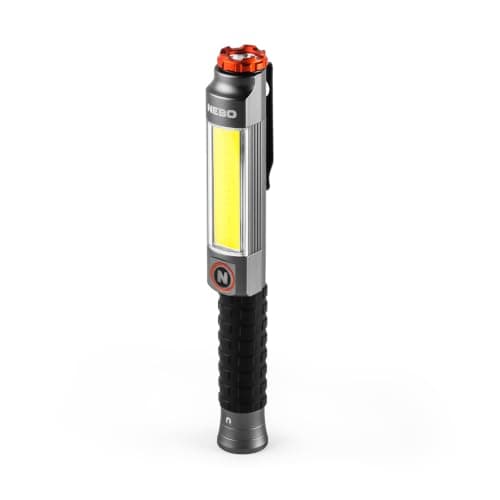
NEBO BIG LARRY 3
A 600-lumen COB panel, a 220-lumen spot and a red task mode, on three AA cells, with a magnet strong enough to hold it under a hood. It is the least glamorous light here and it is the one that gets used most.
Price as of September 14, 2026 — 39 lumens per dollar. #ad How we earn
Disclosure — we earn a commission on qualifying purchases made through the Amazon links on this page, at no extra cost to you. It does not change which lights we pick or what we say about them. The full version.
How we rank. Published ANSI FL1 output divided by the live retail price, with sealed-battery lights marked down because a light you cannot re-cell is a light with an expiry date. Units we claim to have tested: 0 — we compile manufacturers' published figures and show the arithmetic instead. How we work this out.
What a garage light is judged on
In a garage the light stays in one building, so rank on three things: color rendering, because you are looking at wiring, paint and fluid; a mount that actually holds, because both hands are busy; and a runtime that covers a whole session rather than a task. Streamlight publishes a 90-CRI flood at 400 lumens for the Syclone. Raw output is the fourth question, and portability barely matters at all.
Before the picks, the honest advice that costs less than any light here: if your garage has one dim bulb in the middle of the ceiling, fixing that fixture will do more for your working life than any portable light, and a portable is a supplement to it rather than a replacement. This page is about the light you pick up to see into the places the ceiling cannot reach, which in a garage is most places.
Criterion one: color rendering, because of what is in a garage
A garage is where wiring, paint, corrosion and fluids all live, and every one of those is a color judgment. Under a cheap 70-CRI emitter, red and brown wire look alike, dark paint has no shade to it, rust and wet dirt are the same thing, and a coolant drip and a water drip are indistinguishable.
Streamlight publishes a 90 CRI rating for the Syclone, which is the single most useful specification on this page and the reason it leads. It costs output — 400 lumens against the 600 of the cheaper COB panel below it — and that is a trade worth making for any job where you are deciding what something is rather than just finding it. Our review of the Wurkkos FC11 explains what 90 CRI changes in more detail.
Criterion two: flood, not beam
Everything in a garage happens within about two meters of your hands, and at that distance a flashlight's tight hotspot is the wrong tool. It lights a bright circle, blows out your pupil response, and turns everything around the circle black — then moves every time your hand does.
A COB flood panel lights a whole area evenly at a lower intensity, which is far less tiring over an hour and lets you see the thing you are working on and the parts you just put down. The trade is that COB panels as a class render color poorly, which is exactly the tension this page has to resolve: the cheap flood is the better shape and the worse color. NEBO publishes 600 lumens of COB flood on the BIG LARRY 3 and 500 lumens for two and a half hours on the FRANKLIN TaskBar.
| # | Light | Max output | Battery | Lumens / $ | Price |
|---|---|---|---|---|---|
| 1 | NEBO BIG LARRY 3 Best cheap magnetic work light | 600 | AA / AAA | 39 | $15.50 on Amazon Price as of September 14, 2026 — 39 lumens per dollar. #ad How we earn |
| 2 | 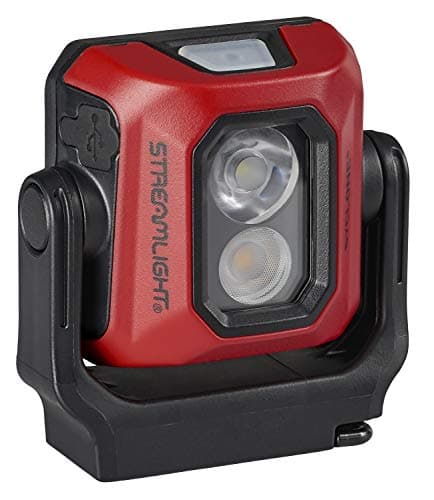 Streamlight Syclone Best work light with a 90 CRI flood | 400 | Sealed | 7 | $60.99 on Amazon Price as of September 14, 2026 — 7 lumens per dollar. #ad How we earn |
| 3 | 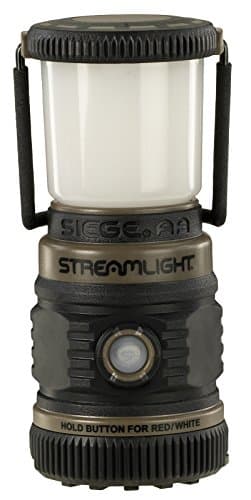 Streamlight Siege AA Best outage lantern that floats | 200 | AA / AAA | 6 | $32.49 on Amazon Price as of September 14, 2026 — 6 lumens per dollar. #ad How we earn |
| 4 | No listing image NEBO FRANKLIN TaskBar Best published runtime on a budget work light | 500 | AA / AAA | Needs a live price | Check price on Amazon We show a price only when we have pulled a live one. #ad How we earn |
| 5 | No listing image NEBO SLIM Mini 500 Best pocket task light for a toolbag | 500 | Sealed | Needs a live price | Check price on Amazon We show a price only when we have pulled a live one. #ad How we earn |
Prices pulled September 14, 2026. Lumens per dollar is the manufacturer's published maximum output divided by that price, recomputed every time the price moves.
Criterion three: it has to stay where you put it
In a garage you are almost always two-handed, so how the light mounts is a functional specification rather than a convenience. A magnet on the base lets a light stand and aim; a magnet on the back only lets it lie flat. A hook lets it hang from a hood or a shelf edge. A wall-mount hole means it can live in one known place and be charged there.
NEBO fits a magnetic base, a steel belt clip and a wall-mount hole to both the BIG LARRY 3 and the FRANKLIN TaskBar, which is a genuinely well-judged set for this room. What no manufacturer publishes is magnet pull force, so we cannot rank on magnet strength and will not pretend to — a magnet that holds through the vibration of an impact driver and one that drops the light into your engine bay look identical on a specification sheet.
Criterion four: a session, not a task
A garage session is two or three hours, not ten minutes, and a light that dies halfway through is worse than a dimmer one that does not. So the figure that matters is the runtime at the setting you will actually work under, and the brands worth buying publish it.
| Light | Published work-light output | Published runtime there | Mounting |
|---|---|---|---|
| Streamlight Syclone | 400 lm, 90 CRI flood | Published by Streamlight | Clip and magnet |
| NEBO FRANKLIN TaskBar | 500 lm flood | 2 h 30 min (150 lm for 14 h 30 min) | Magnetic base, clip, wall hole |
| NEBO BIG LARRY 3 | 600 lm COB / 150 lm low | Not published | Magnetic base, clip, wall hole |
| Streamlight Siege AA | 200 lm area | 7 h (50 lm for 37 h) | Hook and flat base |
| NEBO SLIM Mini 500 | 500 lm turbo for 30 s | 250 lm for 2 h | Magnetic base |
The FRANKLIN TaskBar publishes a runtime for all seven of its modes, which at this price is the exception rather than the rule and is why it finishes ahead of the brighter BIG LARRY 3. NEBO publishes no runtime at all for the BIG LARRY 3, and on a light bought to work under for an evening that is a real gap.
1. Best cheap magnetic work light
NEBO BIG LARRY 3
Lumens per dollar
39
A 600-lumen COB panel, a 220-lumen spot and a red task mode, on three AA cells, with a magnet strong enough to hold it under a hood. It is the least glamorous light here and it is the one that gets used most.
- Max output
- 600 lm
- Runtime
- Not published per mode
- Battery
- AA / AAA
- Water rating
- None published
What it gets right
- A flood panel is the right shape of light for working on something close up
- AA cells, so it survives a year in a toolbox and still lights
- The magnet is strong enough to matter
What it gets wrong
- NEBO publishes no runtime and no water rating for this model
- COB panels have poor color rendering as a class
- Not rechargeable, so the running cost is AA cells
Published specification
- COB work light: 600 lumens high / 150 lumens low — NEBO published specification
- Spot flashlight: 220 lumens high / 60 lumens low — NEBO published specification
- Red task light: 40 lumens high / 12 lumens low — NEBO published specification
- Battery: 3 x AA (included) — NEBO published specification
- Weight: 0.42 lb — NEBO published specification
- Fittings: Magnetic base, steel belt clip, wall-mount hole — NEBO published specification
- Per-mode runtime: Not published on the product page
- Water rating: Not published on the product page
Skip this one if
you need to see color accurately. For paint matching or diagnosing a wiring loom, a high-CRI light is worth the extra money.
Buy it if: the toolbox, the trunk and the shelf above the workbench.
- Output 6.5
- Battery 7.0
- Build 7.5
- Usability 8.5
- Overall 7.3
Price as of September 14, 2026 — 39 lumens per dollar. #ad How we earn
2. Best work light with a 90 CRI flood
Streamlight Syclone
Lumens per dollar
7
Four hundred lumens of spot for two hours or 300 lumens of 90-CRI flood for the same, in a 5.3-ounce body that clips, magnets and stands. Every mode's runtime is published, including the flood modes most brands ignore.
- Max output
- 400 lm
- Runtime
- 2 h
- Battery
- Sealed
- Water rating
- IPX4
What it gets right
- A 90 CRI flood, which matters more than lumens when you are diagnosing anything
- Spot and flood in one body with runtimes published for both
- Magnet, clip and a stand that lets it point where you need it
What it gets wrong
- Sealed lithium-polymer cell
- IPX4 — it handles a splash and not a puddle
- Four hundred lumens is modest if you want to light a whole garage
Published specification
- Spot high: 400 lumens, 141 m, 2 hours — Streamlight published specification
- Spot medium: 200 lumens, 95 m, 4.5 hours — Streamlight published specification
- Spot low: 100 lumens, 72 m, 9.5 hours — Streamlight published specification
- Flood high: 300 lumens, 48 m, 2 hours, 90 CRI — Streamlight published specification
- Flood low: 75 lumens, 24 m, 8 hours — Streamlight published specification
- Battery: Lithium-polymer, USB rechargeable, 4.5 h charge — Streamlight published specification
- Water rating: IPX4 — Streamlight published specification
- Impact: 2 m tested — Streamlight published specification
- Weight: 5.3 oz (150 g) — Streamlight published specification
Skip this one if
you need to flood a large space. This is an arm's-reach light; a lantern or a panel does big areas better.
Buy it if: mechanics and electricians who need to see true color at close range.
- Output 6.5
- Battery 5.0
- Build 8.5
- Usability 9.0
- Overall 7.6
Price as of September 14, 2026 — 7 lumens per dollar. #ad How we earn
3. Best outage lantern that floats
Streamlight Siege AA
Lumens per dollar
6
Two hundred lumens for seven hours, fifty for thirty-seven, and a red night-vision mode Streamlight rates at 192 hours. It runs on AA cells, it is IPX7, and it floats. For a storm shelf that is the correct specification.
- Max output
- 200 lm
- Runtime
- 7 h
- Battery
- AA / AAA
- Water rating
- IPX7
What it gets right
- AA cells store for a decade and are available anywhere, including mid-outage
- IPX7 and it floats, which is the correct answer for a flooded basement
- Runtime published for all five modes, including the 8-day red mode
What it gets wrong
- Two hundred lumens is dim next to a rechargeable lantern
- No rechargeable option in this version
- Removable cover changes the beam pattern and is easy to lose
Published specification
- White high: 200 lumens, 7 hours — Streamlight published specification
- White medium: 100 lumens, 15.5 hours — Streamlight published specification
- White low: 50 lumens, 37 hours — Streamlight published specification
- Red high: 0.7 lumens, 192 hours (8 days) — Streamlight published specification
- SOS flash: 0.7 lumens, 288 hours (12 days) — Streamlight published specification
- Battery: AA alkaline — Streamlight published specification
- Water rating: IPX7, 1 m — and it floats — Streamlight published specification
- Impact: 2 m tested — Streamlight published specification
Skip this one if
you want a bright camp lantern. This is an endurance light, not an area light.
Buy it if: the storm shelf, the boat and the basement that occasionally has water in it.
- Output 4.5
- Battery 9.5
- Build 9.0
- Usability 8.5
- Overall 7.9
Price as of September 14, 2026 — 6 lumens per dollar. #ad How we earn
listing
image
4. Best published runtime on a budget work light
NEBO FRANKLIN TaskBar
Lumens per dollar
Computed the moment we have a live price for it
Five hundred lumens of flood for two and a half hours, 200 lumens of spot for eight, and a red mode for twenty — every one of those numbers printed by NEBO rather than inferred by us. For a light at this price that is unusually complete.
- Max output
- 500 lm
- Runtime
- 2 h 30 min
- Battery
- AA / AAA
- Water rating
- None published
What it gets right
- Runtime published for all seven modes — the exception rather than the rule at this price
- Flood, spot and red in one body with a magnetic base
- AA cells, wall-mount hole, steel belt clip
What it gets wrong
- No water rating published anywhere on the product page
- 500 lumens of COB flood is modest next to a rechargeable panel
- Disposable AAs again
Published specification
- Work light high: 500 lumens, 2 h 30 min, 31 m — NEBO published specification
- Work light low: 150 lumens, 14 h 30 min, 18 m — NEBO published specification
- Flashlight high: 200 lumens, 8 hours, 75 m — NEBO published specification
- Flashlight low: 60 lumens, 24 hours, 50 m — NEBO published specification
- Red task light: 40 lumens, 20 hours — NEBO published specification
- Battery: 3 x AA (included) — NEBO published specification
- Weight: 0.45 lb — NEBO published specification
- Water rating: Not published on the product page
Skip this one if
the light will live outdoors. Without a published IP rating we cannot tell you what it survives, and neither can NEBO.
Buy it if: the person who wants one bar-shaped light that does flood, spot and red without a menu.
- Output 6.0
- Battery 7.0
- Build 7.5
- Usability 8.5
- Overall 7.2
We show a price only when we have pulled a live one. #ad How we earn
listing
image
5. Best pocket task light for a toolbag
NEBO SLIM Mini 500
Lumens per dollar
Computed the moment we have a live price for it
The most honest spec sheet in this whole roundup, and not in the way NEBO intended: turbo is 500 lumens for thirty seconds. High is 250 lumens for two hours. That thirty-second figure is printed by the manufacturer, and it is the clearest illustration of the whole turbo problem you will find.
- Max output
- 500 lm
- Runtime
- 30 seconds at turbo; 2 h at 250 lm high
- Battery
- Sealed
- Water rating
- IPX4
What it gets right
- Genuinely flat — it disappears into a work-pants pocket
- Magnetic base plus green and red modes for inspection work
- NEBO states the turbo duration outright, which is rare and creditable
What it gets wrong
- Turbo lasts half a minute; treat 250 lumens as the real specification
- 450 mAh sealed cell, so this is a light with a service life rather than a lifespan
- IPX4 is splash resistance and nothing more
Published specification
- Turbo: 500 lumens for 30 seconds, 100 m — NEBO published specification
- High: 250 lumens, 2 hours, 250 m — NEBO published specification
- Low: 50 lumens, 5 hours, 50 m — NEBO published specification
- Battery: 450 mAh 3.7V (1.66 Wh) Li-ion, built in — NEBO published specification
- Recharge time: 2 hours, USB-C — NEBO published specification
- Water rating: IPX4 — NEBO published specification
- Weight: 0.07 lb — NEBO published specification
Skip this one if
you want a light for walking outdoors. This is a task light for arm's-length work and it does not throw usefully far in practice.
Buy it if: electricians, mechanics and anyone whose light spends its life eighteen inches from the thing it is lighting.
- Output 6.0
- Battery 4.5
- Build 7.5
- Usability 8.5
- Overall 6.8
We show a price only when we have pulled a live one. #ad How we earn
Light the bay, then light the task
The mistake that makes a garage feel permanently dim is trying to do both jobs with one light. Area lighting and task lighting have opposite requirements: an area light should be high, diffuse and always on, while a task light should be close, aimable and bright only where you are working.
Run one portable as a standing area light — a lantern-style unit like the Siege AA on a shelf, or a bar light hung from a hook — and keep a second in your hand or on the magnet for the actual job. Two 400-lumen lights arranged that way produce a far more usable garage than one 1,500-lumen light does, because the second one kills the shadow the first one casts.
That shadow point is the whole reason a single overhead bulb is so unsatisfying. With one source, your own head and hands block the light exactly where you are looking. Two sources from different angles is the actual fix, and it costs less than upgrading either one.
Where it lives and how it charges
A garage light that has to be hunted for gets replaced by a phone. The advantage of this room over a job site is that the light can have a permanent home with power at it, and the lights worth buying support that: NEBO fits a wall-mount hole to both the BIG LARRY 3 and the FRANKLIN TaskBar, and a magnetic base means a steel cabinet door works as a mount with no drilling.
Put the charger where the light lives rather than on a bench, so putting it away and charging it are the same action. This is the difference between a rechargeable light that is charged when you reach for it and one that is a paperweight with a cable somewhere, and it costs nothing but a decision. Our page on charging a rechargeable flashlight covers the storage habits that actually extend a cell's life.
Rechargeable or AA in a garage
Unusually, this is a room where both answers are defensible and the right one depends on how often you are out there. A light used most weekends should be rechargeable and should live on a charger on the wall, where the running cost is nothing and the output stays steady under load.
A light used four times a year is better on AA cells, because a lithium cell left flat in a cold garage over a winter is frequently unrecoverable, while a set of alkalines sits happily for years. NEBO builds both the BIG LARRY 3 and the FRANKLIN TaskBar around three AA cells for exactly this reason, and the cold argument is why our outage rankings lean the same way.
One more argument for the AA models specifically in this room: a garage light is the one most likely to be borrowed and not returned for a week. A light running on cells you already keep in a kitchen drawer survives that; a light with a proprietary charger somewhere does not, and comes back flat.
Cold, damp and the ratings nobody publishes
A garage in winter is cold and often damp, and this is where the specification sheets get thin. NEBO publishes no water rating for either the BIG LARRY 3 or the FRANKLIN TaskBar, and Streamlight publishes IPX4 for the Syclone — splash resistance, which is adequate for a wash bay but not for a light left on a wet floor.
A missing rating is not proof a light leaks, but it does mean nobody has told you what it survives. If the light will live on a shelf in an unheated garage, the AA-powered options are the safer purchase on the cold argument alone, and our guide to IP ratings covers what the published figures do and do not promise.
Damp has a second effect people miss, and it is not corrosion. A cold light brought into a warm garage, or a warm one taken out to a cold car, breathes moist air past its seals as it cools and condenses it inside. That is how a light with a perfectly good rating ends up with fog behind the lens, and it is an argument for storing the light in the space it is used in rather than carrying it back and forth.
How we ranked these
The four scored attributes published on our methodology page — output against live price, battery architecture, build as evidenced by published ratings, and usability — with color rendering treated as part of output quality and mounting folded into usability. A 90-CRI light at 400 lumens is scored ahead of a 70-CRI light at 600, because the first one shows you what you are looking at and the second only shows you where it is.
Units we claim to have tested: 0
Every publisher in this category says they tested twenty flashlights. We have not tested any, and we say so. What we do instead: compile the manufacturer's own published ANSI FL1 figures, pull the price the light is selling for right now, and divide one by the other. Every number on this page is one you can check yourself in about two minutes.
What we cannot tell you
We have not worked under any of these lights. We cannot tell you how strong each magnet really is, whether a clip survives a year of being knocked off a bench, how the COB panels look against the 90-CRI flood side by side, or how any of them cope with brake cleaner and oily hands. Magnet strength in particular is the attribute most likely to decide whether you keep using one of these, and not one manufacturer publishes a figure for it. The same goes for how well any of these finishes resist brake cleaner, which is the solvent most likely to meet a garage light.
Common questions
What is the best work light for a garage?
For most people, a high-CRI flood rather than the brightest light available — Streamlight publishes a 90-CRI flood at 400 lumens for the Syclone, and color accuracy is what lets you tell red wire from brown and coolant from water. If you need more raw area light for less money, NEBO publishes 600 lumens of COB flood on the BIG LARRY 3 with a magnetic base, at the cost of poorer color rendering.
How many lumens do you need for a garage work light?
Between 300 and 600 lumens of flood covers close work comfortably and will run for hours. Much higher figures mostly shorten the runtime and make the light unpleasant to work under at arm's length, because a bright source close to your eyes contracts your pupils and darkens everything around it. Fixing a dim overhead fixture does more for a garage than buying a brighter portable.
Should a garage work light be rechargeable or run on batteries?
It depends on how often you use the garage. A light used most weekends should be rechargeable and live on a wall charger — no running cost and steadier output under load. A light used a few times a year is safer on AA cells, because a lithium cell left flat through a cold winter is often unrecoverable while alkalines sit for years. NEBO builds the BIG LARRY 3 and FRANKLIN TaskBar around three AA cells for that reason.
Can you replace the battery in a rechargeable flashlight?
It depends entirely on the model, and it is the single most consequential thing to check before buying. Lights built around a standard cell — an 18650, a 21700, a 14500, a 16340 — take a screw-off tailcap and a five-dollar replacement. Lights with a built-in cell, which manufacturers describe as 'integrated' or 'non-removable', cannot be re-celled by an ordinary owner: when the battery reaches the end of its cycle life the whole light is refuse. Energizer, for example, states plainly that the Vision HD Rechargeable uses non-removable lithium-ion batteries.
Sources
- Streamlight published product specifications — per-mode lumens, runtime, beam distance, impact and IP ratings, read 2026-09-01
- NEBO published product specifications — mode-by-mode lumen, runtime and beam figures, read 2026-09-01
- Lumen & Ledger method — how every figure on this page is derived
Who writes this
Scooter M. — I am an enthusiast who is genuinely into this. I read the manuals, compile the published specs, and do the math. No lab coat, no test bench, no drawer of free samples. What I can tell you is exactly what a light claims on paper, exactly what it costs right now, and what those two numbers mean when you divide one by the other.
Read next
Best rechargeable work lights
Flood beats throw at arm's length, and color rendering beats both.
Best rechargeable work lights for mechanics
Color accuracy, magnets and the ability to survive being dropped in a bay.
Best magnetic rechargeable work lights
The magnet is the feature. Here is how to tell a good one from a decoration.
Wurkkos FC11 review
Ninety CRI at a price where seventy is normal, and what those seven hundred missing lumens buy you.
IP and IPX ratings explained
What IPX4, IPX7 and IP68 mean, and why a missing rating is information too.
The Ledger
Every light we cover in one ranked table, sorted by lumens per dollar.