Work Lights & Lanterns
COB vs LED Work Lights
COB is not an alternative to LED. It is LEDs, packed shoulder to shoulder on one board, and that single construction difference decides everything else about the light.
By Scooter M. · Published October 18, 2026

Short answer
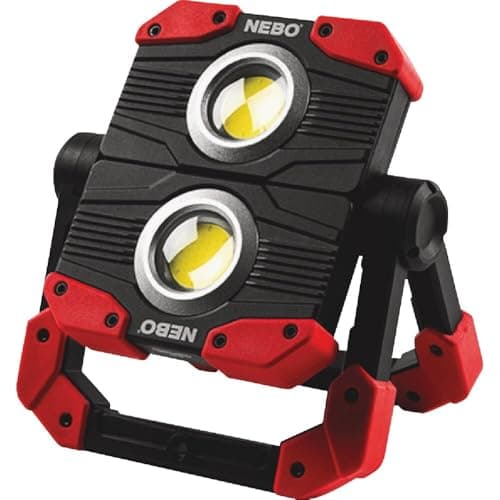
NEBO OMNI 2K
Two thousand lumens of COB flood with a published runtime for all six modes, a 4,000 mAh pack that will also charge a phone, and magnetic handles that let it hang anywhere. What it does not have is a numbered water rating, and COB panels render color poorly as a class.
Price as of October 18, 2026 — 57 lumens per dollar. #ad How we earn
Disclosure — we earn a commission on qualifying purchases made through the Amazon links on this page, at no extra cost to you. It does not change which lights we pick or what we say about them. The full version.
How we rank. Published ANSI FL1 output divided by the live retail price, with sealed-battery lights marked down because a light you cannot re-cell is a light with an expiry date. Units we claim to have tested: 0 — we compile manufacturers' published figures and show the arithmetic instead. How we work this out.
The short answer
COB stands for chip-on-board: dozens of bare LED chips mounted directly on one substrate so they light as a single panel rather than as points. It is not a competing technology to LED — it IS LEDs, packaged differently. Buy COB when you want the most flood light per dollar over a bench, a bay or a campsite: the NEBO OMNI 2K publishes 2,000 lumens for 1.3 hours at a price no single-emitter light comes near. Buy a conventional LED panel when you need to judge color or see any distance: Streamlight's FlipMate publishes a 90-CRI mode at 400 lumens for 4 hours, and that is the specification COB cannot match.
The query that brings most people here is some form of "is COB better than LED", and the honest answer is that the question contains a category error worth untangling before anything else.
What COB actually means
A conventional LED is one semiconductor die in its own package, with its own lens and its own electrical contacts, soldered to a circuit board. A COB array skips the individual packaging: the bare dies are bonded directly onto a shared substrate, sat close together, and covered with one continuous phosphor layer. Where a conventional emitter is a point of light, a COB array is a lit rectangle.
You will also see SMD on work-light packaging. SMD — surface-mounted device — is the conventional arrangement: individually packaged emitters placed on a board, usually in a visible grid of dots. COB versus SMD is the comparison people actually mean when they write COB versus LED, and both are LED.
| COB array | Conventional LED (SMD) emitter | |
|---|---|---|
| Construction | Bare dies bonded to one shared board | Individually packaged dies on a board |
| What the light looks like | One continuous lit panel | One or more visible points |
| Beam | Wide flood, no usable reach | Can be focused; reach is a design choice |
| Lumens per dollar | High — the main reason COB exists | Lower at the same output |
| Color rendering | Typically low; rarely published | Can be specified; 90 CRI is available |
| Shadows | Soft, because the source is large | Harder, because the source is small |
| Typical use | Area and task flood | Spot, throw, and color-critical work |
Why COB is cheap, and what the cheapness costs
Packaging each die individually is most of the cost of an LED. Skip it and you can put a great deal of light on a board for very little money, which is why COB panels dominate the bottom of the work-light market and why the lumens-per-dollar column on this page reads the way it does. The NEBO BIG LARRY 3 publishes 600 COB lumens for about the price of two coffees.
Two things are given up for that, and both are visible in use rather than subtle.
The first is reach. A large emitting surface cannot be collimated into a tight beam — the optics have nothing small to focus — so a COB panel throws a wide, short-range flood no matter what you put in front of it. NEBO publishes 70 meters for the OMNI 2K at 2,000 lumens; the same brand's SLYDE KING 4K publishes 350 meters from its conventional LED at 4,000. Twice the lumens, five times the distance, same manufacturer, same page.
The second is color. COB arrays are phosphor-converted for output rather than fidelity, and their color rendering is poor as a class. The telling detail is not that the CRI is low; it is that almost no COB product publishes a CRI figure at all. Neither NEBO product on this page publishes one. Streamlight publishes 90 CRI at 4,000K for the FlipMate's second emitter set and 90 CRI for the Syclone's flood, and prints the figure where you can read it.
| # | Light | Max output | Battery | Lumens / $ | Price |
|---|---|---|---|---|---|
| 1 | NEBO OMNI 2K Most COB lumens per dollar | 2,000 | Sealed | 57 | $34.88 on Amazon Price as of October 18, 2026 — 57 lumens per dollar. #ad How we earn |
| 2 | 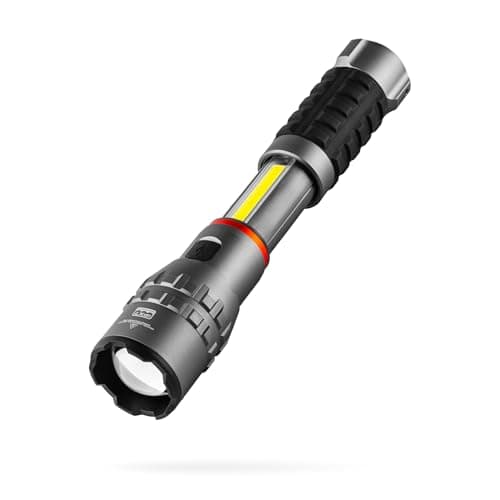 NEBO SLYDE KING 4K Best light with both an LED spot and a COB panel | 4,000 | Sealed | 53 | $75.00 on Amazon Price as of October 18, 2026 — 53 lumens per dollar. #ad How we earn |
| 3 | 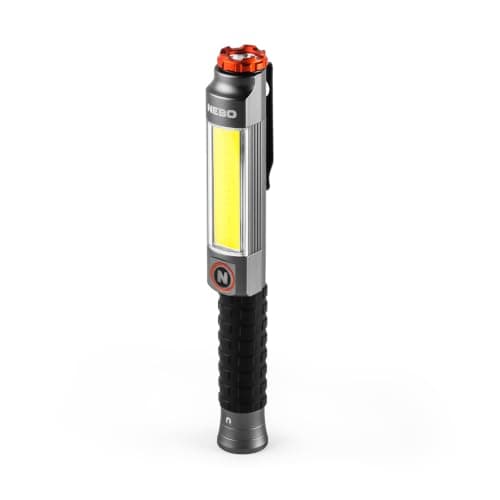 NEBO BIG LARRY 3 Best cheap magnetic work light | 600 | AA / AAA | 50 | $11.92 on Amazon Price as of October 18, 2026 — 50 lumens per dollar. #ad How we earn |
| 4 | 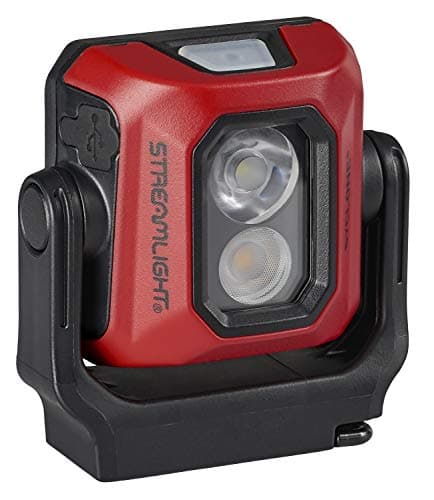 Streamlight Syclone Best work light with a 90 CRI flood | 400 | Sealed | 7 | $60.99 on Amazon Price as of October 18, 2026 — 7 lumens per dollar. #ad How we earn |
| 5 | 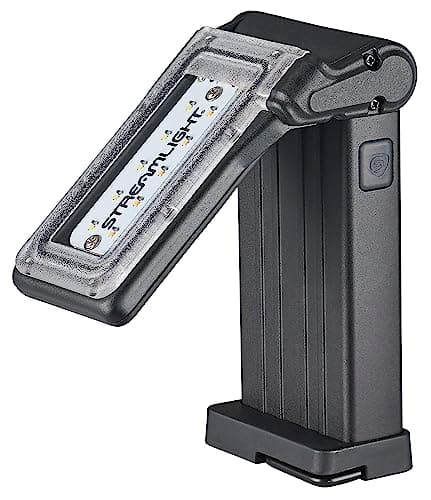 Streamlight FlipMate Best work light that publishes all four modes | 500 | Sealed | 6 | $82.99 on Amazon Price as of October 18, 2026 — 6 lumens per dollar. #ad How we earn |
Prices pulled October 18, 2026. Lumens per dollar is the manufacturer's published maximum output divided by that price, recomputed every time the price moves.
What each one is for
- Lighting a whole garage bay, a campsite or a room in an outage: COB, every time. It is the cheapest wide light there is, and the soft shadows are an advantage when you are moving around under it.
- Working on something at arm's length where color is information — wiring, paint, a leak, bodywork, a wound: a 90-CRI LED. Under a low-CRI panel red wire and brown wire look like the same wire, and no amount of lumens fixes that.
- Seeing to the end of a yard, finding a dog in a field, checking a tree line: a conventional LED with a published beam distance. A COB panel simply cannot do this job.
- One light that has to do all three: a hybrid. The NEBO SLYDE KING 4K carries a zoomable 4,000-lumen LED at one end and a 1,000-lumen COB panel at the other, with a published runtime for each.
1. Most COB lumens per dollar
NEBO OMNI 2K
Lumens per dollar
57
Two thousand lumens of COB flood with a published runtime for all six modes, a 4,000 mAh pack that will also charge a phone, and magnetic handles that let it hang anywhere. What it does not have is a numbered water rating, and COB panels render color poorly as a class.
- Max output
- 2,000 lm
- Runtime
- 1.3 h
- Battery
- Sealed
- Water rating
- None published
What it gets right
- A runtime published beside every one of the six modes, which is more than most work lights manage
- Two thousand lumens of flood for the price of a tank of gas
- Rotating magnetic handles, so it hangs or stands wherever there is steel
- The 4,000 mAh pack doubles as a phone charger in an outage
What it gets wrong
- No IP figure at all — 'water-resistant' is a word, not a rating
- Built-in pack, so the light is refuse when the cell is
- COB panels have poor color rendering as a class, and NEBO publishes no CRI figure
- 1.3 hours at full output is a short evening
Published specification
- Dual COB, high: 2,000 lumens, 1.3 hours, 70 m — NEBO published specification
- Dual COB, low: 250 lumens, 5.5 hours, 22 m — NEBO published specification
- Single COB, high: 1,100 lumens, 2 hours, 50 m — NEBO published specification
- Single COB, low: 150 lumens, 9 hours, 18 m — NEBO published specification
- Red COB: 20 lumens, 11 hours, 8 m — NEBO published specification
- Red COB flash: 20 lumens, 20 hours, 8 m — NEBO published specification
- Battery: Built-in rechargeable pack, 3.7 V, 4,000 mAh — NEBO published specification
- Power bank: 4,000 mAh output for USB devices; port count and amperage not published — NEBO published specification
- Charging: USB-C, 2 to 8 hours depending on the output of the USB source — NEBO published specification
- Water rating: None published — NEBO states only 'water and impact-resistant' — NEBO published specification
- Folded size: 4.8 x 6.25 x 1.875 in — NEBO published specification
- Weight: 0.5 lb — NEBO published specification
Skip this one if
you need to see color accurately — wiring, paint, a leak, a wound. A COB panel is the wrong emitter for that job and no amount of lumens fixes it.
Buy it if: anyone who wants the most flood light per dollar for a garage, a campsite or a power cut, and who will keep it out of the rain.
- Output 9.0
- Battery 5.0
- Build 6.0
- Usability 8.5
- Overall 8.0
Price as of October 18, 2026 — 57 lumens per dollar. #ad How we earn
2. Best light with both an LED spot and a COB panel
NEBO SLYDE KING 4K
Lumens per dollar
53
One body, two emitters: a 4,000-lumen zoomable LED at one end of the slide and a 1,000-lumen COB work light at the other, each with its own published runtime. It is the cheapest way to stop choosing between throw and flood, and the clearest demonstration of what each emitter is actually for.
- Max output
- 4,000 lm
- Runtime
- 1 h
- Battery
- Sealed
- Water rating
- IPX7
What it gets right
- A spot and a flood in one body, each with a published runtime
- IPX7 with the depth and duration stated, which the OMNI 2K does not have
- Twenty-four hours on the 100-lumen work mode is a genuinely useful number
- Magnetic base and a red task mode that runs 35 hours
What it gets wrong
- NEBO does not say whether the 20650 cell can be replaced, so we score it as if it cannot
- One hour at 4,000 lumens, and no sustained figure between that and the 400-lumen low
- 1.1 lb and eight inches — this is a toolbox light, not a pocket light
- No CRI published for either emitter
Published specification
- Flashlight, high: 4,000 lumens, 1 hour, 350 m — NEBO published specification
- Flashlight, low: 400 lumens, 6 hours, 100 m — NEBO published specification
- Work light, high: 1,000 lumens, 4 hours, 35 m — NEBO published specification
- Work light, low: 100 lumens, 24 hours, 10 m — NEBO published specification
- Red task light: 40 lumens for 6 hours, or 4 lumens for 35 hours — NEBO published specification
- Red flashing: 40 lumens, 12 hours — NEBO published specification
- Battery: 20650 Li-ion, 2,600 mAh, 3.7 V — NEBO does not state whether it is replaceable — NEBO published specification
- Water rating: IPX7, 1 meter for 30 minutes — NEBO published specification
- Beam: 4x zoom, slide-to-reveal COB panel, magnetic base — NEBO published specification
- Weight: 1.1 lb — NEBO published specification
- Length: 8.15 in closed, 10.25 in extended — NEBO published specification
- Charging time: Not published — NEBO published specification
Skip this one if
you want one small light. This is a deliberately large two-in-one tool, and the compromise it makes is size.
Buy it if: anyone who keeps one light in a truck or a toolbox and needs it to both reach across a yard and light up a bumper at arm's length.
- Output 9.5
- Battery 5.0
- Build 8.0
- Usability 8.5
- Overall 8.3
Price as of October 18, 2026 — 53 lumens per dollar. #ad How we earn
3. Best cheap magnetic work light
NEBO BIG LARRY 3
Lumens per dollar
50
A 600-lumen COB panel, a 220-lumen spot and a red task mode, on three AA cells, with a magnet strong enough to hold it under a hood. It is the least glamorous light here and it is the one that gets used most.
- Max output
- 600 lm
- Runtime
- Not published per mode
- Battery
- AA / AAA
- Water rating
- None published
What it gets right
- A flood panel is the right shape of light for working on something close up
- AA cells, so it survives a year in a toolbox and still lights
- The magnet is strong enough to matter
What it gets wrong
- NEBO publishes no runtime and no water rating for this model
- COB panels have poor color rendering as a class
- Not rechargeable, so the running cost is AA cells
Published specification
- COB work light: 600 lumens high / 150 lumens low — NEBO published specification
- Spot flashlight: 220 lumens high / 60 lumens low — NEBO published specification
- Red task light: 40 lumens high / 12 lumens low — NEBO published specification
- Battery: 3 x AA (included) — NEBO published specification
- Weight: 0.42 lb — NEBO published specification
- Fittings: Magnetic base, steel belt clip, wall-mount hole — NEBO published specification
- Per-mode runtime: Not published on the product page
- Water rating: Not published on the product page
Skip this one if
you need to see color accurately. For paint matching or diagnosing a wiring loom, a high-CRI light is worth the extra money.
Buy it if: the toolbox, the trunk and the shelf above the workbench.
- Output 6.5
- Battery 7.0
- Build 7.5
- Usability 8.5
- Overall 7.3
Price as of October 18, 2026 — 50 lumens per dollar. #ad How we earn
4. Best work light with a 90 CRI flood
Streamlight Syclone
Lumens per dollar
7
Four hundred lumens of spot for two hours or 300 lumens of 90-CRI flood for the same, in a 5.3-ounce body that clips, magnets and stands. Every mode's runtime is published, including the flood modes most brands ignore.
- Max output
- 400 lm
- Runtime
- 2 h
- Battery
- Sealed
- Water rating
- IPX4
What it gets right
- A 90 CRI flood, which matters more than lumens when you are diagnosing anything
- Spot and flood in one body with runtimes published for both
- Magnet, clip and a stand that lets it point where you need it
What it gets wrong
- Sealed lithium-polymer cell
- IPX4 — it handles a splash and not a puddle
- Four hundred lumens is modest if you want to light a whole garage
Published specification
- Spot high: 400 lumens, 141 m, 2 hours — Streamlight published specification
- Spot medium: 200 lumens, 95 m, 4.5 hours — Streamlight published specification
- Spot low: 100 lumens, 72 m, 9.5 hours — Streamlight published specification
- Flood high: 300 lumens, 48 m, 2 hours, 90 CRI — Streamlight published specification
- Flood low: 75 lumens, 24 m, 8 hours — Streamlight published specification
- Battery: Lithium-polymer, USB rechargeable, 4.5 h charge — Streamlight published specification
- Water rating: IPX4 — Streamlight published specification
- Impact: 2 m tested — Streamlight published specification
- Weight: 5.3 oz (150 g) — Streamlight published specification
Skip this one if
you need to flood a large space. This is an arm's-reach light; a lantern or a panel does big areas better.
Buy it if: mechanics and electricians who need to see true color at close range.
- Output 6.5
- Battery 5.0
- Build 8.5
- Usability 9.0
- Overall 7.6
Price as of October 18, 2026 — 7 lumens per dollar. #ad How we earn
5. Best work light that publishes all four modes
Streamlight FlipMate
Lumens per dollar
6
Streamlight's answer to the COB panel is an LED panel with a 90-CRI mode, and a runtime printed beside all four outputs. You pay several times what a COB bar costs and you get a quarter of the lumens; what you get back is light you can judge color by and a 2-meter impact rating.
- Max output
- 500 lm
- Runtime
- 4 h
- Battery
- Sealed
- Water rating
- IPX4
What it gets right
- A runtime beside all four outputs, including both 90-CRI modes
- 90 CRI at 4,000K — the only work light here you can judge a color by
- A numbered 2-meter impact rating and a numbered IPX4 water rating
- Magnetic base, hang hook and a head that turns 270 degrees
What it gets wrong
- Five hundred lumens against two thousand from a COB panel costing a fraction as much
- IPX4 is splash resistance, not immersion
- Battery capacity and replaceability are not published
- No beam distance or candela figure for either emitter
Published specification
- Cool white, high: 500 lumens, 4 hours — Streamlight published specification
- Cool white, low: 250 lumens, 5.75 hours — Streamlight published specification
- 90 CRI (4,000K), high: 400 lumens, 4 hours — Streamlight published specification
- 90 CRI (4,000K), low: 200 lumens, 6 hours — Streamlight published specification
- Emitters: Cool white LEDs plus 4,000K 90-CRI Color-Rite LEDs — Streamlight published specification
- Water rating: IPX4 — Streamlight published specification
- Impact resistance: 2 meters, tested — Streamlight published specification
- Charging: USB; 4.5 hours to recharge — Streamlight published specification
- Weight: 8.70 oz (246.64 g) — Streamlight published specification
- Length: 4.58 in folded, 7.94 in extended — Streamlight published specification
- Fittings: Magnetic base, stowable hang hook, 270-degree rotating head — Streamlight published specification
- Battery capacity: Not published; Streamlight states one Li-ion cell — Streamlight published specification
- Beam distance: Not published — Streamlight published specification
Skip this one if
you are lighting a whole garage. This is a task light for the thing in front of you, and a 2,000-lumen COB panel will flood a bay far better for far less.
Buy it if: anyone whose work is close, detailed and color-dependent — wiring, paint, bodywork, a bench — and who wants the runtime printed before they buy.
- Output 5.5
- Battery 5.0
- Build 9.0
- Usability 9.0
- Overall 7.8
Price as of October 18, 2026 — 6 lumens per dollar. #ad How we earn
How we ranked these
Published output over live price, as everywhere on this site, with two adjustments stated here because they change the order. A light that publishes no numbered water rating is marked down, which costs the OMNI 2K — NEBO describes it as "water and impact-resistant" and publishes no IP figure, and a word you cannot check is not a specification. A light that publishes a CRI figure is marked up, because on a work light that number is the difference between seeing a fault and missing it.
Note what the ledger arithmetic does to this page honestly: the COB lights win it, by a lot. That is the real finding. COB is the correct answer when lumens per dollar is the question, and the two Streamlights are here to show what the extra money buys when it is not.
Units we claim to have tested: 0
Every publisher in this category says they tested twenty flashlights. We have not tested any, and we say so. What we do instead: compile the manufacturer's own published ANSI FL1 figures, pull the price the light is selling for right now, and divide one by the other. Every number on this page is one you can check yourself in about two minutes.
What to check on a COB spec sheet before you buy
COB listings are unusually noisy, partly because the format is cheap enough that unbranded sellers flood it. Four checks separate the ones worth buying.
- 1.Is there a runtime beside every mode? NEBO publishes one for all six modes of the OMNI 2K and all seven of the SLYDE KING 4K. A listing that gives a lumen count and a battery capacity and leaves you to divide one by the other is telling you it has not measured anything.
- 2.Is the water rating a number? 'Water-resistant' is a word. IPX4 and IPX7 are test results. The OMNI 2K has the word and not the number, and we mark it down for exactly that.
- 3.Is there a CRI figure? Almost never on COB, which is itself the answer — but if color accuracy matters to your work, this is the first thing to look for and the quickest way to disqualify most of the category.
- 4.How does it attach? A base magnet, a hook and a stand are three different capabilities and a light with one of them will be in your way at some point. Magnets are the most useful and the least specified: no manufacturer publishes a holding force.
There is a fifth check that is not on the spec sheet at all: how the panel is diffused. A bare COB array without a diffuser is a glare source you will end up turning away from, and the only way to assess it is to look at the product photograph for a frosted cover.
Why COB took over the cheap end
A decade ago a budget work light meant a halogen tube on a stand, a bank of discrete LEDs, or a fluorescent wand. COB displaced all three for a straightforward manufacturing reason: once you stop packaging each die, the cost per lumen collapses, and a format that produces a wide soft flood needs no optics at all. The emitting surface IS the fixture.
That is also why COB arrived at the bottom of the market rather than the top. The things it gives up — collimation, color fidelity, per-emitter binning — are precisely the things that matter in a premium light and are irrelevant in a twelve-dollar magnetic bar you stick under a hood. It is a genuinely good solution to the cheap-flood problem rather than a cut-down version of something better, and the honest conclusion of this page is that most people wanting to light a garage should buy one.
The brand pattern worth noticing
Three of the five lights here are NEBO and two are Streamlight, and that split is not an accident of selection. NEBO builds most of the COB lighting worth buying at this price and publishes a runtime beside every mode of it. Streamlight does not sell a COB work light at all in the range we cover; its answer to the same job is an LED panel with a 90-CRI mode, at four times the price per lumen.
That is a genuine strategic difference between two companies rather than a quality ranking, and it maps exactly onto the choice this page is about. If you want light, NEBO. If you want to see detail accurately, Streamlight. Our wider work-light ranking covers the rest of the category.
What we cannot tell you
We have not measured any of these lights. We cannot tell you the actual CRI of either NEBO panel, because NEBO does not publish one and we will not estimate it; we cannot tell you how either brand's output holds up over the published runtime, since neither publishes a sustained figure; and we cannot tell you how the OMNI 2K survives rain, because the only water claim attached to it is a word. Every figure above is the manufacturer's own.
Common questions
What is a COB light?
COB stands for chip-on-board. Instead of packaging each LED die individually, the bare dies are bonded directly onto one shared substrate and covered with a single phosphor layer, so the light source is a continuous lit rectangle rather than a point. It is a way of packaging LEDs, not a different technology from LED.
Is COB better than LED?
The comparison does not work as stated, because COB is LED. Against conventionally packaged (SMD) emitters, COB gives you far more lumens per dollar and a soft, wide flood, and gives up beam distance and color accuracy. For lighting an area cheaply, COB wins. For seeing color correctly or seeing any distance, a conventional LED with a published CRI or beam-distance figure wins.
What is the difference between COB and SMD?
SMD means surface-mounted device: individually packaged LEDs placed on a board, usually visible as a grid of separate dots. COB bonds bare dies straight to a shared board, so the panel lights as one surface. SMD allows per-emitter optics and tighter beams; COB is cheaper per lumen and produces softer shadows because the emitting surface is large.
Do COB work lights have good color rendering?
Generally no, and the more useful signal is that almost none of them publish a CRI figure at all. Neither NEBO COB light on this page does. If color accuracy matters to your work, buy a light that prints the number: Streamlight publishes 90 CRI at 4,000K for the FlipMate and for the Syclone's flood.
How many lumens should a work light have?
For a bench or an engine bay, 500 to 1,000 lumens of flood is comfortable and runs for hours. For a whole garage bay, 2,000 lumens of COB is the cheap way to get there. Above that you are usually buying a burst rather than a mode — check that a runtime is published beside the headline figure, because on work lights it very often is not.
Are cheap rechargeable flashlights any good?
Many are, and for a specific reason: the LED emitters, drivers and 18650 cells that budget brands buy are the same commodity parts the expensive brands buy. What you give up at the low end is documentation, quality control between batches, and a warranty worth using. The way to shop it is to look for a brand that publishes runtime figures — a manufacturer willing to print how long the turbo mode lasts is telling you something about the rest of the specification.
Sources
- NEBO published product specifications — mode-by-mode lumen, runtime and beam figures, read 2026-09-01; LUXTREME SL75 and SL50 read 2026-09-22; OMNI 2K and SLYDE KING 4K read 2026-10-18
- Streamlight published product specifications — per-mode lumens, runtime, beam distance, impact and IP ratings, read 2026-09-01; Waypoint 400 and Waypoint C-cell read 2026-09-22; FlipMate read 2026-10-18
- Lumen & Ledger method — how every figure on this page is derived
Who writes this
Scooter M. — I am an enthusiast who is genuinely into this. I read the manuals, compile the published specs, and do the math. No lab coat, no test bench, no drawer of free samples. What I can tell you is exactly what a light claims on paper, exactly what it costs right now, and what those two numbers mean when you divide one by the other.
Read next
Best rechargeable work lights
Flood beats throw at arm's length, and color rendering beats both.
Best rechargeable work lights for a garage
A garage is a fixed room, so the magnet and the color rendering matter more than the output.
Best high-CRI flashlights
The four lights we cover that publish a color rendering figure, and what it costs in lumens.
Best magnetic rechargeable work lights
The magnet is the feature. Here is how to tell a good one from a decoration.
Best rechargeable inspection lights
Color rendering first, beam shape second, lumens last.
The Ledger
Every light we cover in one ranked table, sorted by lumens per dollar.