Work Lights & Lanterns
Streamlight FlipMate Review: The Only Work Light Here That Prints All Four Runtimes
Most work lights give you a lumen number and silence. This one gives you four outputs, four durations and a color-rendering figure — then asks two and a half times what a COB panel costs.
By Scooter M. · Published November 5, 2026
Short answer
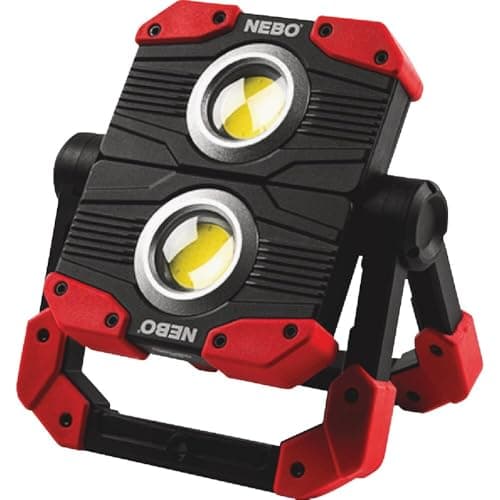
NEBO OMNI 2K
Two thousand lumens of COB flood with a published runtime for all six modes, a 4,000 mAh pack that will also charge a phone, and magnetic handles that let it hang anywhere. What it does not have is a numbered water rating, and COB panels render color poorly as a class.
Price as of November 5, 2026 — 57 lumens per dollar. #ad How we earn
Disclosure — we earn a commission on qualifying purchases made through the Amazon links on this page, at no extra cost to you. It does not change which lights we pick or what we say about them. The full version.
How we rank. Published ANSI FL1 output divided by the live retail price, with sealed-battery lights marked down because a light you cannot re-cell is a light with an expiry date. Units we claim to have tested: 0 — we compile manufacturers' published figures and show the arithmetic instead. How we work this out.
The verdict
Buy the FlipMate if your work is close, detailed and color-dependent — wiring, paint, bodywork, a bench — and you want to know how long the light lasts before you pay. Streamlight publishes a runtime beside all four of its outputs: 500 lumens of cool white for 4 hours, 250 for 5.75, and crucially 400 lumens of 90-CRI light at 4,000K for 4 hours and 200 for 6. It is IPX4, tested to 2 meters of impact, weighs 247 grams and folds to 4.58 inches. Skip it if you are lighting a whole bay, where a COB panel gives four times the lumens for a fraction of the money.
We have not used this light. What makes it worth a dedicated page is not the hardware, which is a competent folding panel with a magnet. It is the specification table, and specifically two columns of it that almost nothing else in this category fills in.
The published specification
| Mode | Output | Runtime |
|---|---|---|
| Cool white, high | 500 lumens | 4 hours |
| Cool white, low | 250 lumens | 5 h 45 min |
| 90 CRI (4,000K), high | 400 lumens | 4 hours |
| 90 CRI (4,000K), low | 200 lumens | 6 hours |
Read the right-hand column. Four modes, four durations. Then consider how unusual that is: across the work lights on this site the normal pattern is a headline lumen figure with nothing beside it, or a runtime published for the dim setting only. The NEBO OMNI 2K below is one of the few others that fills the column in, and it is a COB panel rather than an LED one.
What 90 CRI is actually for
Color rendering index measures how faithfully a light source shows color against a reference. A typical work light sits somewhere in the 70s, which is fine for finding a dropped socket and actively misleading when the job is to tell one wire from another, judge whether a paint blend matches, or read the color of a fluid. Under a low-CRI light, a brown wire and a dark red wire can look like the same wire.
The FlipMate carries a second set of emitters — Streamlight calls them Color-Rite — rated at 90 CRI and 4,000K, and publishes 400 lumens for 4 hours on that channel. That is the product. Everything else about this light is ordinary; a 90-CRI mode with a published duration is not.
Where the money goes, and where it does not
The FlipMate costs roughly two and a half times what the NEBO OMNI 2K costs and produces a quarter of its light. NEBO publishes 2,000 lumens of dual-COB flood for 1.3 hours, 1,100 on a single panel for 2 hours, and a runtime for all six of its modes including a red one. On lumens per dollar there is no contest and this site is not going to pretend otherwise.
What the extra money buys is three things you can check. A 90-CRI channel, which no COB panel here offers and which COB as a technology renders poorly as a class. A numbered water rating — IPX4 — where NEBO publishes none at all and describes the OMNI 2K only as water and impact-resistant. And a numbered impact rating, 2 meters, tested.
What it does not buy is brightness, immersion resistance, or a replaceable cell. IPX4 covers splashes and rain and does not cover dropping the light in a puddle, and that is true of all three lights on this page.
What Streamlight does not publish
Three gaps, and they are worth naming on a page that praises this light for its table.
- 1.No beam distance and no candela for either emitter. On a flood panel that matters less than it would on a handheld — the light is for arm's length, not distance — but it means you cannot compare the FlipMate's reach against anything numerically.
- 2.No battery capacity. Streamlight states one lithium-ion cell and does not publish its milliamp-hour rating, so the only way to judge endurance is the runtime figures, which is exactly why those figures matter.
- 3.No statement on whether the cell is user-replaceable. We treat that as sealed, which is the conservative reading: it means the light has a service life rather than a lifespan, and when the battery reaches the end of its cycles the panel, the magnet and the hinge go with it.
| # | Light | Max output | Battery | Lumens / $ | Price |
|---|---|---|---|---|---|
| 1 | NEBO OMNI 2K Most COB lumens per dollar | 2,000 | Sealed | 57 | $34.88 on Amazon Price as of November 5, 2026 — 57 lumens per dollar. #ad How we earn |
| 2 | 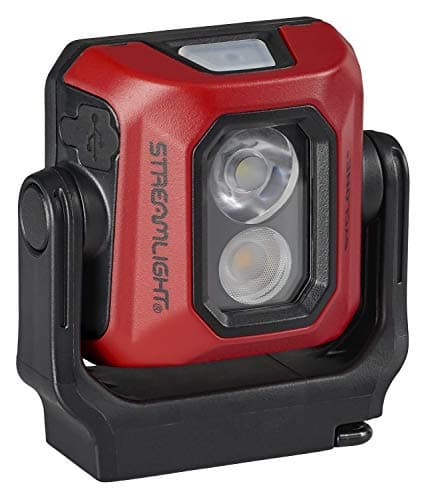 Streamlight Syclone Best work light with a 90 CRI flood | 400 | Sealed | 7 | $54.89 on Amazon Price as of November 5, 2026 — 7 lumens per dollar. #ad How we earn |
| 3 | 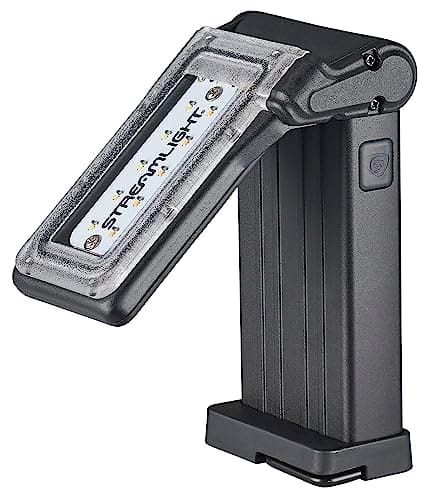 Streamlight FlipMate Best work light that publishes all four modes | 500 | Sealed | 6 | $82.99 on Amazon Price as of November 5, 2026 — 6 lumens per dollar. #ad How we earn |
Prices pulled November 5, 2026. Lumens per dollar is the manufacturer's published maximum output divided by that price, recomputed every time the price moves.
The three lights, side by side
| Light | Max output | Runtime at max | High-CRI mode | Water | Weight as published |
|---|---|---|---|---|---|
| Streamlight FlipMate | 500 lumens | 4 hours | 400 lm at 90 CRI, 4 h | IPX4 | 8.70 oz |
| Streamlight Syclone | 400 lm spot | 2 hours | 300 lm at 90 CRI, 2 h | IPX4 | 5.3 oz |
| NEBO OMNI 2K | 2,000 lumens | 1.3 hours | None | None published | 0.5 lb |
That table is the whole buying decision. The NEBO is the light to own if you need to flood a space and the color of what you are looking at does not matter. The Syclone is the one to own if you need a spot beam as well as a flood and can live with half the high-CRI runtime. The FlipMate is the one to own if the job is color-critical and close. One note on the last column: each maker publishes weight in its own unit, so those three figures are quoted as published rather than converted — the Syclone is the lightest and the FlipMate and the OMNI 2K are within an ounce of each other.
1. Most COB lumens per dollar
NEBO OMNI 2K
Lumens per dollar
57
Two thousand lumens of COB flood with a published runtime for all six modes, a 4,000 mAh pack that will also charge a phone, and magnetic handles that let it hang anywhere. What it does not have is a numbered water rating, and COB panels render color poorly as a class.
- Max output
- 2,000 lm
- Runtime
- 1.3 h
- Battery
- Sealed
- Water rating
- None published
What it gets right
- A runtime published beside every one of the six modes, which is more than most work lights manage
- Two thousand lumens of flood for the price of a tank of gas
- Rotating magnetic handles, so it hangs or stands wherever there is steel
- The 4,000 mAh pack doubles as a phone charger in an outage
What it gets wrong
- No IP figure at all — 'water-resistant' is a word, not a rating
- Built-in pack, so the light is refuse when the cell is
- COB panels have poor color rendering as a class, and NEBO publishes no CRI figure
- 1.3 hours at full output is a short evening
Published specification
- Dual COB, high: 2,000 lumens, 1.3 hours, 70 m — NEBO published specification
- Dual COB, low: 250 lumens, 5.5 hours, 22 m — NEBO published specification
- Single COB, high: 1,100 lumens, 2 hours, 50 m — NEBO published specification
- Single COB, low: 150 lumens, 9 hours, 18 m — NEBO published specification
- Red COB: 20 lumens, 11 hours, 8 m — NEBO published specification
- Red COB flash: 20 lumens, 20 hours, 8 m — NEBO published specification
- Battery: Built-in rechargeable pack, 3.7 V, 4,000 mAh — NEBO published specification
- Power bank: 4,000 mAh output for USB devices; port count and amperage not published — NEBO published specification
- Charging: USB-C, 2 to 8 hours depending on the output of the USB source — NEBO published specification
- Water rating: None published — NEBO states only 'water and impact-resistant' — NEBO published specification
- Folded size: 4.8 x 6.25 x 1.875 in — NEBO published specification
- Weight: 0.5 lb — NEBO published specification
Skip this one if
you need to see color accurately — wiring, paint, a leak, a wound. A COB panel is the wrong emitter for that job and no amount of lumens fixes it.
Buy it if: anyone who wants the most flood light per dollar for a garage, a campsite or a power cut, and who will keep it out of the rain.
- Output 9.0
- Battery 5.0
- Build 6.0
- Usability 8.5
- Overall 8.0
Price as of November 5, 2026 — 57 lumens per dollar. #ad How we earn
2. Best work light with a 90 CRI flood
Streamlight Syclone
Lumens per dollar
7
Four hundred lumens of spot for two hours or 300 lumens of 90-CRI flood for the same, in a 5.3-ounce body that clips, magnets and stands. Every mode's runtime is published, including the flood modes most brands ignore.
- Max output
- 400 lm
- Runtime
- 2 h
- Battery
- Sealed
- Water rating
- IPX4
What it gets right
- A 90 CRI flood, which matters more than lumens when you are diagnosing anything
- Spot and flood in one body with runtimes published for both
- Magnet, clip and a stand that lets it point where you need it
What it gets wrong
- Sealed lithium-polymer cell
- IPX4 — it handles a splash and not a puddle
- Four hundred lumens is modest if you want to light a whole garage
Published specification
- Spot high: 400 lumens, 141 m, 2 hours — Streamlight published specification
- Spot medium: 200 lumens, 95 m, 4.5 hours — Streamlight published specification
- Spot low: 100 lumens, 72 m, 9.5 hours — Streamlight published specification
- Flood high: 300 lumens, 48 m, 2 hours, 90 CRI — Streamlight published specification
- Flood low: 75 lumens, 24 m, 8 hours — Streamlight published specification
- Battery: Lithium-polymer, USB rechargeable, 4.5 h charge — Streamlight published specification
- Water rating: IPX4 — Streamlight published specification
- Impact: 2 m tested — Streamlight published specification
- Weight: 5.3 oz (150 g) — Streamlight published specification
Skip this one if
you need to flood a large space. This is an arm's-reach light; a lantern or a panel does big areas better.
Buy it if: mechanics and electricians who need to see true color at close range.
- Output 6.5
- Battery 5.0
- Build 8.5
- Usability 9.0
- Overall 7.6
Price as of November 5, 2026 — 7 lumens per dollar. #ad How we earn
3. Best work light that publishes all four modes
Streamlight FlipMate
Lumens per dollar
6
Streamlight's answer to the COB panel is an LED panel with a 90-CRI mode, and a runtime printed beside all four outputs. You pay several times what a COB bar costs and you get a quarter of the lumens; what you get back is light you can judge color by and a 2-meter impact rating.
- Max output
- 500 lm
- Runtime
- 4 h
- Battery
- Sealed
- Water rating
- IPX4
What it gets right
- A runtime beside all four outputs, including both 90-CRI modes
- 90 CRI at 4,000K — the only work light here you can judge a color by
- A numbered 2-meter impact rating and a numbered IPX4 water rating
- Magnetic base, hang hook and a head that turns 270 degrees
What it gets wrong
- Five hundred lumens against two thousand from a COB panel costing a fraction as much
- IPX4 is splash resistance, not immersion
- Battery capacity and replaceability are not published
- No beam distance or candela figure for either emitter
Published specification
- Cool white, high: 500 lumens, 4 hours — Streamlight published specification
- Cool white, low: 250 lumens, 5.75 hours — Streamlight published specification
- 90 CRI (4,000K), high: 400 lumens, 4 hours — Streamlight published specification
- 90 CRI (4,000K), low: 200 lumens, 6 hours — Streamlight published specification
- Emitters: Cool white LEDs plus 4,000K 90-CRI Color-Rite LEDs — Streamlight published specification
- Water rating: IPX4 — Streamlight published specification
- Impact resistance: 2 meters, tested — Streamlight published specification
- Charging: USB; 4.5 hours to recharge — Streamlight published specification
- Weight: 8.70 oz (246.64 g) — Streamlight published specification
- Length: 4.58 in folded, 7.94 in extended — Streamlight published specification
- Fittings: Magnetic base, stowable hang hook, 270-degree rotating head — Streamlight published specification
- Battery capacity: Not published; Streamlight states one Li-ion cell — Streamlight published specification
- Beam distance: Not published — Streamlight published specification
Skip this one if
you are lighting a whole garage. This is a task light for the thing in front of you, and a 2,000-lumen COB panel will flood a bay far better for far less.
Buy it if: anyone whose work is close, detailed and color-dependent — wiring, paint, bodywork, a bench — and who wants the runtime printed before they buy.
- Output 5.5
- Battery 5.0
- Build 9.0
- Usability 9.0
- Overall 7.8
Price as of November 5, 2026 — 6 lumens per dollar. #ad How we earn
Who should skip it
- Anyone lighting a garage bay or a driveway. Five hundred lumens is a task output. A 2,000-lumen COB panel costs less and floods far better, and we rank those separately.
- Anyone who needs the light to survive immersion. IPX4 is splash resistance. Nothing on this page is rated for more, and if that matters the category to shop is sealed handhelds rather than folding panels.
- Anyone who wants to re-cell the light in three years. Streamlight does not say the battery can be replaced, so plan on this being a consumable with a long service life rather than a tool you keep indefinitely.
- Anyone shopping purely on lumens per dollar. The NEBO wins that by a factor of four and it is not close.
How we rated it
Published output over the live price, adjusted for battery architecture and published ratings, as on every page here — which is why a 500-lumen light does not top our work-light rankings and was never going to. Two adjustments apply specifically to this one. A sealed cell whose capacity and replaceability are both unpublished is scored down, because an unverifiable battery is the weakest part of an otherwise checkable specification. And a published 90-CRI figure with a runtime attached is credited, because color rendering is the one performance attribute in this category that lumens cannot stand in for.
Units we claim to have tested: 0
Every publisher in this category says they tested twenty flashlights. We have not tested any, and we say so. What we do instead: compile the manufacturer's own published ANSI FL1 figures, pull the price the light is selling for right now, and divide one by the other. Every number on this page is one you can check yourself in about two minutes.
What we cannot tell you
We have not used this light, so nothing here is a claim about how the hinge holds up after a year in a toolbox, whether the magnet is strong enough for the panel's weight on a vertical surface, or how close to 90 the color rendering measures in practice. We also cannot tell you the cell's capacity or whether it can be replaced, because Streamlight publishes neither. This review compares what the manufacturer publishes against what the light costs today, and on that narrow measure the FlipMate's table is the best in its category.
Common questions
Is the Streamlight FlipMate worth it?
It is if the work is color-critical. Streamlight publishes 400 lumens of 90-CRI light at 4,000K for 4 hours, and a runtime beside all four of the light's outputs, which almost nothing else in this category does. It is not worth it if you are flooding a space: the NEBO OMNI 2K publishes 2,000 lumens for a fraction of the price, and on lumens per dollar the FlipMate loses badly.
FlipMate or Syclone?
FlipMate if you want high-CRI flood, because it publishes 400 lumens for 4 hours on that channel against the Syclone's 300 lumens for 2 — more light for twice as long, from the same manufacturer. Syclone if you also need a spot beam: it publishes 400 lumens and 141 meters on spot high, where the FlipMate publishes no beam distance at all because it is purely a panel. The Syclone is also lighter at 150 grams against 247.
What does 90 CRI mean on a work light?
Color rendering index measures how faithfully a light shows color against a reference source. Most work lights sit in the 70s, which is fine for finding a tool and misleading when you are telling a brown wire from a dark red one, judging a paint match or reading the color of a fluid. A 90-CRI mode shows those differences honestly. The FlipMate publishes 90 CRI at 4,000K and, unusually, a runtime for both of its high-CRI levels.
Is the FlipMate waterproof?
No. Streamlight publishes IPX4, which covers splashing water and rain and does not cover submersion. It also publishes a 2-meter impact rating, tested, which is more than most work lights state. If the light needs to survive going into water, a folding panel is the wrong category and a sealed handheld rated IPX7 or IP68 is the right one.
Are cheap rechargeable flashlights any good?
Many are, and for a specific reason: the LED emitters, drivers and 18650 cells that budget brands buy are the same commodity parts the expensive brands buy. What you give up at the low end is documentation, quality control between batches, and a warranty worth using. The way to shop it is to look for a brand that publishes runtime figures — a manufacturer willing to print how long the turbo mode lasts is telling you something about the rest of the specification.
Sources
- Streamlight published product specifications — per-mode lumens, runtime, beam distance, impact and IP ratings, read 2026-09-01; Waypoint 400 and Waypoint C-cell read 2026-09-22; FlipMate read 2026-10-18
- NEBO published product specifications — mode-by-mode lumen, runtime and beam figures, read 2026-09-01; LUXTREME SL75 and SL50 read 2026-09-22; OMNI 2K and SLYDE KING 4K read 2026-10-18
- Lumen & Ledger method — how every figure on this page is derived
Who writes this
Scooter M. — I am an enthusiast who is genuinely into this. I read the manuals, compile the published specs, and do the math. No lab coat, no test bench, no drawer of free samples. What I can tell you is exactly what a light claims on paper, exactly what it costs right now, and what those two numbers mean when you divide one by the other.
Read next
COB vs LED work lights
What COB actually is, what it costs you in color, and when the LED is worth four times the money.
Best rechargeable work lights
Flood beats throw at arm's length, and color rendering beats both.
Best high-CRI flashlights
The four lights we cover that publish a color rendering figure, and what it costs in lumens.
Best rechargeable work lights for mechanics
Color accuracy, magnets and the ability to survive being dropped in a bay.
Best rechargeable inspection lights
Color rendering first, beam shape second, lumens last.
The Ledger
Every light we cover in one ranked table, sorted by lumens per dollar.