EDC & Keychain
Best Rechargeable Keychain Flashlights
A keychain light runs on a cell the size of a pill. That sets everything: the runtime, the output and, in almost every case, the lifespan.
By Scooter M. · Published September 2, 2026
Short answer
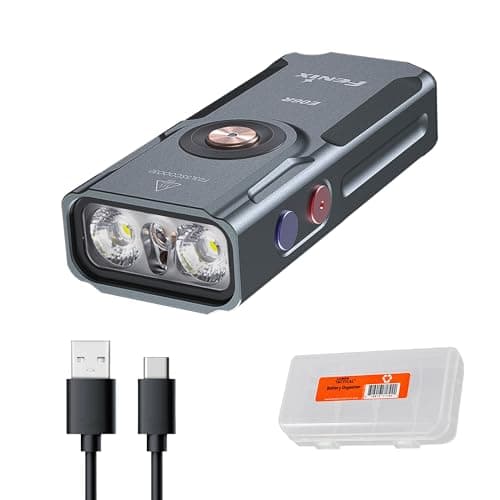
Fenix E06R
Seven hundred lumens and 110 meters from a light that hangs off a keyring, with a 750 mAh built-in cell and a magnetic tail. It costs more than the budget keychain options and it puts out several times their light.
Price as of October 18, 2026 — 13 lumens per dollar. #ad How we earn
Disclosure — we earn a commission on qualifying purchases made through the Amazon links on this page, at no extra cost to you. It does not change which lights we pick or what we say about them. The full version.
How we rank. Published ANSI FL1 output divided by the live retail price, with sealed-battery lights marked down because a light you cannot re-cell is a light with an expiry date. Units we claim to have tested: 0 — we compile manufacturers' published figures and show the arithmetic instead. How we work this out.
What the cell size decides
Keychain lights run on cells between about 130 and 750 mAh, and that capacity sets everything else. Olight publishes 130 mAh and up to 12 hours on the i1R 2 PRO; Fenix publishes 750 mAh on the E06R. Almost all of them are sealed, which means the light has a service life measured in charge cycles rather than a lifespan measured in years.
Put those figures next to a full-size light and the scale becomes clear. A standard 18650 holds around 3,000 mAh. A keychain light with 130 mAh has roughly four percent of that energy. Everything about how it behaves follows from that: short runtimes, aggressive step-down, and a cell that reaches the end of its cycle life relatively quickly because every charge is a deep one.
| # | Light | Max output | Battery | Lumens / $ | Price |
|---|---|---|---|---|---|
| 1 | Fenix E06R Most output from a keychain body | 700 | Sealed | 13 | $55.95 on Amazon Price as of October 18, 2026 — 13 lumens per dollar. #ad How we earn |
| 2 | 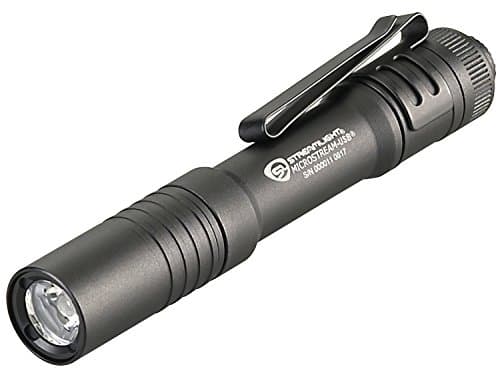 Streamlight MicroStream USB Best pen-clip light with published runtimes | 250 | Sealed | 7 | $37.81 on Amazon Price as of October 18, 2026 — 7 lumens per dollar. #ad How we earn |
| 3 | No listing image Sofirn SC21 Pro Best keychain light with a replaceable cell | 1,100 | Replaceable | Needs a live price | Check price on Amazon We show a price only when we have pulled a live one. #ad How we earn |
| 4 | No listing image Olight i1R 2 PRO Smallest light worth putting on a keyring | 180 | Sealed | Needs a live price | Check price on Amazon We show a price only when we have pulled a live one. #ad How we earn |
| 5 | No listing image Wurkkos TS10 V2 Best pocket light under two ounces | 1,400 | Replaceable | Needs a live price | Check price on Amazon We show a price only when we have pulled a live one. #ad How we earn |
Prices pulled October 18, 2026. Lumens per dollar is the manufacturer's published maximum output divided by that price, recomputed every time the price moves.
The one with a replaceable cell
Sofirn's SC21 Pro is the exception on this page and the reason it leads it. It publishes 1,100 lumens and 131 meters from an included 16340 cell that the owner can replace, in a body still small enough to live on a keyring. Every other light here seals its battery in.
Sofirn does not publish a water rating or a per-mode runtime for that model, and we are not going to invent either. So the honest summary is: the best keychain light on battery architecture, with an incomplete specification in two other places.
What a keychain light is for
- Finding a keyhole, which is the use case that named the category.
- Reading something in a dim restaurant, a cellar or the back of a cupboard.
- Getting from a car to a door across an unlit yard.
- Being the light you have when the light you own is at home — the entire point.
None of those needs four figures of output. A hundred and eighty lumens, which is what Olight publishes for the i1R 2 PRO, is genuinely adequate for all of them, and its low 5-lumen mode is the one that runs for hours.
1. Most output from a keychain body
Fenix E06R
Lumens per dollar
13
Seven hundred lumens and 110 meters from a light that hangs off a keyring, with a 750 mAh built-in cell and a magnetic tail. It costs more than the budget keychain options and it puts out several times their light.
- Max output
- 700 lm
- Runtime
- Not published per mode on the retail page
- Battery
- Sealed
- Water rating
- None published
What it gets right
- Seven hundred lumens from a keyring light is a genuine step up
- Magnetic tail turns it into a hands-free task light
- Lockout function, so it does not cook in a pocket
What it gets wrong
- Sealed 750 mAh cell
- The UV mode and laser pointer are features looking for a use
- No per-mode runtime on the retail page
Published specification
- Maximum output: 700 lumens — Fenix published specification
- Beam distance: 361 ft (110 m) — Fenix published specification
- Battery: Built-in 750 mAh — Fenix published specification
- Modes: Ten, including UV and a red laser pointer — Fenix published specification
- Fittings: Magnetic tail, key ring loop, lockout — Fenix published specification
- Per-mode runtime: Not published on the retail page we read
Skip this one if
you want a keychain light with a replaceable cell — that is the Sofirn SC21 Pro's job here.
Buy it if: someone who wants their smallest light to still be a real light.
- Output 7.0
- Battery 4.0
- Build 8.5
- Usability 8.0
- Overall 7.1
Price as of October 18, 2026 — 13 lumens per dollar. #ad How we earn
2. Best pen-clip light with published runtimes
Streamlight MicroStream USB
Lumens per dollar
7
Two hundred and fifty lumens for an hour and a half, fifty for three and a half, at 1.2 ounces. The battery is sealed, which caps its lifespan, but every other number on the sheet is published and checkable.
- Max output
- 250 lm
- Runtime
- 1 h 30 min
- Battery
- Sealed
- Water rating
- IPX4
What it gets right
- Every mode's runtime is published, which is why it scores well here despite modest output
- Deep pocket clip that actually holds in a shirt pocket
- 1.2 ounces — it is easy to forget you have it
What it gets wrong
- The cell is sealed in; when it fails the light is finished
- IPX4 splash rating only
- 250 lumens is not enough to light a yard
Published specification
- High: 250 lumens, 68 m, 1.5 hours — Streamlight published specification
- Low: 50 lumens, 31 m, 3.5 hours — Streamlight published specification
- Battery: Lithium-ion, charges in-product in 4 hours — Streamlight published specification
- Water rating: IPX4 — Streamlight published specification
- Impact: 1 m tested — Streamlight published specification
- Weight: 1.2 oz (34.1 g) — Streamlight published specification
- Length: 3.87 in (9.83 cm) — Streamlight published specification
Skip this one if
you want a light you can re-cell. For a keychain-sized light with a replaceable battery, look at the Sofirn SC21 Pro instead.
Buy it if: a shirt pocket, a scrubs pocket, or anyone who wants a light without a bulge.
- Output 5.5
- Battery 4.5
- Build 8.5
- Usability 9.0
- Overall 7.2
Price as of October 18, 2026 — 7 lumens per dollar. #ad How we earn
listing
image
3. Best keychain light with a replaceable cell
Sofirn SC21 Pro
Lumens per dollar
Computed the moment we have a live price for it
Eleven hundred lumens from a keyring-sized body with a 16340 you can actually swap. Almost every rival at this size seals the battery in, which turns the light into a two-year consumable.
- Max output
- 1,100 lm
- Runtime
- Not published per mode
- Battery
- Replaceable cell
- Water rating
- None published
What it gets right
- A replaceable cell in a keychain-sized light, which is genuinely rare
- Magnetic tail, so it doubles as a hands-free task light
- USB-C in the light rather than a proprietary dock
What it gets wrong
- Sofirn publishes neither runtime nor a water rating for this model
- 1,100 lumens out of a 16340 is a very short-lived 1,100 lumens
- Anduril on a light this small means a lot of clicking
Published specification
- Maximum output: 1,100 lumens — Sofirn published specification
- Beam distance: 131 m — Sofirn published specification
- Battery: 1 x 16340 Li-ion, included and replaceable — Sofirn published specification
- Charging: USB-C into the light — Sofirn published specification
- Fittings: Magnetic tailcap and pocket clip — Sofirn published specification
- Water rating: Not published on the product page
- Per-mode runtime: Not published on the product page
Skip this one if
you want a published IP rating. Sofirn does not state one for this model, and we are not going to guess on your behalf.
Buy it if: someone who wants keychain size without accepting a disposable battery.
- Output 7.5
- Battery 8.5
- Build 7.0
- Usability 7.0
- Overall 7.8
We show a price only when we have pulled a live one. #ad How we earn
listing
image
4. Smallest light worth putting on a keyring
Olight i1R 2 PRO
Lumens per dollar
Computed the moment we have a live price for it
One hundred and eighty lumens and 48 meters from something the size of a AAA cell, with 12 hours of published runtime on low. The 130 mAh battery is sealed in, so treat it as a two-year item bought at a two-year price.
- Max output
- 180 lm
- Runtime
- Up to 12 h
- Battery
- Sealed
- Water rating
- None published
What it gets right
- Small enough that it genuinely stays on the keyring
- Twist-head operation with no switch to press in a pocket
- USB-C without disassembling the light
What it gets wrong
- One hundred and thirty milliamp-hours sealed in — this is a consumable
- Twist interface means you cannot operate it one-handed while holding something
- No published water rating
Published specification
- Maximum output: 180 lumens — Olight published specification
- Beam distance: 48 m — Olight published specification
- Low mode: 5 lumens — Olight published specification
- Runtime: Up to 12 hours — Olight published specification
- Battery: Built-in 130 mAh lithium-ion — Olight published specification
- Charging: USB-C, full charge in 100 minutes — Olight published specification
- Length: 2.02 in — Olight published specification
- Water rating: Not stated on the pages we read
Skip this one if
you expect a keyring light to last a decade. It will not, and at 130 mAh nothing this size will.
Buy it if: the keyring, where the alternative is having no light at all.
- Output 4.0
- Battery 3.5
- Build 8.0
- Usability 8.5
- Overall 6.4
We show a price only when we have pulled a live one. #ad How we earn
listing
image
5. Best pocket light under two ounces
Wurkkos TS10 V2
Lumens per dollar
Computed the moment we have a live price for it
Thirty-two grams, three 90-CRI emitters, and one of the very few budget lights whose maker publishes the runtime at maximum output: one hour fourteen at 1,400 lumens. Publishing that number at all puts Wurkkos ahead of several brands ten times its size.
- Max output
- 1,400 lm
- Runtime
- 1 h 14 min
- Battery
- Replaceable cell
- Water rating
- IPX8
What it gets right
- Wurkkos publishes runtime at maximum output, which most brands quietly do not
- Thirty-two grams — light enough that you stop noticing it in a pocket
- Standard 14500 cell, replaceable
- Documented automatic step-down instead of an undocumented one
What it gets wrong
- A 14500 is a small cell; sustained output is not this light's job
- RGB auxiliary LEDs are a toy, and they draw from the same cell
- Anduril again, with the same learning curve
Published specification
- Maximum output: 1,400 lumens — Wurkkos published specification
- Runtime at maximum: 1 h 14 min — Wurkkos published specification
- Runtime at 1 lumen: 6 h 43 min — Wurkkos published specification
- Battery: 1 x 14500 Li-ion, user replaceable — Wurkkos published specification
- Water rating: IPX8, 2 m — Wurkkos published specification
- Weight: 32 g +/- 1 g without battery — Wurkkos published specification
- Length: 71.5 mm — Wurkkos published specification
- Thermal behavior: Automatic step-down from turbo to high — Wurkkos published specification
Skip this one if
you need something to run for an hour on high without getting hot. A light this small has nowhere to put the heat, and the step-down is not optional.
Buy it if: the person who wants a real light on them at all times and will not carry anything heavier than a pen.
- Output 8.0
- Battery 8.0
- Build 7.5
- Usability 7.5
- Overall 8.2
We show a price only when we have pulled a live one. #ad How we earn
How we ranked these
Published output over live price, battery architecture, published ratings and usability. Battery architecture does most of the sorting here because it is the attribute that separates a light with an indefinite life from one with a two-to-three-year one, and at this size almost nothing else differs meaningfully.
Units we claim to have tested: 0
Every publisher in this category says they tested twenty flashlights. We have not tested any, and we say so. What we do instead: compile the manufacturer's own published ANSI FL1 figures, pull the price the light is selling for right now, and divide one by the other. Every number on this page is one you can check yourself in about two minutes.
Two things that kill keychain lights
The first is accidental activation. A light that switches on in a pocket runs itself flat and gets hot against your leg. Twist-head designs like the Olight i1R 2 PRO avoid it structurally; button lights need an electronic lockout, which several brands publish as a named feature.
The second is the keyring itself. A light attached to a set of car keys is subjected to constant vibration, gets dragged against other metal, and lives in a pocket full of lint. That environment is harder on a light than most outdoor use, which is why it is worth checking whether a keychain light publishes a water rating at all — several here do not.
Common questions
Are keychain flashlights bright enough to be useful?
For what they are for, yes. Olight publishes 180 lumens and 48 meters for the i1R 2 PRO, which is plenty for a keyhole, a dim room or a walk across a yard. Fenix publishes 700 lumens on the E06R, which is more than most people need on a keyring. The constraint is runtime rather than output: a 130 mAh cell simply cannot hold much energy.
Can you replace the battery in a rechargeable flashlight?
It depends entirely on the model, and it is the single most consequential thing to check before buying. Lights built around a standard cell — an 18650, a 21700, a 14500, a 16340 — take a screw-off tailcap and a five-dollar replacement. Lights with a built-in cell, which manufacturers describe as 'integrated' or 'non-removable', cannot be re-celled by an ordinary owner: when the battery reaches the end of its cycle life the whole light is refuse. Energizer, for example, states plainly that the Vision HD Rechargeable uses non-removable lithium-ion batteries.
How long do keychain flashlight batteries last?
Two questions in one. Per charge, published figures range from about 12 hours on low for a 130 mAh light to considerably more for a larger cell. Across years, a sealed keychain cell has a shorter service life than a full-size one because every use is a deep discharge of a very small battery — which is why the one model here with a replaceable 16340 is worth seeking out.
Sources
- Sofirn published product specifications — read 2026-09-01
- Olight published product specifications — read 2026-09-01
- Fenix published product specifications — read 2026-09-01; PD36R Pro product page read 2026-10-18
- Wurkkos published product specifications and user manuals — FC11 and TS10 read 2026-09-01; FC11C read 2026-09-21
- Streamlight published product specifications — per-mode lumens, runtime, beam distance, impact and IP ratings, read 2026-09-01; Waypoint 400 and Waypoint C-cell read 2026-09-22; FlipMate read 2026-10-18
- Lumen & Ledger method — how every figure on this page is derived
Who writes this
Scooter M. — I am an enthusiast who is genuinely into this. I read the manuals, compile the published specs, and do the math. No lab coat, no test bench, no drawer of free samples. What I can tell you is exactly what a light claims on paper, exactly what it costs right now, and what those two numbers mean when you divide one by the other.
Read next
Best USB-C keychain lights
One cable for everything, on the light most likely to be flat when you need it.
Best budget EDC flashlights
The light you carry beats the light you own. Ranked on carryability first.
How long do rechargeable flashlights last?
Cycle counts, calendar aging, and the question that decides it: can you re-cell it?
Best cheap flashlights under $20
What twenty dollars actually buys, and the two categories where it buys plenty.
Best pocket flashlights
Ranked on published millimeters and grams, because length is what decides if it gets carried.
The Ledger
Every light we cover in one ranked table, sorted by lumens per dollar.