Flashlights
Olight Alternatives
There is nothing wrong with an Olight. There is something specific about them that makes people go looking, and it is almost always the same thing.
By Scooter M. · Published September 27, 2026
Short answer
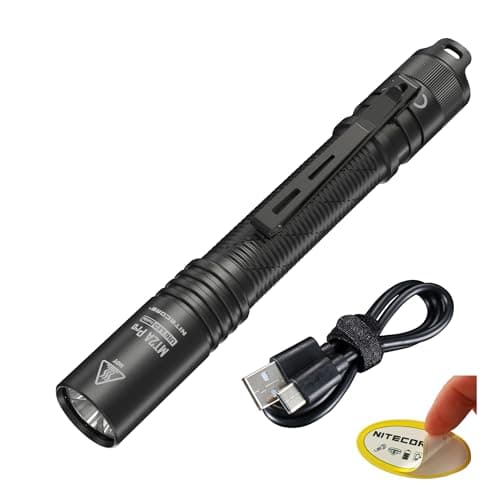
NITECORE MT2A Pro
A thousand lumens and 255 meters out of a penlight body that runs on its own removable 14500 or on two AA cells from any shop on earth. IP68 on top. It is the rare light that answers the shelf-life problem and the output problem in the same package.
Price as of September 27, 2026 — 22 lumens per dollar. #ad How we earn
Disclosure — we earn a commission on qualifying purchases made through the Amazon links on this page, at no extra cost to you. It does not change which lights we pick or what we say about them. The full version.
How we rank. Published ANSI FL1 output divided by the live retail price, with sealed-battery lights marked down because a light you cannot re-cell is a light with an expiry date. Units we claim to have tested: 0 — we compile manufacturers' published figures and show the arithmetic instead. How we work this out.
The short answer
If you want an Olight-sized light without Olight's battery, the NITECORE MT2A Pro is the strongest answer: 1,000 lumens, a stated IP68 rating, and it runs on its own 14500 or on two AA cells from any shop. For a keychain light with a cell you can actually swap, the Sofirn SC21 Pro takes a standard 16340. For published figures you can check, the Streamlight MicroStream gives a runtime for every mode. All three cost less than the Olight they replace.
This page exists because people search for it, not because Olight is bad. Olight builds well, its in-cell USB-C charging is genuinely clever, and it discounts hard enough that the value case is often better than it looks. We compare it directly against two other brands elsewhere and it holds up.
But there are three specific reasons people go looking for something else, and they are worth naming before any pick, because which one applies to you changes what you should buy.
Why people look for an alternative
- 1.The cells are Olight parts. The i5R EOS's 14500 has the charging circuit built into it, which is neat until you want a spare from a different shop. You can replace it; you replace it from one company, for as long as that company sells it.
- 2.Some models seal the cell in entirely. The i1R 2 PRO's 130 mAh battery is not user replaceable, which at that capacity makes the light a consumable rather than a tool.
- 3.Stock and channel. Olight sells mainly through its own store, and its Amazon listings move in and out of stock — the i5R EOS listing returned Currently unavailable when we checked on 2026-09-21. If you want to buy a light today from wherever you normally shop, that is friction.
There is a fourth reason we will not claim, because we cannot verify it: nothing here is a judgment about Olight's build quality or customer service, neither of which we have tested.
The criteria we used instead
- 1.A cell you can buy anywhere. A standard 14500, 16340, 18650 or AA beats a proprietary pack, and a light that accepts ordinary primaries as a fallback beats both.
- 2.A published water rating. Neither Olight model we cover states one, so any alternative that does is straightforwardly ahead on a point that matters outdoors.
- 3.A published runtime — ideally per mode. This is the figure most of the category hides, and the one alternative here that publishes it fully is scored up for it.
- 4.Comparable size and output. Replacing a 350-lumen pocket light with a two-pound spotlight is not an alternative, it is a different purchase.
- 5.Ordinary availability. If the point is to escape a single-channel product, the replacement needs to be buyable in the usual places.
What each alternative publishes
| Light | Maximum output | Cell | Water rating | Runtime published |
|---|---|---|---|---|
| NITECORE MT2A Pro | 1,000 lumens | 2 x AA or NL1416R 14500 | IP68, 2 m | 20 h at 50 lm |
| Sofirn SC21 Pro | 1,100 lumens | 16340, replaceable | Not published | Not published |
| Streamlight MicroStream | 250 lumens | Sealed Li-ion | IPX4 | Every mode |
| Fenix E06R | 700 lumens | Built-in 750 mAh | Not stated | Not published |
| Wurkkos TS10 V2 | 1,400 lumens | 14500, replaceable | IPX8, 2 m | 1 h 14 min at maximum |
Two rows deserve attention. The MT2A Pro is the only light on this page that answers all three complaints at once — standard cells, a stated IP68, and ordinary retail availability. And the MicroStream is the only one that publishes a runtime for every mode, which is why a 250-lumen light appears on a list otherwise full of four-figure claims.
| # | Light | Max output | Battery | Lumens / $ | Price |
|---|---|---|---|---|---|
| 1 | NITECORE MT2A Pro Best dual-power pocket light | 1,000 | Replaceable | 22 | $44.95 on Amazon Price as of September 27, 2026 — 22 lumens per dollar. #ad How we earn |
| 2 | 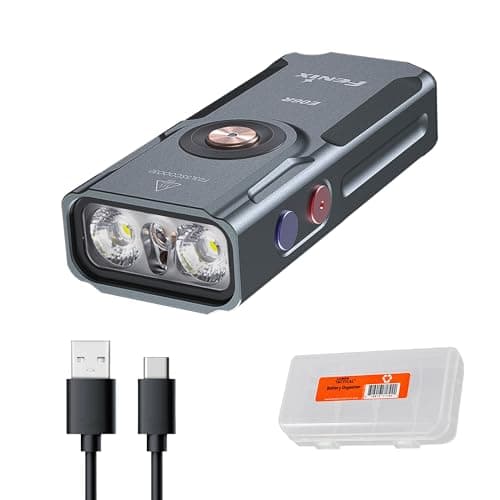 Fenix E06R Most output from a keychain body | 700 | Sealed | 13 | $55.95 on Amazon Price as of September 27, 2026 — 13 lumens per dollar. #ad How we earn |
| 3 | 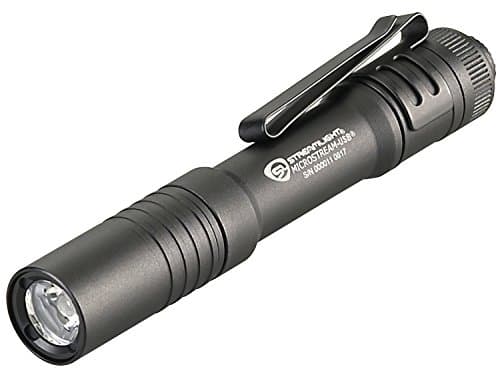 Streamlight MicroStream USB Best pen-clip light with published runtimes | 250 | Sealed | 7 | $37.81 on Amazon Price as of September 27, 2026 — 7 lumens per dollar. #ad How we earn |
| 4 | No listing image Sofirn SC21 Pro Best keychain light with a replaceable cell | 1,100 | Replaceable | Needs a live price | Check price on Amazon We show a price only when we have pulled a live one. #ad How we earn |
| 5 | No listing image Wurkkos TS10 V2 Best pocket light under two ounces | 1,400 | Replaceable | Needs a live price | Check price on Amazon We show a price only when we have pulled a live one. #ad How we earn |
Prices pulled September 27, 2026. Lumens per dollar is the manufacturer's published maximum output divided by that price, recomputed every time the price moves.
1. Best dual-power pocket light
NITECORE MT2A Pro
Lumens per dollar
22
A thousand lumens and 255 meters out of a penlight body that runs on its own removable 14500 or on two AA cells from any shop on earth. IP68 on top. It is the rare light that answers the shelf-life problem and the output problem in the same package.
- Max output
- 1,000 lm
- Runtime
- 20 h
- Battery
- Replaceable cell
- Water rating
- IP68
What it gets right
- Dual power: a removable 14500 for output, or two AA cells when there is no charger
- IP68 to two meters, which almost nothing at this size publishes
- Two hundred and fifty-five meters of throw from a penlight-shaped body
- The charging port is in the cell, so a spare cell charges while the light is in use
What it gets wrong
- NITECORE publishes only the maximum runtime, not a figure per mode
- On alkaline AA cells the output is far below the 1,000-lumen headline
- A penlight body is long for its diameter and rolls off a sloped surface
Published specification
- Maximum output: 1,000 lumens — NITECORE published specification
- Peak beam intensity: 16,500 cd — NITECORE published specification
- Beam distance: 255 m — NITECORE published specification
- Battery: 2 x AA, or 1 x NL1416R 14500 Li-ion with USB-C charging in the cell — NITECORE published specification
- Water rating: IP68, submersible to 2 m — NITECORE published specification
- Impact: 1 m — NITECORE published specification
- Weight: 40 g (1.41 oz) without battery — NITECORE published specification
- Length: 142.8 mm — NITECORE published specification
- Modes: Three brightness levels, single tail switch — NITECORE published specification
- Maximum runtime: 20 hours at 50 lumens — NITECORE published specification
- Per-mode runtime: Not published on the product page
Skip this one if
you want the smallest possible pocket light. At 142.8 mm this is a long, thin light rather than a short one, and that shape suits a shirt pocket better than a jeans pocket.
Buy it if: anyone who wants one light for both daily use and the drawer, and refuses to be stopped by a flat cell.
- Output 8.0
- Battery 9.5
- Build 9.0
- Usability 8.0
- Overall 8.6
Price as of September 27, 2026 — 22 lumens per dollar. #ad How we earn
2. Most output from a keychain body
Fenix E06R
Lumens per dollar
13
Seven hundred lumens and 110 meters from a light that hangs off a keyring, with a 750 mAh built-in cell and a magnetic tail. It costs more than the budget keychain options and it puts out several times their light.
- Max output
- 700 lm
- Runtime
- Not published per mode on the retail page
- Battery
- Sealed
- Water rating
- None published
What it gets right
- Seven hundred lumens from a keyring light is a genuine step up
- Magnetic tail turns it into a hands-free task light
- Lockout function, so it does not cook in a pocket
What it gets wrong
- Sealed 750 mAh cell
- The UV mode and laser pointer are features looking for a use
- No per-mode runtime on the retail page
Published specification
- Maximum output: 700 lumens — Fenix published specification
- Beam distance: 361 ft (110 m) — Fenix published specification
- Battery: Built-in 750 mAh — Fenix published specification
- Modes: Ten, including UV and a red laser pointer — Fenix published specification
- Fittings: Magnetic tail, key ring loop, lockout — Fenix published specification
- Per-mode runtime: Not published on the retail page we read
Skip this one if
you want a keychain light with a replaceable cell — that is the Sofirn SC21 Pro's job here.
Buy it if: someone who wants their smallest light to still be a real light.
- Output 7.0
- Battery 4.0
- Build 8.5
- Usability 8.0
- Overall 7.1
Price as of September 27, 2026 — 13 lumens per dollar. #ad How we earn
3. Best pen-clip light with published runtimes
Streamlight MicroStream USB
Lumens per dollar
7
Two hundred and fifty lumens for an hour and a half, fifty for three and a half, at 1.2 ounces. The battery is sealed, which caps its lifespan, but every other number on the sheet is published and checkable.
- Max output
- 250 lm
- Runtime
- 1 h 30 min
- Battery
- Sealed
- Water rating
- IPX4
What it gets right
- Every mode's runtime is published, which is why it scores well here despite modest output
- Deep pocket clip that actually holds in a shirt pocket
- 1.2 ounces — it is easy to forget you have it
What it gets wrong
- The cell is sealed in; when it fails the light is finished
- IPX4 splash rating only
- 250 lumens is not enough to light a yard
Published specification
- High: 250 lumens, 68 m, 1.5 hours — Streamlight published specification
- Low: 50 lumens, 31 m, 3.5 hours — Streamlight published specification
- Battery: Lithium-ion, charges in-product in 4 hours — Streamlight published specification
- Water rating: IPX4 — Streamlight published specification
- Impact: 1 m tested — Streamlight published specification
- Weight: 1.2 oz (34.1 g) — Streamlight published specification
- Length: 3.87 in (9.83 cm) — Streamlight published specification
Skip this one if
you want a light you can re-cell. For a keychain-sized light with a replaceable battery, look at the Sofirn SC21 Pro instead.
Buy it if: a shirt pocket, a scrubs pocket, or anyone who wants a light without a bulge.
- Output 5.5
- Battery 4.5
- Build 8.5
- Usability 9.0
- Overall 7.2
Price as of September 27, 2026 — 7 lumens per dollar. #ad How we earn
listing
image
4. Best keychain light with a replaceable cell
Sofirn SC21 Pro
Lumens per dollar
Computed the moment we have a live price for it
Eleven hundred lumens from a keyring-sized body with a 16340 you can actually swap. Almost every rival at this size seals the battery in, which turns the light into a two-year consumable.
- Max output
- 1,100 lm
- Runtime
- Not published per mode
- Battery
- Replaceable cell
- Water rating
- None published
What it gets right
- A replaceable cell in a keychain-sized light, which is genuinely rare
- Magnetic tail, so it doubles as a hands-free task light
- USB-C in the light rather than a proprietary dock
What it gets wrong
- Sofirn publishes neither runtime nor a water rating for this model
- 1,100 lumens out of a 16340 is a very short-lived 1,100 lumens
- Anduril on a light this small means a lot of clicking
Published specification
- Maximum output: 1,100 lumens — Sofirn published specification
- Beam distance: 131 m — Sofirn published specification
- Battery: 1 x 16340 Li-ion, included and replaceable — Sofirn published specification
- Charging: USB-C into the light — Sofirn published specification
- Fittings: Magnetic tailcap and pocket clip — Sofirn published specification
- Water rating: Not published on the product page
- Per-mode runtime: Not published on the product page
Skip this one if
you want a published IP rating. Sofirn does not state one for this model, and we are not going to guess on your behalf.
Buy it if: someone who wants keychain size without accepting a disposable battery.
- Output 7.5
- Battery 8.5
- Build 7.0
- Usability 7.0
- Overall 7.8
We show a price only when we have pulled a live one. #ad How we earn
listing
image
5. Best pocket light under two ounces
Wurkkos TS10 V2
Lumens per dollar
Computed the moment we have a live price for it
Thirty-two grams, three 90-CRI emitters, and one of the very few budget lights whose maker publishes the runtime at maximum output: one hour fourteen at 1,400 lumens. Publishing that number at all puts Wurkkos ahead of several brands ten times its size.
- Max output
- 1,400 lm
- Runtime
- 1 h 14 min
- Battery
- Replaceable cell
- Water rating
- IPX8
What it gets right
- Wurkkos publishes runtime at maximum output, which most brands quietly do not
- Thirty-two grams — light enough that you stop noticing it in a pocket
- Standard 14500 cell, replaceable
- Documented automatic step-down instead of an undocumented one
What it gets wrong
- A 14500 is a small cell; sustained output is not this light's job
- RGB auxiliary LEDs are a toy, and they draw from the same cell
- Anduril again, with the same learning curve
Published specification
- Maximum output: 1,400 lumens — Wurkkos published specification
- Runtime at maximum: 1 h 14 min — Wurkkos published specification
- Runtime at 1 lumen: 6 h 43 min — Wurkkos published specification
- Battery: 1 x 14500 Li-ion, user replaceable — Wurkkos published specification
- Water rating: IPX8, 2 m — Wurkkos published specification
- Weight: 32 g +/- 1 g without battery — Wurkkos published specification
- Length: 71.5 mm — Wurkkos published specification
- Thermal behavior: Automatic step-down from turbo to high — Wurkkos published specification
Skip this one if
you need something to run for an hour on high without getting hot. A light this small has nowhere to put the heat, and the step-down is not optional.
Buy it if: the person who wants a real light on them at all times and will not carry anything heavier than a pen.
- Output 8.0
- Battery 8.0
- Build 7.5
- Usability 7.5
- Overall 8.2
We show a price only when we have pulled a live one. #ad How we earn
The honest catch on two of these
Two picks here do not actually fix the sealed-cell complaint, and we would rather say so than quietly count them as wins. The Streamlight MicroStream has a sealed lithium-ion cell, and the Fenix E06R has 750 mAh built in. Neither can be re-celled.
They are on the page for the other reasons. The MicroStream is here because it publishes everything — every mode's runtime, an IPX4 rating, a 1-meter impact figure — and because at 1.2 ounces it is the closest thing to the i1R 2 PRO's carry experience from a brand you can buy anywhere. The E06R is here because it is what an Olight-class keychain light looks like when the manufacturer spends the budget on output instead: 700 lumens against 180.
If the sealed cell is your actual objection, the two lights that genuinely solve it are the Sofirn SC21 Pro and the Wurkkos TS10 V2, both of which take a standard cell you can buy for a few dollars.
And the catch on the other two
The Sofirn and the Wurkkos both ship Anduril, an open-source firmware with ramping and a menu system. Enthusiasts like it. Somebody who wants to press a button and get light will find it irritating for about a week and will then either learn it or resent it.
Sofirn also publishes neither a runtime nor a water rating for the SC21 Pro, which is a real gap on a light being recommended partly for its honesty about batteries. We are not going to pretend a replaceable cell makes the rest of the spec sheet complete.
Map the shape first, then the brand
The commonest way this goes wrong is replacing an Olight with a light that is better on paper and a different size. A light that does not fit where the old one lived will not get carried, and the specification becomes irrelevant. So work from the shape you already have.
- Replacing an i1R 2 PRO — a keyring fob that makes light. The closest equivalents are the Sofirn SC21 Pro, which adds a replaceable 16340 and far more output, or the Fenix E06R at 700 lumens. Both are larger than the i1R, and there is genuinely nothing this small from another brand we cover.
- Replacing an i5R EOS — a slim tail-switch pocket light. The Streamlight MicroStream is the closest match on carry, lighter at 1.2 ounces though dimmer and only IPX4. The NITECORE MT2A Pro is longer and thinner rather than shorter, so check the pocket before assuming it swaps.
- Replacing something bigger in Olight's range that we do not cover — start from our main value rankings rather than from this page, because the answer is probably a standard-cell 18650 light.
The MT2A Pro deserves one shape warning of its own: at 142.8 mm it is a long, thin penlight rather than a short one. That suits a shirt pocket or a bag far better than a jeans pocket, and it will roll off a sloped surface.
If your objection is the ecosystem rather than the cell
Some people are not bothered by a proprietary battery in itself. What they are avoiding is a set of purchases that only work with each other — a charging arrangement, a cell, and the accessories built around them — and the sense that leaving means replacing all of it at once.
If that is your position, the criterion to weight is not the cell size but how ordinary the parts are. A light running a standard 18650, 16340 or AA is compatible with chargers and cells you may already own and can buy from anyone. A light charging over plain USB-C with no dock needs nothing but the cable already on your desk. On both counts every pick on this page is more ordinary than what it replaces, and the MT2A Pro is the most ordinary of all: it runs on the batteries in a kitchen drawer.
What Olight does that none of these match
In fairness, and because a page like this can easily become a hit piece: two things on the Olight side have no equivalent below.
The first is the in-cell charging port on the i5R EOS, which is a genuinely better arrangement than a flap in the body and is not something any pick here reproduces. The second is size — the i1R 2 PRO is smaller than anything else we cover, and if the only thing that matters is that a light is present on your keys and never noticed, Olight wins and nothing on this page is a real substitute.
None of this is a judgment about how well Olight's lights hold up, which we have not tested. This page is about what each manufacturer publishes and how ordinary the parts are, because those are the parts a buyer can check.
What to skip
- Any light whose only published figure is a maximum output. Escaping one brand's ecosystem is not worth landing on a product with no checkable numbers at all.
- Cheap lights advertising six-figure lumen claims. They are invented, and the spotlight category is the worst offender.
- Buying a bigger light than the one you are replacing. If the Olight fitted your pocket, a replacement that does not will simply stay in a drawer.
- Assuming a standard cell size means a good light. The cell is one criterion of several, and the water rating and runtime still matter.
How we ranked these
Published output over the live price, adjusted for cell architecture and published ratings, with the weighting tilted toward the specific things that send people away from Olight: a standard replaceable cell counts heavily, a published water rating counts, and ordinary retail availability counts. A light that is merely brighter does not rank above one that is buyable and documented.
Units we claim to have tested: 0
Every publisher in this category says they tested twenty flashlights. We have not tested any, and we say so. What we do instead: compile the manufacturer's own published ANSI FL1 figures, pull the price the light is selling for right now, and divide one by the other. Every number on this page is one you can check yourself in about two minutes.
What we cannot tell you
We have not used any of these lights, including the Olights they are alternatives to. Nothing here is a claim about Olight's durability, its warranty service or its customer support, all of which it has a reputation for and none of which we have tested. This page compares what each manufacturer publishes and how each one sells, which is the part a buyer can check before paying.
Common questions
What is a good alternative to Olight?
The NITECORE MT2A Pro is the closest thing to a complete answer: 1,000 lumens, a stated IP68 rating, ordinary retail availability, and it runs on its own 14500 cell or on two AA batteries when that is flat. If you specifically want a keychain light with a swappable cell, the Sofirn SC21 Pro takes a standard 16340. If you want published figures for every mode, the Streamlight MicroStream is the only light here that gives them.
Why do people avoid Olight batteries?
Because they are Olight parts rather than standard cells. The i5R EOS uses an Olight 1,420 mAh 14500 with the USB-C charging circuit built into the battery itself, so it is replaceable but only from one company. The i1R 2 PRO goes further and seals a 130 mAh cell in, which cannot be replaced by an owner at all. Neither is dishonest — Olight publishes both facts — but it does mean the light's service life is tied to one supplier.
Are Olight flashlights overpriced?
Not obviously, once you account for how they sell. Olight discounts through its own store frequently and deeply, so the list price is rarely the price anyone pays, and the hardware is well made. The fair criticism is not the price but what you get for it on paper: neither model we cover publishes a water rating, and neither publishes a runtime for more than one mode. You can buy more documented specification for the same money elsewhere.
Are cheap rechargeable flashlights any good?
Many are, and for a specific reason: the LED emitters, drivers and 18650 cells that budget brands buy are the same commodity parts the expensive brands buy. What you give up at the low end is documentation, quality control between batches, and a warranty worth using. The way to shop it is to look for a brand that publishes runtime figures — a manufacturer willing to print how long the turbo mode lasts is telling you something about the rest of the specification.
Sources
- NITECORE published product specifications — NU25 MCT UL read 2026-09-01; MT2A Pro read 2026-09-13
- Sofirn published product specifications — read 2026-09-01
- Streamlight published product specifications — per-mode lumens, runtime, beam distance, impact and IP ratings, read 2026-09-01; Waypoint 400 and Waypoint C-cell read 2026-09-22
- Fenix published product specifications — read 2026-09-01
- Wurkkos published product specifications and user manuals — FC11 and TS10 read 2026-09-01; FC11C read 2026-09-21
- Lumen & Ledger method — how every figure on this page is derived
Who writes this
Scooter M. — I am an enthusiast who is genuinely into this. I read the manuals, compile the published specs, and do the math. No lab coat, no test bench, no drawer of free samples. What I can tell you is exactly what a light claims on paper, exactly what it costs right now, and what those two numbers mean when you divide one by the other.
Read next
NITECORE vs Olight
Batteries you can buy anywhere against cells only one company sells.
Olight vs Fenix
More light and a stated IP68 against the nicer object to own.
Olight vs Streamlight
Convenience against documentation, and the one spec column that settles it.
Best AA flashlights
The cell that is never flat when you need it, and the six lights worth putting it in.
Best rechargeable keychain flashlights
Tiny cells, short lives, and the one keychain light with a replaceable battery.
The Ledger
Every light we cover in one ranked table, sorted by lumens per dollar.