Flashlights
Olight vs Fenix
One brand sells output and sealing, the other sells the experience of owning it. On one of the two head-to-heads here the gap is not close at all.
By Scooter M. · Published September 27, 2026
Short answer
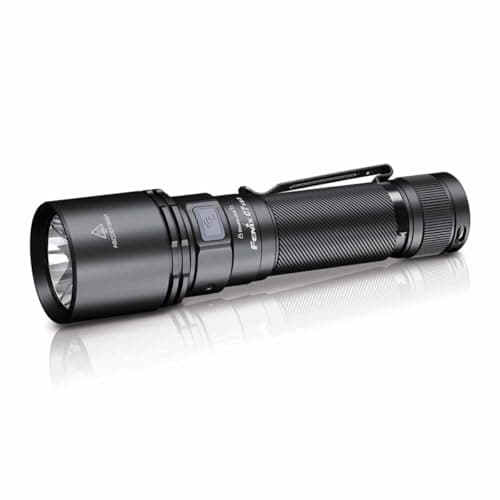
Fenix C7 V2.0
Thirty-three hundred lumens and 575 meters of throw with an IP68 rating. It appears here as a reference point: this is what a well-built high-output light costs, and it is the number every budget 10,000-lumen claim should be measured against.
Price as of September 27, 2026 — 41 lumens per dollar. #ad How we earn
Disclosure — we earn a commission on qualifying purchases made through the Amazon links on this page, at no extra cost to you. It does not change which lights we pick or what we say about them. The full version.
How we rank. Published ANSI FL1 output divided by the live retail price, with sealed-battery lights marked down because a light you cannot re-cell is a light with an expiry date. Units we claim to have tested: 0 — we compile manufacturers' published figures and show the arithmetic instead. How we work this out.
The short answer
Buy Fenix if you want more light and a water rating you can hold someone to: the C7 V2.0 publishes 3,300 lumens, 575 meters and IP68, and even the keychain E06R publishes 700 lumens against Olight's 180. Buy Olight if the light is something you will handle every day and you value that more than the numbers — the in-cell USB-C charging on the i5R EOS is the best-engineered detail on this page. Neither brand publishes a runtime for every mode, so on the figure that matters most on this site, this comparison is a draw.
These two get shortlisted together constantly, usually by someone who has decided to spend more than a budget light costs and wants to know where the money goes. It goes to different places in each case, and the difference is easier to see if you stop comparing brands and compare the two actual head-to-heads.
Published specifications, side by side
| Fenix C7 V2.0 | Olight i5R EOS | Fenix E06R | Olight i1R 2 PRO | |
|---|---|---|---|---|
| Maximum output | 3,300 lumens | 350 lumens | 700 lumens | 180 lumens |
| Beam distance | 575 m | 64 m | 110 m | 48 m |
| Runtime published | Not published per mode | 37 h at 15 lm | Not published per mode | Up to 12 h |
| Runtime for every mode? | No | No | No | No |
| Cell | Removable, USB-C | Olight 1,420 mAh 14500 | Built-in 750 mAh | Built-in 130 mAh |
| Water rating | IP68 | Not stated | Not stated | Not stated |
| Fittings | Magnetic tail, lockout | Tail switch, momentary | Magnetic tail, lockout | Twist head |
The keychain match-up is lopsided
Compare the two small lights first, because this is where most people are actually choosing. The Fenix E06R publishes 700 lumens and 110 meters from a keyring-sized body with a magnetic tail and a lockout. The Olight i1R 2 PRO publishes 180 lumens and 48 meters.
That is nearly four times the output and more than twice the reach, and it is not a close call on the numbers. The i1R 2 PRO's answer is size: it is genuinely tiny, it operates by twisting the head rather than pressing anything, and it will still be on your keys in a year because you never notice it. The E06R is a real light that happens to fit on a keyring; the i1R 2 PRO is a keyring fob that happens to make light.
Both seal their cells in, and the capacities tell you how to think about each. Fenix puts 750 mAh in the E06R; Olight puts 130 mAh in the i1R 2 PRO. At 130 mAh you are buying a consumable, which is Olight's own published figure rather than our inference, and at keyring prices that is a defensible product. It is not a light to expect much from in three years.
The larger match-up is a different question entirely
The C7 V2.0 and the i5R EOS are barely the same category. Fenix publishes 3,300 lumens, 575 meters of throw and an IP68 rating; Olight publishes 350 lumens, 64 meters and no water rating at all. If you are choosing on capability, this ends immediately.
But the i5R EOS is not trying to win that fight. It publishes one genuinely excellent number — 37 hours at 15 lumens — which is the mode a pocket light spends nearly all its life in, and it charges through a USB-C port built into the cell itself rather than through a flap in the body. That flap is the usual first thing to fail on a cheap rechargeable, and removing it is a real engineering decision rather than a marketing one.
So the honest framing is that the C7 V2.0 is a tool you fetch and the i5R EOS is a light you carry. Comparing their lumen figures is comparing a floodlight with a pen.
| # | Light | Max output | Battery | Lumens / $ | Price |
|---|---|---|---|---|---|
| 1 | Fenix C7 V2.0 The throw comparison, not a value pick | 3,300 | Replaceable | 41 | $79.95 on Amazon Price as of September 27, 2026 — 41 lumens per dollar. #ad How we earn |
| 2 | 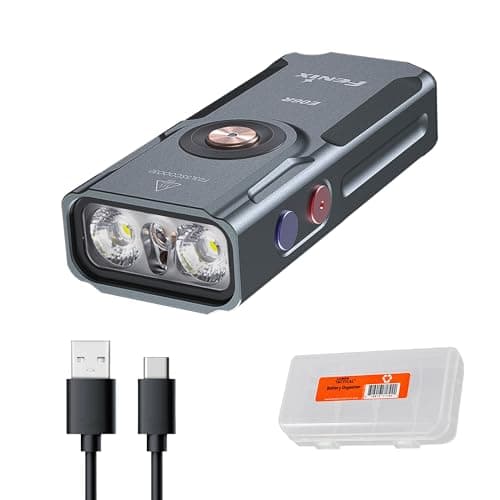 Fenix E06R Most output from a keychain body | 700 | Sealed | 13 | $55.95 on Amazon Price as of September 27, 2026 — 13 lumens per dollar. #ad How we earn |
| 3 | No listing image Olight i5R EOS Best simple twist-free EDC | 350 | Replaceable | Needs a live price | Check price on Amazon We show a price only when we have pulled a live one. #ad How we earn |
| 4 | No listing image Olight i1R 2 PRO Smallest light worth putting on a keyring | 180 | Sealed | Needs a live price | Check price on Amazon We show a price only when we have pulled a live one. #ad How we earn |
Prices pulled September 27, 2026. Lumens per dollar is the manufacturer's published maximum output divided by that price, recomputed every time the price moves.
1. The throw comparison, not a value pick
Fenix C7 V2.0
Lumens per dollar
41
Thirty-three hundred lumens and 575 meters of throw with an IP68 rating. It appears here as a reference point: this is what a well-built high-output light costs, and it is the number every budget 10,000-lumen claim should be measured against.
- Max output
- 3,300 lm
- Runtime
- Not published per mode on the retail page
- Battery
- Replaceable cell
- Water rating
- IP68
What it gets right
- Five hundred and seventy-five meters is real throw, not a marketing figure
- IP68 and a magnetic tail
- Removable cell
What it gets wrong
- Expensive by this site's standards
- No per-mode runtime on the retail page
- A dedicated thrower is the wrong shape of light for most jobs
Published specification
- Maximum output: 3,300 lumens — Fenix published specification
- Beam distance: 1,886 ft (575 m) — Fenix published specification
- Water rating: IP68 — Fenix published specification
- Body: Ultra-thick A6061-T6 aluminum — Fenix published specification
- Charging: Inner-waterproofed USB-C — Fenix published specification
- Fittings: Magnetic tail, lockout mode — Fenix published specification
- Per-mode runtime: Not published on the retail page we read
Skip this one if
you want one light for the house. A thrower puts its light in a small circle a long way away, which is not what you want indoors.
Buy it if: search work, large properties and anyone who genuinely needs to see a third of a mile.
- Output 9.5
- Battery 9.0
- Build 9.5
- Usability 8.0
- Overall 8.5
Price as of September 27, 2026 — 41 lumens per dollar. #ad How we earn
2. Most output from a keychain body
Fenix E06R
Lumens per dollar
13
Seven hundred lumens and 110 meters from a light that hangs off a keyring, with a 750 mAh built-in cell and a magnetic tail. It costs more than the budget keychain options and it puts out several times their light.
- Max output
- 700 lm
- Runtime
- Not published per mode on the retail page
- Battery
- Sealed
- Water rating
- None published
What it gets right
- Seven hundred lumens from a keyring light is a genuine step up
- Magnetic tail turns it into a hands-free task light
- Lockout function, so it does not cook in a pocket
What it gets wrong
- Sealed 750 mAh cell
- The UV mode and laser pointer are features looking for a use
- No per-mode runtime on the retail page
Published specification
- Maximum output: 700 lumens — Fenix published specification
- Beam distance: 361 ft (110 m) — Fenix published specification
- Battery: Built-in 750 mAh — Fenix published specification
- Modes: Ten, including UV and a red laser pointer — Fenix published specification
- Fittings: Magnetic tail, key ring loop, lockout — Fenix published specification
- Per-mode runtime: Not published on the retail page we read
Skip this one if
you want a keychain light with a replaceable cell — that is the Sofirn SC21 Pro's job here.
Buy it if: someone who wants their smallest light to still be a real light.
- Output 7.0
- Battery 4.0
- Build 8.5
- Usability 8.0
- Overall 7.1
Price as of September 27, 2026 — 13 lumens per dollar. #ad How we earn
listing
image
3. Best simple twist-free EDC
Olight i5R EOS
Lumens per dollar
Computed the moment we have a live price for it
Three hundred and fifty lumens, 64 meters, and 37 hours at 15 lumens from a 1,420 mAh cell — the low-mode runtime is the number that makes this light useful. The cell is proprietary, which is the trade for how neatly the charging works.
- Max output
- 350 lm
- Runtime
- 37 h at 15 lm
- Battery
- Replaceable cell
- Water rating
- None published
What it gets right
- Charging port is in the cell, so there is no port flap to fail
- Thirty-seven hours at 15 lumens is a genuinely useful published figure
- Tail switch with momentary-on
What it gets wrong
- The 14500 is an Olight part, not a standard cell you can buy anywhere
- No water rating on the product pages we could read
- Three hundred and fifty lumens is modest for the price
Published specification
- Maximum output: 350 lumens — Olight published specification
- Beam distance: 64 m — Olight published specification
- Output range: 15 to 350 lumens — Olight published specification
- Runtime: 37 hours at 15 lumens — Olight published specification
- Battery: Olight 1,420 mAh 14500 with integrated USB-C — Olight published specification
- Weight: 2.2 oz — Olight published specification
- Length: 95.4 mm — Olight published specification
- Water rating: Not stated on the pages we read
Skip this one if
you want to standardize on one battery type across your lights. Olight's ecosystem is convenient right up to the point where you want a spare from a different shop.
Buy it if: someone who wants an EDC light that never needs thinking about, and does not mind buying replacement cells from one company.
- Output 5.5
- Battery 6.5
- Build 8.5
- Usability 9.0
- Overall 7.4
We show a price only when we have pulled a live one. #ad How we earn
listing
image
4. Smallest light worth putting on a keyring
Olight i1R 2 PRO
Lumens per dollar
Computed the moment we have a live price for it
One hundred and eighty lumens and 48 meters from something the size of a AAA cell, with 12 hours of published runtime on low. The 130 mAh battery is sealed in, so treat it as a two-year item bought at a two-year price.
- Max output
- 180 lm
- Runtime
- Up to 12 h
- Battery
- Sealed
- Water rating
- None published
What it gets right
- Small enough that it genuinely stays on the keyring
- Twist-head operation with no switch to press in a pocket
- USB-C without disassembling the light
What it gets wrong
- One hundred and thirty milliamp-hours sealed in — this is a consumable
- Twist interface means you cannot operate it one-handed while holding something
- No published water rating
Published specification
- Maximum output: 180 lumens — Olight published specification
- Beam distance: 48 m — Olight published specification
- Low mode: 5 lumens — Olight published specification
- Runtime: Up to 12 hours — Olight published specification
- Battery: Built-in 130 mAh lithium-ion — Olight published specification
- Charging: USB-C, full charge in 100 minutes — Olight published specification
- Length: 2.02 in — Olight published specification
- Water rating: Not stated on the pages we read
Skip this one if
you expect a keyring light to last a decade. It will not, and at 130 mAh nothing this size will.
Buy it if: the keyring, where the alternative is having no light at all.
- Output 4.0
- Battery 3.5
- Build 8.0
- Usability 8.5
- Overall 6.4
We show a price only when we have pulled a live one. #ad How we earn
Where both brands fail, equally
Neither company publishes a runtime for every mode on any of these four lights, and it would be dishonest to let one of them off. Fenix publishes 3,300 lumens for the C7 V2.0 and 700 for the E06R with no duration beside either. Olight publishes a single low-mode figure for each of its two and nothing for the modes in between.
That matters because a 3,300-lumen handheld cannot sustain 3,300 lumens — nothing that size can shed the heat — so the number is a burst whose length only the manufacturer knows. Streamlight, Black Diamond and Petzl all publish full tables. Neither of these two does, and on a site built around dividing published figures that is the single biggest reservation about both.
Neither publishes a CRI figure either, so how accurately either renders color is unknown to us.
The C7 V2.0 has been renamed, and it is worth knowing
One practical note. Our specification for this light was read from Fenix as the C7 V2.0, and the current retail listing for the same product — same 3,300 lumens, same 575 meters — is titled C7-R. Fenix appears to have renamed the model rather than changed it.
We have kept our original name and figures because those are what we read from the manufacturer, and we are flagging the rename rather than quietly swapping a name we have not re-verified. If you are shopping for it, expect to see both.
How each brand sells, and what it does to the price
Olight sells primarily through its own store and discounts hard and often, which is why no fixed price appears in this page's prose and why the figures beside each pick are pulled live. An Olight is frequently worth waiting for.
That direct model has a consequence we keep running into: Olight's Amazon listings go in and out of stock. When we checked on 2026-09-21 the i5R EOS listing returned Currently unavailable, which is why both Olight lights here use a tagged Amazon search rather than a link to one listing. A search finds whatever is live. Fenix sells through ordinary distribution and is easier to buy at a predictable number.
Which one to buy
- For a keyring light that is actually bright: Fenix E06R, at 700 lumens against 180. Not close.
- For the smallest thing that will still be on your keys next year: Olight i1R 2 PRO, on size alone.
- For seeing a long way, or for anything wet or dusty: Fenix C7 V2.0, the only light here with a stated IP68.
- For a pocket light you will use daily and charge constantly: Olight i5R EOS, whose in-cell charging is the nicest detail on this page.
- If you need to know how long any mode lasts before you buy: neither. Look at Streamlight instead.
- If price is the deciding factor and you can wait: Olight, which discounts far more aggressively.
What each brand does not make
A comparison is as much about the gaps as the overlap. Olight has nothing in our coverage that competes with the C7 V2.0: no thrower, nothing publishing three-figure meters, nothing with an IP68 rating. If reaching a long way is the job, this comparison is over before it starts.
Fenix, equally, has nothing that competes with the i5R EOS on the specific thing that light does well. Putting the USB-C port inside the removable cell rather than in the body is an unusual design choice, and it removes the rubber charging flap that is the most common failure point on an inexpensive rechargeable. Fenix builds better lights and Olight built a better charging arrangement.
In the middle, between about 200 and 700 lumens in a pocketable body, they compete directly, and there the E06R's raw output advantage is hard to argue with.
Where both sit against the value tier
Neither of these brands will win an arithmetic contest on this site, and it is worth saying plainly so the comparison is not read out of context. A Sofirn SC31 Pro publishes 2,000 lumens, IPX8 and a replaceable 18650 for less than either of the larger lights here costs, and on lumens per dollar it beats both comfortably.
What the extra money buys differs by brand, which is the useful way to think about it. With Fenix you are buying optics, sealing and build — 575 meters and IP68 are real engineering results a budget brand does not match. With Olight you are buying the experience of ownership: size, charging, switch feel and packaging. Neither is buying you better documentation, because on runtime neither publishes more than the budget brands do, and Wurkkos publishes more.
How we ranked these
Published output over the live price, adjusted for cell architecture and published ratings, with completeness of the specification weighted deliberately — and because neither brand publishes per-mode runtime, neither gains anything on that axis. Fenix's stated IP68 on the C7 V2.0 earns real points that Olight cannot match on these models, and Olight's published low-mode endurance earns some back.
The E06R's extra modes are a real differentiator, for better or worse
Fenix publishes ten modes on the E06R, including a UV output and a red laser pointer. That is either a genuine advantage or clutter on a keyring light, and which one depends entirely on whether you have a use for either.
Our view is that both are features looking for a use on a light this size, and that the modes you will actually cycle through are the white ones — so the extra positions mostly mean more clicking to reach what you want. If you specifically want UV for checking documents or spotting pet stains, it is a free addition on a light you were considering anyway. Olight's answer here is the opposite: the i1R 2 PRO has two levels and a twist head, and nothing to cycle at all.
Units we claim to have tested: 0
Every publisher in this category says they tested twenty flashlights. We have not tested any, and we say so. What we do instead: compile the manufacturer's own published ANSI FL1 figures, pull the price the light is selling for right now, and divide one by the other. Every number on this page is one you can check yourself in about two minutes.
What we cannot tell you
We have not used any of these four lights. We cannot tell you whose tint you will prefer, whose switch still feels right after a year, how the E06R's UV mode and red laser perform, or how either company handles a warranty claim. We also cannot tell you how long Olight will keep selling the specific 14500 cell the i5R EOS needs, which is the central risk in any proprietary-cell purchase and one nobody can answer in advance.
Common questions
Is Olight or Fenix better?
Fenix is better on the published numbers: 3,300 lumens and IP68 on the C7 V2.0, and 700 lumens against Olight's 180 in the keychain class. Olight is better as an object to own — the i5R EOS charges through a port built into the cell, which removes the rubber flap that usually fails first, and it publishes 37 hours at 15 lumens. Neither publishes a runtime for every mode, so if checkable figures are what you want, look at Streamlight instead of either.
Is the Fenix E06R better than the Olight i1R 2 Pro?
On output, decisively — Fenix publishes 700 lumens and 110 meters against Olight's 180 lumens and 48 meters, and the E06R adds a magnetic tail and a lockout. The i1R 2 PRO's advantage is purely size: it is small enough that you genuinely forget it is on your keys, and it twists on rather than having a button to press in a pocket. Both seal their cells in, but Fenix uses 750 mAh against Olight's 130 mAh, so the Olight has a noticeably shorter service life.
Do Fenix flashlights use standard batteries?
It varies by model and you have to check. The C7 V2.0 uses a removable cell with USB-C charging, which means you can carry a spare. The E06R has a 750 mAh cell built in, so it cannot be re-celled at all. That is the same split Olight has, except that Olight's removable cells are Olight parts with the charging circuit inside them. If a standard replaceable cell is what you want, the budget brands we cover elsewhere serve that better than either of these.
Can you replace the battery in a rechargeable flashlight?
It depends entirely on the model, and it is the single most consequential thing to check before buying. Lights built around a standard cell — an 18650, a 21700, a 14500, a 16340 — take a screw-off tailcap and a five-dollar replacement. Lights with a built-in cell, which manufacturers describe as 'integrated' or 'non-removable', cannot be re-celled by an ordinary owner: when the battery reaches the end of its cycle life the whole light is refuse. Energizer, for example, states plainly that the Vision HD Rechargeable uses non-removable lithium-ion batteries.
Sources
- Olight published product specifications — read 2026-09-01
- Fenix published product specifications — read 2026-09-01
- Streamlight, ANSI Information — definitions of light output, beam distance, run time, impact and water resistance under the FL1 standard, read 2026-09-01
- Lumen & Ledger method — how every figure on this page is derived
Who writes this
Scooter M. — I am an enthusiast who is genuinely into this. I read the manuals, compile the published specs, and do the math. No lab coat, no test bench, no drawer of free samples. What I can tell you is exactly what a light claims on paper, exactly what it costs right now, and what those two numbers mean when you divide one by the other.
Read next
NITECORE vs Olight
Batteries you can buy anywhere against cells only one company sells.
Olight vs Streamlight
Convenience against documentation, and the one spec column that settles it.
Streamlight vs Fenix
Fenix publishes the bigger numbers. Streamlight publishes how long they last.
Olight alternatives
Five lights that skip the proprietary cell and the direct-only stock.
Best rechargeable keychain flashlights
Tiny cells, short lives, and the one keychain light with a replaceable battery.
The Ledger
Every light we cover in one ranked table, sorted by lumens per dollar.